
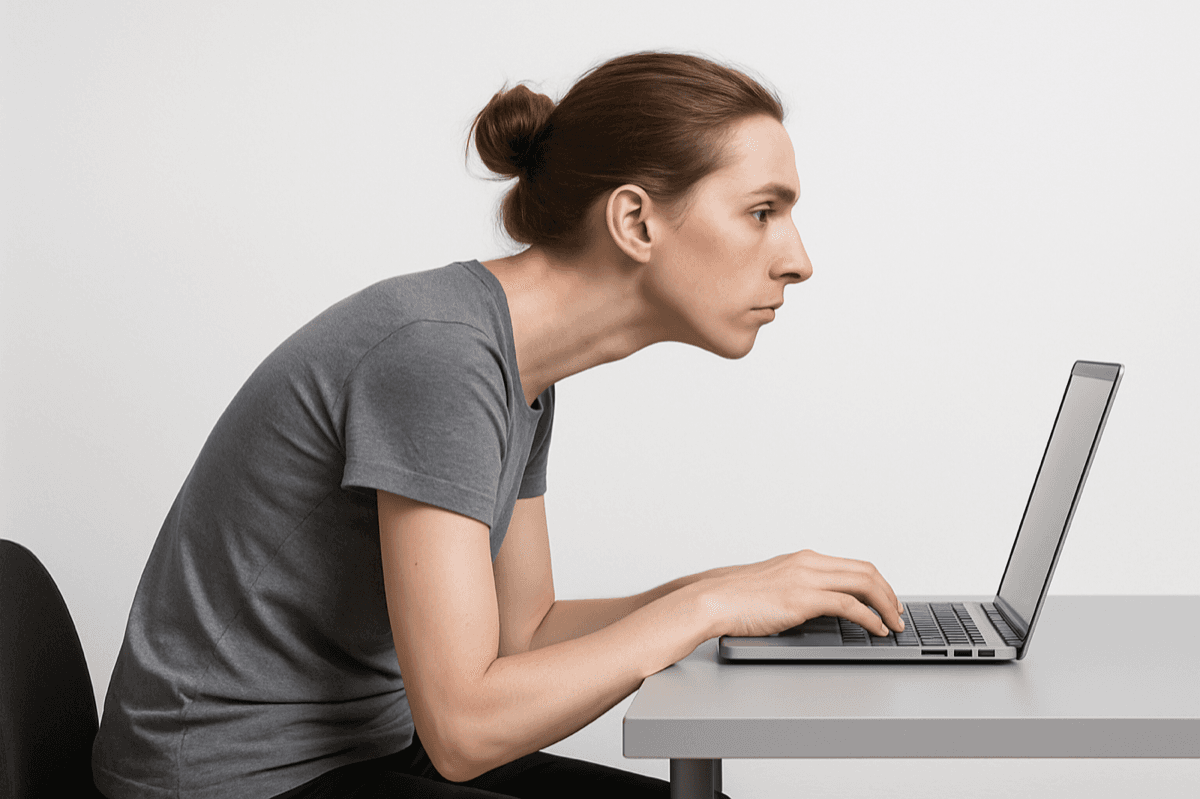
What Forward Head Posture Actually Is
Stand sideways in front of a mirror. Your ear should be directly over your shoulder, which should be directly over your hip. If your head is in front of that vertical line, even slightly, that is forward head posture.
The physics are not forgiving. Your head weighs 10 to 12 pounds in neutral position. For every inch your head moves forward of that center line, the effective load on your cervical spine increases by approximately 10 pounds. Two inches forward and your neck is managing 30 to 32 pounds. Four inches forward, which is common in people who work at computers, puts 50 pounds of effective load on a structure designed to handle 10.
That is not a neck problem. That is an engineering problem.
Watch: 3 Exercises to Fix Forward Head Posture
This video covers three of the corrective exercises broken down below: static back, thoracic extension, and cervical retraction. Follow along once to learn the movements, then use the written guide below for the full routine and why each step works.
Why It Develops
Most people treat forward head posture as a neck issue and address it with neck stretches, cervical retraction exercises, or by trying to force their chin back. These approaches may provide temporary relief, but the head comes forward again within hours because the cause is still there.
The cause is structural and it starts below the neck.
Thoracic Kyphosis
The thoracic spine, the middle segment of your back from roughly the shoulder blades down to the lower ribs, is designed to have a moderate natural curve. In most adults who sit for significant portions of the day, this curve is exaggerated into what clinicians call hyperkyphosis: the mid-back rounds forward.
When the thoracic spine rounds forward, the head has two options. It can follow, pointing at the floor, or it can compensate by extending at the cervical spine to keep the eyes level with the horizon. The body always chooses to keep the eyes level. So the upper cervical spine extends, the lower cervical spine compensates, and the head ends up forward of the shoulders even though the spine above the neck is doing its best to correct.
You cannot fix forward head posture without addressing thoracic extension. They are mechanically linked.
Hip Flexor Tightness from Sitting
Here is the connection most people miss: tight hip flexors cause forward head posture.
When you sit, the hip flexors (specifically the iliopsoas, which attaches from the lumbar vertebrae to the femur) shorten to the length your hip angle requires. Over hours of sitting per day, over years, this becomes their resting length. The pelvis tips forward (anterior pelvic tilt), the lumbar spine arches, and the center of gravity shifts. The thoracic spine rounds in compensation, and the head comes forward to keep the eyes level.
Fix the hips, the lumbar follows. Fix the lumbar, the thoracic follows. Fix the thoracic, the head comes back.
Pec Minor Tightness
The pec minor is a small muscle that attaches from the front of the shoulder blade (coracoid process) to the third, fourth, and fifth ribs. When it tightens from the forward arm position of desk work, steering, or paddling, it pulls the shoulder blade into a tilted, forward-tipped position. The shoulder rounds forward. The thoracic spine follows. The head comes with it.
Tight pec minor is almost universal in adults who work at computers or use smartphones heavily. It is also one of the first structures to respond to targeted corrective exercise.
Free - 60 seconds
Not sure which program you need?
Take the free posture quiz and get a personalized recommendation based on your pain and goals.
The Corrective Exercise Approach: Address the Root, Not the Symptom
A foundational insight of corrective exercise is that pain is almost never located at its cause. The site of pain is where the body breaks down under a compensating load. The cause is structural mismatch in the kinetic chain below.
For forward head posture, the corrective exercise approach means working from the bottom up. Here are five exercises that address each layer of the problem.
Static Back
Lie on your back with your legs at 90 degrees, calves resting on a chair, coffee table, or couch. Arms at 45 degrees from your sides, palms up. Stay for 5 minutes.
This deactivates the hip flexors by removing the weight-bearing load. The lumbar spine drops toward the floor, the pelvis levels, and the thoracic spine begins to release its protective tension. It is deceptively simple and one of the most effective corrective exercises.
Abdominal Contractions
Remaining in the static back position, contract your abdominal muscles without holding your breath. Hold for 5 seconds, release, repeat 20 times.
This re-engages the deep core stabilizers that become inhibited when anterior pelvic tilt is chronic. When these muscles are offline, the hip flexors and lower back take over as primary stabilizers, compressing the lumbar and thoracic spines.
Supine Groin Stretch
Lie on your back, one leg extended flat on the floor, the other bent with the foot flat on the floor. Hold for 5 to 10 minutes per side.
The extended leg stretches the hip flexor from below while the static back position decompresses the lumbar. The extended leg in contact with the floor provides proprioceptive feedback that encourages the hip to settle. This is a passive stretch, not an active one. The body does the work.
Thoracic Extension Over a Foam Roller
Place a foam roller horizontally across the mid-thoracic spine, approximately at the shoulder blade line. Arms crossed over the chest. Extend gently over the roller, then move it up and down the thoracic spine, two inches at a time.
Spend 30 to 60 seconds at each position. The goal is to restore extension range, not to create pain. If you find a point that does not move, stay there until it softens.
Cervical Retraction (Wall Slides)
Stand with your back and head against a wall, feet slightly forward. Without lifting your chin, slide your head backward against the wall, creating the sensation of a double chin. Hold for 5 seconds. Repeat 10 times.
This targets the deep cervical flexors, the muscles at the front of the neck that are chronically underused in forward head posture while the suboccipitals at the back are chronically overloaded. Strengthening the deep cervical flexors is the cervical-specific end of the corrective chain. For the full technique breakdown, see the chin tuck exercise guide.
What to Expect
Done daily, this sequence takes 20 to 25 minutes. Most people notice reduced neck tension within the first week. Structural change, meaning measurable improvement in head position relative to shoulders, typically takes 3 to 6 weeks of consistent work.
The critical thing to understand is that forward head posture developed over years. It will not reverse in a session. But the body is designed to self-correct when given the right input. This method provides that input systematically.
If this resonates and you want a structured program built around this approach, the Forward Head Posture Fix program walks through 20 videos, in sequence, addressing every layer of the problem from the hips to the cervical spine.
Not sure if forward head posture is your primary issue? Take the free posture quiz to find out which patterns are driving your symptoms.

Mike Boshnack
Corrective Exercise Specialist · Posture Guy Mike
Mike Boshnack grew up skateboarding and surfing, trained MMA, and rode road bikes competitively. A shoulder injury put him on a path to discover corrective exercise. He has since helped thousands of people fix the structural patterns causing their pain, without surgery or passive treatments.
Keep Reading
Conditions & Pain
Dentists and Hygienists: Your Neck Is Paying for Every Patient You Lean Over
4 min read
Conditions & Pain
Why Your Neck Cracks When You Turn Your Head (And What It's Really Telling You)
4 min read
Conditions & Pain
Levator Scapulae Pain: Why That Knot Between Your Neck and Shoulder Blade Won't Quit
4 min read
Related Conditions
Free tool
See where your posture stands right now.
Upload a photo and get an instant AI-powered posture analysis with personalized recommendations. Free, no account required.
Try the Free Posture CheckTake the next step
Fix the structural root cause, not just the symptom.
Mike's programs apply this corrective method to your specific condition. No gym, no equipment. Just a floor and 15 minutes. Buy once, own forever.
Discussion
Discussion is a Pro member feature. Visit the community for more.