Standing Hip Circle
Standing on one leg, you draw slow, controlled circles with the lifted knee — moving the hip through its full available range of flexion, abduction, extension, and adduction. Hip circles lubricate the hip capsule, improve neuromuscular control of the femoral head, and restore the smooth 3D mobility that chronic sitting erodes.
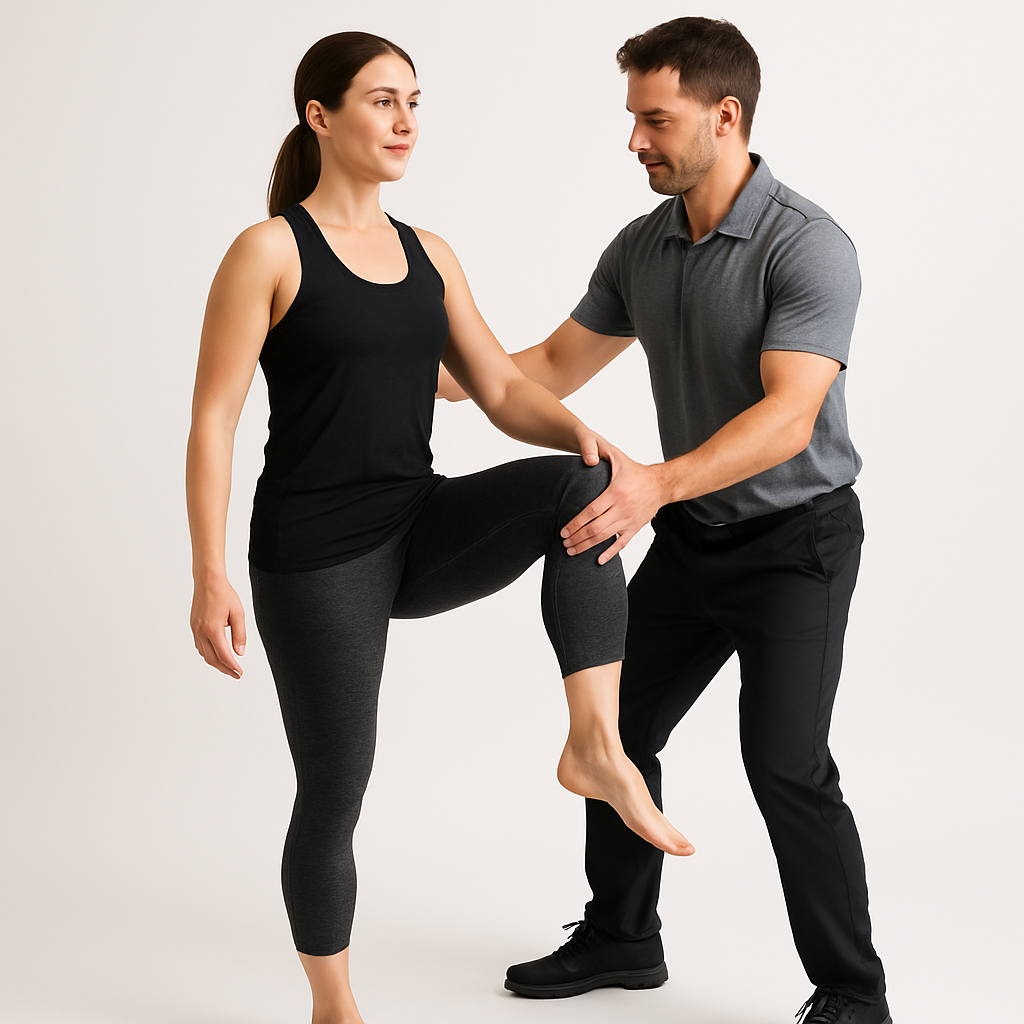
How to do it
- 1
1. Stand tall on one leg, engaging your core and keeping your standing leg straight but not locked. Place your hand on a wall or chair for light balance support if needed.
- 2
2. Lift the opposite knee up to hip height, creating a 90-degree angle at the hip and knee.
- 3
3. Slowly draw a large circle with your lifted knee, moving it forward, out to the side, back, and down in one smooth motion—like tracing a circle on the ground in front of you.
- 4
4. Complete the full circle with control, keeping your torso upright and your pelvis stable throughout.
- 5
5. Reverse direction and draw circles the opposite way for the prescribed number of reps.
- 6
6. Switch legs and repeat on the other side.
Easier option
If balancing on one leg is tough, hold a wall or chair firmly and make smaller circles, or just lift the knee and lower it without the full circle to start.
Benefits
- Restores full 3D hip mobility and synovial fluid distribution, reversing stiffness from prolonged sitting
- Strengthens hip stabilizers and improves neuromuscular control of the hip joint, reducing compensation patterns that cause lower back and knee pain
- Resets hip-pelvis rhythm and reduces anterior pelvic tilt, improving overall postural alignment and spinal load distribution
Common mistakes
- Allowing the pelvis to tilt, rotate, or shift toward the standing leg—keep your hips level and stable throughout the movement
- Drawing small circles or moving only within the sagittal plane instead of using full flexion, abduction, extension, and adduction ranges
- Locking or hyperextending the standing knee, which reduces stability and transfers tension to the lower back
Target areas
Good for
Used in these programs
Get the full guided program, with video walkthroughs for every exercise.
Find Your ProgramBrowse all programs →