
What the SI Joint Does and Why It Hurts
The sacroiliac joint sits where the sacrum, the triangular bone at the base of the spine, meets the ilium on each side of the pelvis. There are two SI joints, one on each side, and they are among the most stable joints in the body. They are designed to transfer force between the spine and the legs during walking, running, and lifting, with very little actual movement. Their stability is maintained by a dense network of ligaments and, critically, by balanced muscular forces across the pelvis.
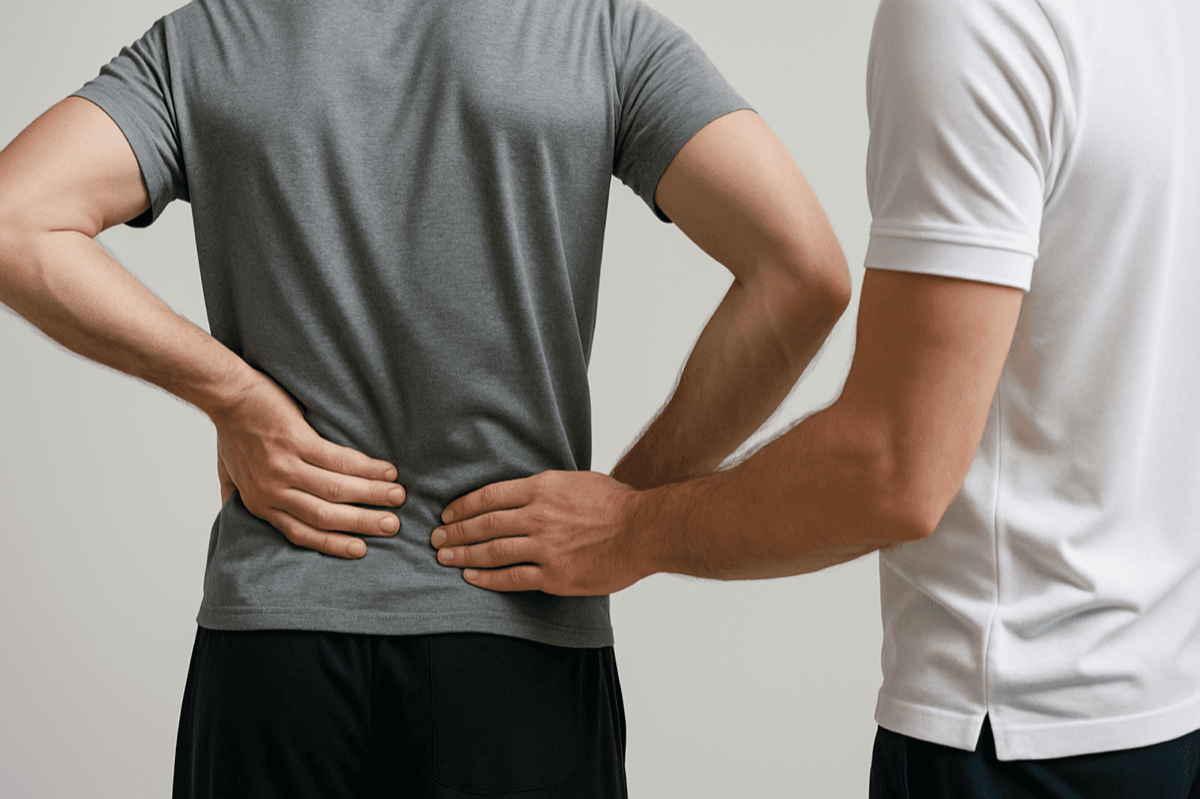
SI joint pain presents as a deep, often sharp ache at one or both sides of the lower back, just above the tailbone and to the side of the spine. It frequently radiates into the glute and sometimes down the back of the thigh. It is worsened by transitional movements: getting up from a chair, turning over in bed, climbing stairs, and lifting one leg at a time.
The reason SI joint pain is so persistent is that the standard treatments, anti-inflammatories, SI joint injections, belts, address the symptom at the joint without addressing what is creating the mechanical stress in the first place. The joint hurts because it is being loaded asymmetrically. Something upstream is creating that asymmetric loading. Unless that is fixed, the joint continues to be stressed and the pain returns.
Pelvic Asymmetry Is Almost Always the Cause
The SI joint is stressed when the pelvis is asymmetric, when one side is rotated, tilted, or shifted relative to the other. This asymmetry creates a shear force through the SI joint that it is not designed to handle chronically. The ligaments become strained, the joint capsule becomes irritated, and local inflammation creates the characteristic pain.
What creates pelvic asymmetry? Most commonly, a combination of hip flexor tightness on one side, glute weakness on the same or opposite side, and the rotational demands of sport, work, or repetitive movement patterns. Right-hand dominance creates systematic differences in how the left and right sides of the pelvis are loaded. Athletes in rotational sports, golf, tennis, baseball, develop predictable pelvic rotation patterns that stress specific SI joints.
The important point is that pelvic asymmetry is muscular in origin, not structural. The bones are in the wrong position because the muscles controlling those bones are imbalanced. Corrective exercise that restores muscular balance corrects the pelvic position, removes the asymmetric load from the SI joint, and resolves the pain.
What Actually Fixes SI Joint Pain
The first priority is decompressing the joint and reducing acute inflammation. Static back, lying supine with hips and knees at ninety degrees, neutralizes the hip flexor tension that often creates the most immediate SI joint stress. Hip crossover stretches gently mobilize the pelvis and begin to address rotational asymmetry.
The second step is identifying and addressing the side-to-side imbalance. This typically involves releasing the shorter hip flexor on the involved side and activating the weaker glute on the opposite side. The combination restores pelvic rotation toward neutral.
The third step is reestablishing symmetric gluteal function through exercises like single-leg glute bridges and lateral band walks, which load the hip stabilizers in a way that promotes pelvic symmetry rather than reinforcing asymmetry.
People with SI joint pain often see the connection to hip pain once they understand that the pelvis controls both. The hip joint and the SI joint are linked through the same bone, if the pelvis is out of position, both are affected. Correcting pelvic mechanics resolves both simultaneously in most cases. The Hip Alignment program addresses the full pelvis in sequence.

Mike Boshnack
Corrective Exercise Specialist · Posture Guy Mike
Mike Boshnack grew up skateboarding and surfing, trained MMA, and rode road bikes competitively. A shoulder injury put him on a path to discover corrective exercise. He has since helped thousands of people fix the structural patterns causing their pain, without surgery or passive treatments.
Keep Reading
Related Conditions
Related Programs
Free tool
See where your posture stands right now.
Upload a photo and get an instant AI-powered posture analysis with personalized recommendations. Free, no account required.
Try the Free Posture CheckTake the next step
Fix the structural root cause, not just the symptom.
Mike's programs apply this corrective method to your specific condition. No gym, no equipment. Just a floor and 15 minutes. Buy once, own forever.
Discussion
Discussion is a Pro member feature. Visit the community for more.