
Why the Hip Flexors Matter More Than You Think
The iliopsoas is the most structurally influential muscle in the human body. It attaches from the lumbar vertebrae and inner pelvis to the top of the femur. When it shortens, which it does from sitting, it does not just affect the hip. It pulls the lumbar spine into an exaggerated arch, tips the pelvis forward into anterior pelvic tilt, compresses the facet joints of the lower back, inhibits the glutes through reciprocal inhibition, and shifts the body's center of gravity forward.
This single muscle pattern is the structural driver behind the majority of lower back pain, a significant contributor to knee pain, and the root cause of the anterior pelvic tilt that affects most adults who sit for a living.
Most stretches do not adequately address it. The iliopsoas is deep and thick, and quick, active stretches cannot reach the layers of tension that have accumulated over years. Force does not work on this muscle. Time does.
That is where the supine groin stretch comes in.
What the Supine Groin Stretch Is
The supine groin stretch is a passive corrective position, not a traditional stretch. You are not pulling, pressing, or forcing anything. You set yourself up in a specific position and let gravity and time do the work.
The position places the hip flexors of one leg in a lengthened state while the body is fully supported and relaxed. Over 15 to 20 minutes per side, the nervous system gradually releases the protective tension in the iliopsoas and the pelvis settles toward neutral.
This is one of the foundational positions in the Egoscue method, and it is one of the exercises I use most frequently with clients. I have seen it produce more change in lower back pain and pelvic alignment than almost any other single exercise.
How to Set It Up
Equipment
You need a chair, ottoman, or couch. The support surface should be roughly knee height when you are lying on the floor. A yoga mat or carpet makes the floor position more comfortable.
Position
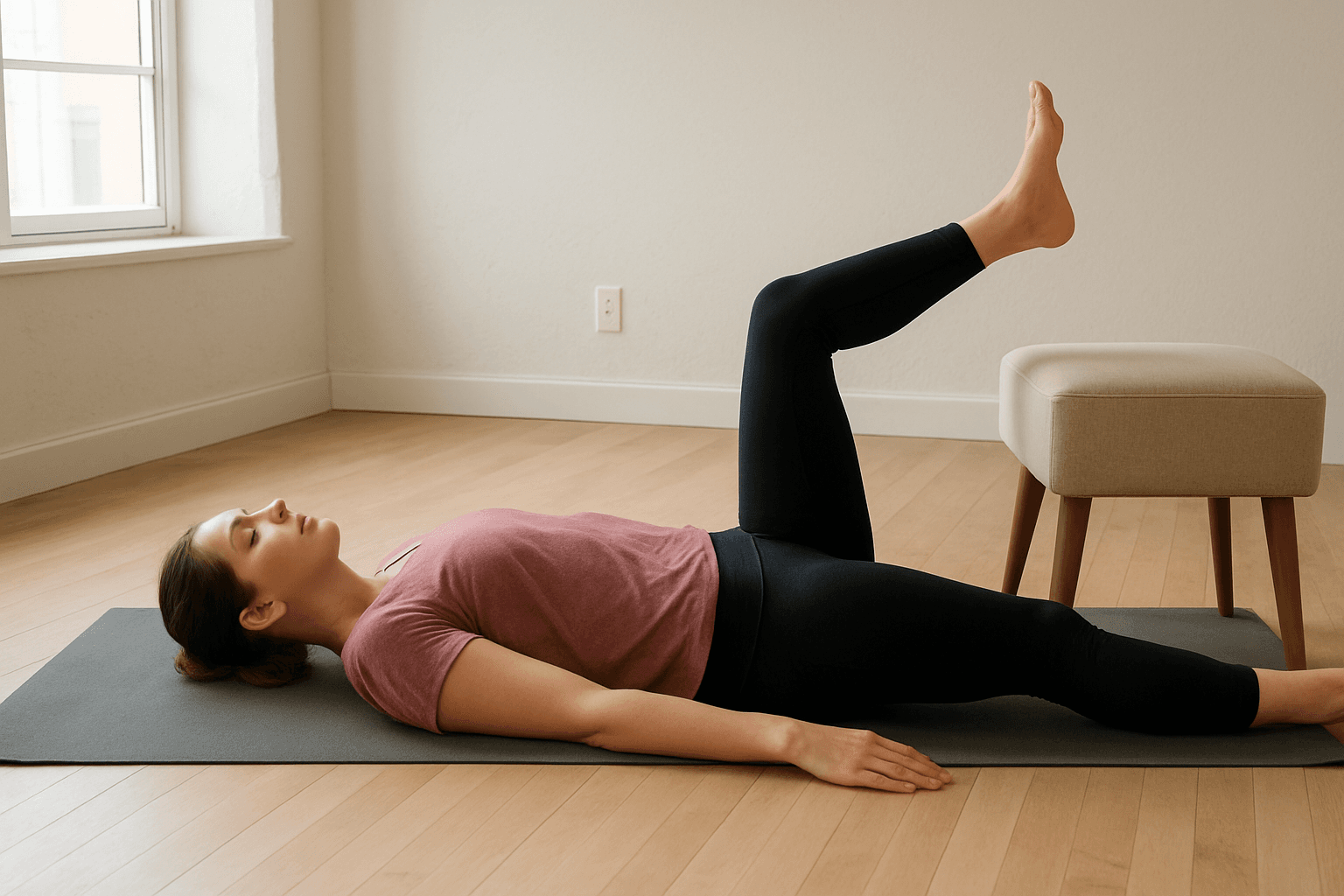
- Lie on your back on the floor.
- Place one leg up on the chair with the knee bent at approximately 90 degrees. The calf rests on the seat of the chair. The thigh should be roughly vertical.
- Extend the other leg straight out on the floor. The leg should be completely straight with the foot pointing toward the ceiling. If the foot falls outward, that indicates external rotation from hip tightness - let it fall where it naturally goes and it will gradually rotate toward center as the hip flexor releases.
- Arms rest at your sides at about 45 degrees, palms up.
- Let your entire body relax. Do not hold tension anywhere. The floor supports you.
Timing
Hold for 15 to 20 minutes per side. This is not optional. The time is the mechanism. Five minutes is not enough. The iliopsoas has layers of tension, and the nervous system releases them in sequence. The first 5 minutes address surface tension. Minutes 5 through 10 begin to reach the deeper layers. Minutes 10 through 20 are where the meaningful structural change happens.
Set a timer. The position is comfortable enough that you can read, listen to a podcast, or just close your eyes. The point is to be passive.
Free - 60 seconds
Not sure which program you need?
Take the free posture quiz and get a personalized recommendation based on your pain and goals.
What You Should Feel
First 2 to 5 Minutes
You may feel a pulling sensation in the front of the hip of the extended leg. The lower back will likely be arched off the floor, especially if your hip flexors are tight. This is normal. Do not try to force your lower back down.
Minutes 5 to 10
The pulling sensation in the hip begins to decrease. You may notice your lower back starting to settle toward the floor. This is the iliopsoas beginning to release its grip on the lumbar spine. Some people feel a subtle shift or softening in the hip joint.
Minutes 10 to 20
The lower back continues to flatten toward the floor. The hip of the extended leg feels more open and less restricted. The extended leg may rotate slightly toward center if it started in external rotation. You may feel an overall sense of the pelvis leveling out.
The lower back reaching the floor is the clearest indicator that the hip flexor has released. If it does not happen in one session, it will with consistent daily practice.
Why Rushing It Does Not Work
The hip flexors are guarded by the nervous system. They are postural muscles, meaning they are always partially contracted to keep you upright. The nervous system does not let them release quickly because it interprets a rapid stretch as a threat and responds by tightening further. This is the stretch reflex.
Aggressive hip flexor stretching - lunging hard into a stretch, bouncing, or forcing the hip into extension - triggers this protective response. The muscle contracts harder, not softer. You feel like you stretched, but the resting length does not change.
The supine groin stretch bypasses this entirely. The position is passive and the stretch is gentle. Over 15 to 20 minutes, the nervous system recognizes that the position is safe and incrementally releases the tension. No forcing. No fighting the stretch reflex. Just time.
This is why a 20-minute passive hold produces more lasting change than a 30-second aggressive lunge stretch repeated ten times. The mechanism is neurological, not mechanical.
Who Benefits Most
People with Lower Back Pain
The lower back pain program addresses the full structural pattern, and the supine groin stretch is a core component. If your lower back hurts when you stand for long periods, hurts when you walk, or feels tight after sitting, the hip flexors are almost certainly a primary driver. The supine groin stretch addresses the cause directly.
People with Anterior Pelvic Tilt
Anterior pelvic tilt is, at its root, a hip flexor problem. The anterior pelvic tilt condition guide explains the full mechanism. The supine groin stretch is the most effective exercise for restoring the hip flexor length that allows the pelvis to return to neutral.
Runners and Cyclists
High-volume hip flexor loading from running and cycling creates progressive shortening. The supine groin stretch counterbalances this by restoring length passively after training sessions. Many endurance athletes find that 15 minutes of supine groin stretch post-training eliminates the lower back tightness that accumulates over a season.
Desk Workers
Eight hours of sitting shortens the hip flexors to the exact length your chair requires. Over years, this becomes their new resting length. The supine groin stretch resets it. Done daily after work, it directly counters the primary structural effect of prolonged sitting.
The Supine Groin Progressive
The standard supine groin stretch uses a single surface height. The supine groin progressive takes this further by systematically lowering the bent leg from a high surface to progressively lower surfaces during the hold.
You start with the leg on a chair (highest position), hold for a set period, then move to a lower ottoman or stack of pillows, hold again, and continue lowering until the leg is resting on a low surface near the floor. Each lowering increases the hip flexor stretch on the opposite side incrementally.
The progressive version is more thorough and produces deeper release, but the standard version is where most people should start. Master the basic hold first, then progress.
Fitting It Into a Corrective Routine
The supine groin stretch works best as part of a sequence. Start with static back for 5 minutes to deactivate the hip flexors and decompress the lumbar spine. Then move to the supine groin stretch for 15 to 20 minutes per side. Follow with glute activation work like the glute bridge to strengthen the muscles that hold the correction.
This release-then-activate sequence is the foundation of the Hip Alignment program, which builds on the supine groin stretch with structured daily progressions.
If you are not sure whether hip flexor tightness is driving your issues, take the free posture quiz to identify your primary pattern. Tight hip flexors show up as anterior pelvic tilt, lower back pain, and often knee discomfort - and the supine groin stretch is one of the fastest ways to start addressing all three.

Mike Boshnack
Corrective Exercise Specialist · Posture Guy Mike
Mike Boshnack grew up skateboarding and surfing, trained MMA, and rode road bikes competitively. A shoulder injury put him on a path to discover corrective exercise. He has since helped thousands of people fix the structural patterns causing their pain, without surgery or passive treatments.
Keep Reading
Corrective Method
Why Your Ankles Are Stiff (And How They're Wrecking Your Squat and Your Posture)
4 min read
Corrective Method
Pigeon Pose for Hip Pain: What It Actually Releases and What It Misses
4 min read
Corrective Method
Side Plank for Posture: Fix the Lateral Weakness Behind Your Hip Shift
4 min read
Related Programs
Free tool
See where your posture stands right now.
Upload a photo and get an instant AI-powered posture analysis with personalized recommendations. Free, no account required.
Try the Free Posture CheckTake the next step
Fix the structural root cause, not just the symptom.
Mike's programs apply this corrective method to your specific condition. No gym, no equipment. Just a floor and 15 minutes. Buy once, own forever.
Discussion
Discussion is a Pro member feature. Visit the community for more.