Static Back
Static back is a passive reset position from Pete Egoscue's method that lets gravity flatten your lower back and release tight hip flexors. Lie on your back with your calves on a chair or block so hips and knees are at 90 degrees, arms out, and stay about 5 minutes.
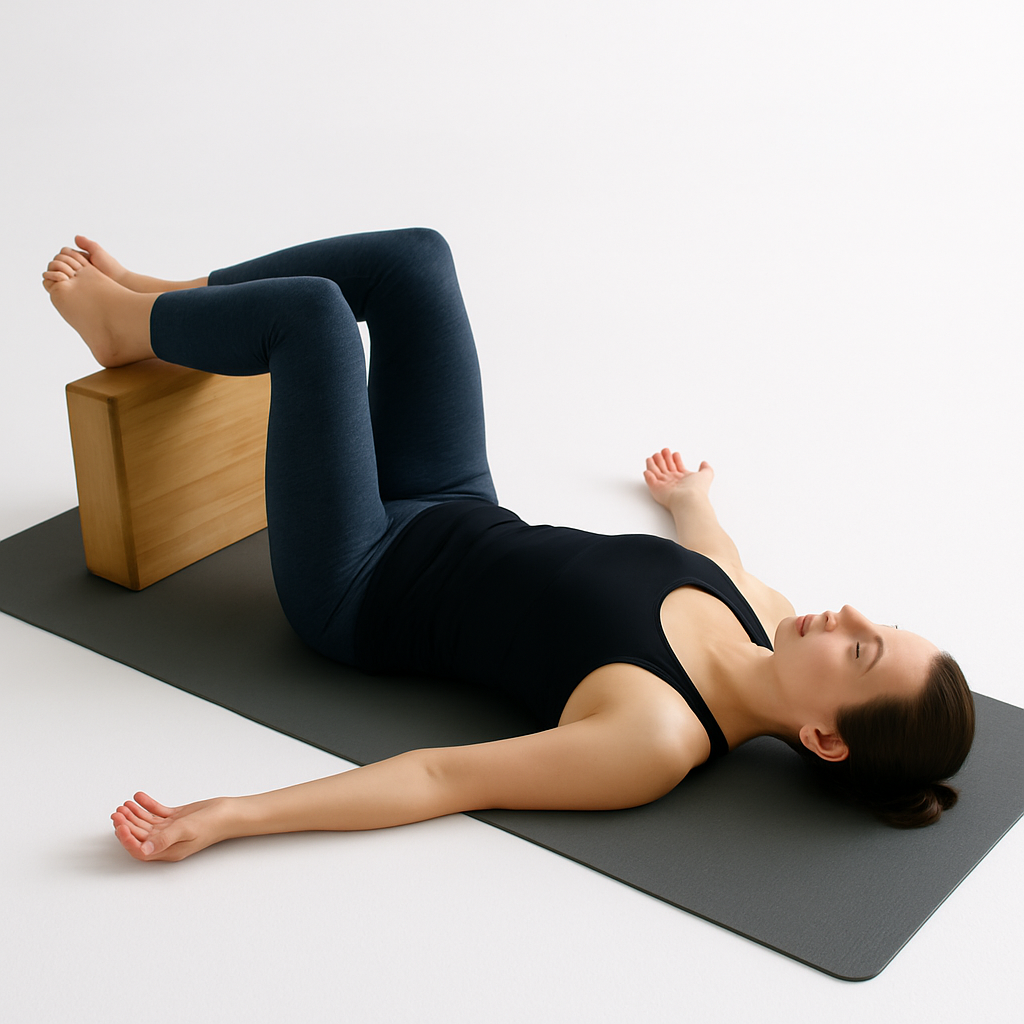
How to do it
- 1
1. Lie flat on your back on a firm surface like a yoga mat or carpet.
- 2
2. Place a chair seat, ottoman, or block under your calves so your knees and hips both bend to 90 degrees—shins should be parallel to the floor.
- 3
3. Extend both arms out to the sides at roughly 45 degrees from your body, palms facing up in a relaxed position.
- 4
4. Let your head rest naturally on the floor with your gaze straight up; do not use a pillow.
- 5
5. Relax completely and breathe naturally, allowing gravity to gently flatten your lower back to the floor without any muscular tension.
Mike's coaching cues
- No pillow under your head, because that is the common mistake that kills the reset.
- Put your calves on the chair so your knees and hips hit 90 degrees and your shins sit parallel to the floor.
- If your knees fall out to the sides, the surface is too low, so stack towels or cushions to raise it.
- Let your arms rest at 45 degrees from your body with your palms facing up.
- Do absolutely nothing: don't stretch, don't push, don't fix anything, just breathe and let gravity do the work.
Easier option
If getting to the floor is too hard, do this on a firm bed with your calves propped on pillows or a stack of cushions to get that 90-90 leg position.
Benefits
- Resets the pelvis to neutral alignment by releasing chronically tight hip flexors and lumbar erectors without active effort.
- Gently decompresses the lumbar spine and reduces lower back pain by restoring natural spinal curves through passive gravity.
- Reestablishes bilateral symmetry in the hips and core, correcting postural imbalances that develop from prolonged sitting.
Common mistakes
- Using a pillow under the head, which tilts the cervical spine and prevents full spinal relaxation.
- Setting the block or chair too high or too low, causing knees and hips to deviate from 90 degrees and reducing hip flexor release.
- Tensing muscles or trying to flatten the back actively instead of letting gravity do the work passively.
Watch Mike explain it
Common questions
What are the benefits of the static back exercise?
Static back lets gravity settle your lower back toward the floor, which helps release tight hip flexors and lower back muscles and brings your pelvis back toward neutral. Because both sides are positioned the same way, it also helps even out the hip and core imbalances that build up from long hours of sitting.
How long should you stay in static back?
Stay in the position for about 5 minutes, one time through. Relax and breathe the whole time, because the release comes from staying still, not from effort.
Is static back a stretch?
Not really. It is a passive position, so you are not pulling or reaching for anything. If you start stretching or pressing your back into the floor, you add tension and lose the reset.
Is static back the same as a static back extension?
No. Static back is done lying face up with your legs supported and requires no muscular effort, so it is not an extension exercise where you lift your torso.
Why shouldn't I use a pillow during static back?
A pillow tilts your neck forward and keeps your spine from relaxing fully. Let your head rest flat on the floor with your gaze straight up.
What if I can't get down to the floor?
Do it on a firm bed instead, with your calves propped on pillows or a stack of cushions. Keep the same 90 degree angle at your hips and knees.
Target areas
Good for
Used in these programs
Get the full guided program, with video walkthroughs for every exercise.
Find Your ProgramBrowse all programs →