
Why Toes Matter More Than You Think
Your toes are the very bottom of the postural chain. They are the last point of contact between your body and the ground, and they do a job most people never think about: they spread your weight across the foot, grip and stabilize as you stand and walk, and give your arch the tension it needs to support everything above.
When your toes are aligned and able to spread, your foot is a wide, stable base. When they are crowded together, curled, or angled off course, that base narrows and destabilizes, and the whole structure above it has to compensate. Toe alignment is not a cosmetic detail. It is foundational.
What Normal Toe Alignment Looks Like
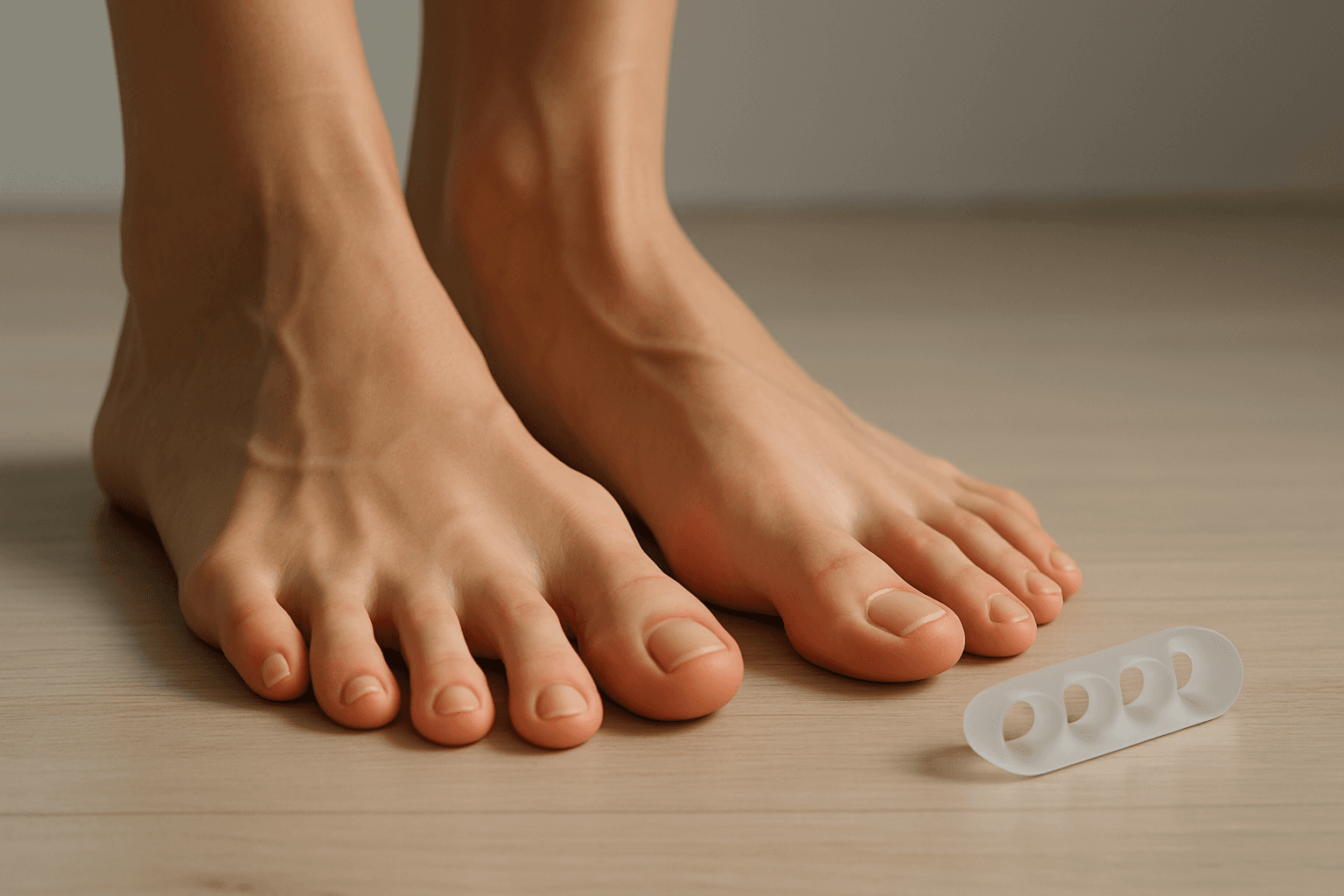
Healthy, properly aligned toes are straight and splayed. Each toe points forward in line with its corresponding metatarsal, and there is visible space between the toes when the foot is relaxed and bearing weight. The big toe in particular should point straight ahead, not angle in toward the others.
Stand barefoot and look down. In good alignment your toes fan out slightly, each one with a little room around it, the big toe tracking straight forward. That splayed position is what gives the foot its wide base and lets the arch load and unload correctly with every step.
Most people do not see that when they look down. They see toes pressed tightly together, a big toe angling inward, and little to no space between them. That is the normal result of decades in shoes that taper to a point at the front.
How Toes Lose Their Alignment
Toes drift out of alignment for a few connected reasons.
Narrow, tapered shoes are the biggest driver. Most footwear squeezes the front of the foot into a point, holding the toes pressed together for years until they hold that shape on their own. The big toe gets pushed inward, which over time is how a bunion forms.
Lack of use matters too. Toes are meant to move, spread, and grip. Inside stiff shoes they do almost none of that, and the small muscles that splay and control them weaken and switch off, the same way any unused muscle does.
Collapsed arches change the angle the toes meet the ground, often forcing them to claw or grip to find stability the arch is no longer providing.
Free - 60 seconds
Not sure which program you need?
Take the free posture quiz and get a personalized recommendation based on your pain and goals.
How Misaligned Toes Travel Up the Body
A narrowed, unstable forefoot does not stay a foot problem. When the base is unstable, the arch tends to collapse inward, which rotates the lower leg inward, which pulls the knee out of its tracking line, which tips and rotates the pelvis. By the time the chain reaches the lower back, a problem that started in the toes is showing up as hip and back complaints.
This is why foot and toe alignment is part of real posture work rather than a separate niche. The body is a chain, and the toes are the first link.
How to Correct Toe Alignment
The good news is that toes respond well to being given back their space and their job.
Create space. Spend time barefoot, and choose shoes with a wide toe box that lets the toes spread rather than tapering them to a point. Toe spacers worn for short periods help reintroduce the splayed position the toes have lost.
Wake the muscles up. Practice spreading your toes apart and lifting them individually. Lift just the big toe while keeping the others down, then reverse it. These look small and feel clumsy at first, which tells you exactly how switched off those muscles have become.
Rebuild the foundation. Strengthen the arch and the small foot muscles so the toes have a stable base to align on. The Foot and Ankle program walks through the toe, arch, and ankle work in order, which also addresses related issues like plantar fasciitis that share the same root cause.
What to Expect
Toes that have been crowded for decades do not splay overnight, but foot and toe muscles respond relatively quickly because you are using them constantly once you start paying attention. Most people notice better toe spread and a more grounded, stable feeling in their stance within a few weeks of daily work and roomier footwear.
Correcting the base does not just change your feet. Because the toes are the foundation the whole chain stacks on, giving them back their alignment and their job improves how everything above them is able to stack and move. If bunions are part of your picture, read the bunion correction guide. Take the free posture quiz to find out how your alignment stacks from the ground up.

Mike Boshnack
Corrective Exercise Specialist · Posture Guy Mike
Mike Boshnack grew up skateboarding and surfing, trained MMA, and rode road bikes competitively. A shoulder injury put him on a path to discover corrective exercise. He has since helped thousands of people fix the structural patterns causing their pain, without surgery or passive treatments.
Keep Reading
Free tool
See where your posture stands right now.
Upload a photo and get an instant AI-powered posture analysis with personalized recommendations. Free, no account required.
Try the Free Posture CheckTake the next step
Fix the structural root cause, not just the symptom.
Mike's programs apply this corrective method to your specific condition. No gym, no equipment. Just a floor and 15 minutes. Buy once, own forever.
Discussion
Discussion is a Pro member feature. Visit the community for more.