
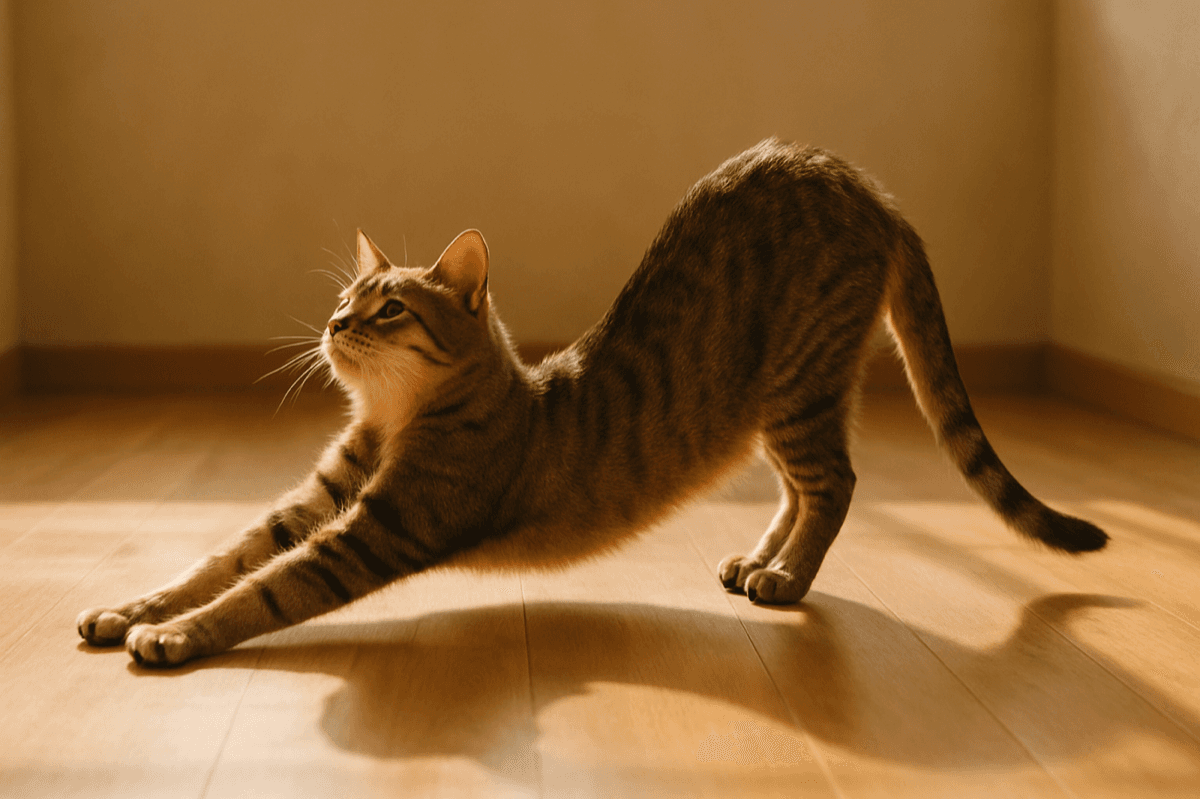
The Word You Have Never Heard but Do Every Morning
Pandiculation. It is the scientific term for the act of stretching and yawning simultaneously upon waking: the full-body extension a cat performs the moment it rises from a nap. Observe any cat, dog, lion, bear, or horse coming out of rest and you will see the same sequence: a slow, deliberate extension of the spine, a reach through the front legs, a press back through the hips, a yawn. It lasts five to ten seconds. Then they are fully functional.
This is not a habit they learned. It is a reflex encoded in the nervous system.
Humans have the same reflex. Infants do it spontaneously. Watch a baby wake from sleep and you will see the same instinctive reach, arch, and yawn before full consciousness is established. Somewhere between infancy and adulthood, most of us stop doing it.
What Pandiculation Actually Does
When a muscle is held in one position for an extended period, the motor neurons that control it gradually reduce their firing rate. This is called motor adaptation: the nervous system stops actively managing a position once it becomes stable, because it costs energy to maintain active motor control.
When you rise from rest after several hours of sleep, or several hours of sitting, those motor neurons need to be re-engaged. The nervous system does this through pandiculation: a slow, active contraction followed by a slow release. It is essentially a reset signal: the nervous system running a diagnostic on the muscular system, confirming motor connectivity, and establishing a new postural baseline.
This is categorically different from passive stretching. A passive stretch is you pulling a muscle to a longer length from the outside. Pandiculation is the nervous system actively contracting and releasing from the inside. The result is a reset of the motor neuron firing patterns, which is what reduces the stiffness and tightness that accumulates during rest.
Why Animals Get It Right
Watch a lion rise from several hours of sleep in the grass. The animal stretches completely before it does anything else. It does not stand up and immediately walk. It does not check its phone. It performs a full pandiculation sequence. Only then does it begin to move.
The same is true of dogs, horses, elephants, and most mammals. Cats are the most observed example because they are domestic, but the behavior is universal. These animals are not doing yoga. They are doing what their nervous systems require before they can function optimally.
The body does not distinguish between sleeping for eight hours and sitting at a desk for three. Both involve sustained positions with reduced motor neuron activity. Both require a reset before the body functions at its intended level.
Free - 60 seconds
Not sure which program you need?
Take the free posture quiz and get a personalized recommendation based on your pain and goals.
What Happens When You Skip It
Most adults rise from a chair or from bed and immediately begin walking, typing, driving, or otherwise demanding full function from a nervous system that has not been reset.
The consequences accumulate slowly.
The motor neurons that were adapting to the seated or supine position carry those patterns into the movement that follows. The hip flexors that shortened during sitting remain shortened. The thoracic extensors that were inactive during desk work remain offline. The cervical flexors that were compressed during sleep do not decompress. Each transition from rest to movement without a reset is a small deposit into an account of structural dysfunction that compounds over years.
This is, in part, why people stiffen progressively with age. It is not purely biological age. It is the accumulated effect of years of transitions without reset.
The Human Version: What to Do
The full pandiculation reflex is available to you. You do not need to suppress it. When you wake up in the morning, before you sit up:
Lie on your back. Press your arms overhead as far as they will go. Not a stretch, just a reach. Simultaneously press your heels down and away. Feel the full-body elongation from fingertips to heels. Hold three to five seconds. Release slowly.
Then turn on your side, draw your knees toward your chest briefly, and extend again. Take your time rising to seated.
This is the same sequence a cat performs. It takes thirty seconds. It signals to the nervous system that a new period of demand is beginning and that full motor function is required.
Apply the Same Principle to Your Day
The cat does not pandiculate only in the morning. It pandiculates every time it rises from rest, multiple times per day. After every nap, after every hour of being still.
The application for humans is straightforward: every ninety minutes to two hours of sustained sitting, stand and perform a brief version of this reset. Arms overhead. Hips extended. A slow press and release. It takes sixty seconds.
This is not about flexibility. It is about neurological reset. The flexibility comes as a consequence. The more often you return the body to a full-extension position and actively release from it, the less stiffness accumulates between those resets.
Why This Is Not Stretching
Stretching, as most people practice it, is a passive intervention. You hold a position for thirty to sixty seconds hoping the muscle lengthens. The research on static stretching for long-term mobility improvement is weak, and practically speaking, most people who stretch regularly find that the same muscles tighten again within hours.
Pandiculation works differently because it works through the nervous system rather than the muscle tissue. The slow contraction-release cycle resets the resting tone of the muscle at the neurological level, which is why the effect lasts longer.
Corrective exercise is built around this principle. The exercises are slow, deliberate, position-based movements that work through the motor nervous system rather than through passive muscle elongation. The static back exercise, lying supine with hips and knees at ninety degrees, uses gravity and time to reset lumbar and hip motor patterns in the same way a cat's pandiculation resets its postural chain after rest.
The cat has had this figured out for millions of years. It is worth paying attention to.

Mike Boshnack
Corrective Exercise Specialist · Posture Guy Mike
Mike Boshnack grew up skateboarding and surfing, trained MMA, and rode road bikes competitively. A shoulder injury put him on a path to discover corrective exercise. He has since helped thousands of people fix the structural patterns causing their pain, without surgery or passive treatments.
Keep Reading
Related Programs
Free tool
See where your posture stands right now.
Upload a photo and get an instant AI-powered posture analysis with personalized recommendations. Free, no account required.
Try the Free Posture CheckTake the next step
Fix the structural root cause, not just the symptom.
Mike's programs apply this corrective method to your specific condition. No gym, no equipment. Just a floor and 15 minutes. Buy once, own forever.
Discussion
Discussion is a Pro member feature. Visit the community for more.