
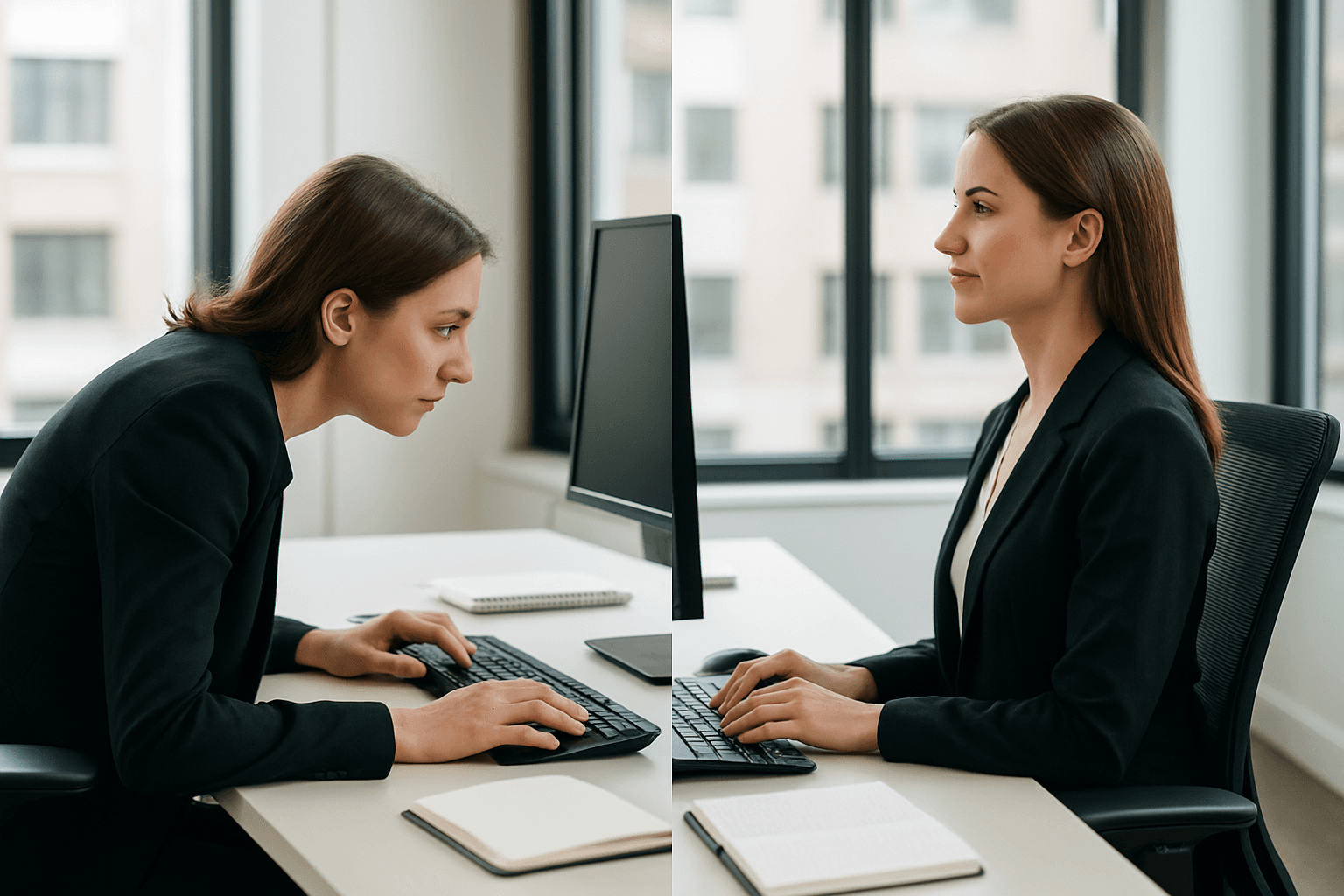
The Problem Is Not Your Chair
If better equipment fixed posture, everyone with an ergonomic office would stand up straight. They do not. The best-designed chair in the world does not change the fact that your hip flexors shorten at the same rate, your thoracic spine rounds at the same rate, and your glutes shut off at the same rate regardless of what you are sitting on.
This is not the desk ergonomics guide - that covers equipment and setup. This is about the corrective and behavioral side: what is happening to your body during 8 hours of desk work, and the specific movements that reverse it.
The 3 Positions Your Body Defaults To
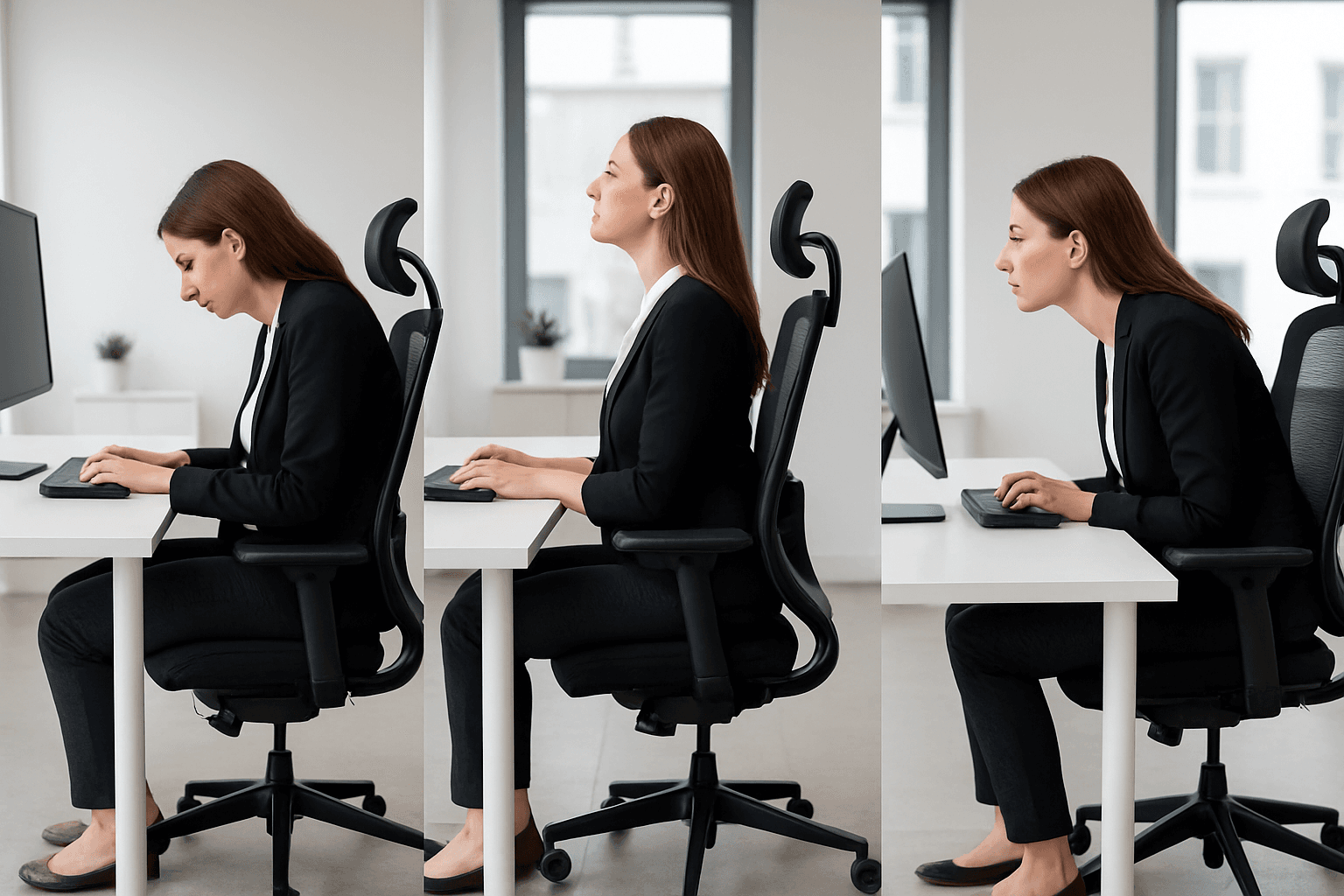
Watch someone work at a desk for an hour without them knowing, and you will see their body cycle through three positions. All three are compensatory patterns driven by muscle fatigue.
The Slump
The most common default. The thoracic spine rounds, the head comes forward, the shoulders roll in. This is the path of least resistance when the posterior chain muscles that hold you upright fatigue, which usually happens within 15 to 20 minutes of sitting. The slump shortens the chest, stretches the upper back, and loads the cervical spine with 30 to 50 extra pounds of effective force from the forward head.
The Overcorrection
After the slump, you notice and "sit up straight." This usually means arching the lower back, pulling the shoulders back with the upper traps, and lifting the chin. It looks upright but it is not a neutral spine - it is an anterior pelvic tilt with lumbar hyperextension. This position fatigues even faster than the slump because it requires constant muscular effort to maintain. Within 5 to 10 minutes, you are back in the slump.
The Lean
When both the slump and the overcorrection feel uncomfortable, the body leans to one side, resting on an armrest or propping on one elbow. This creates asymmetrical loading through the spine and is the sitting pattern most associated with SI joint dysfunction and hip imbalance.
All three positions are symptoms of the same underlying problem: the muscles that should hold you upright are not strong enough or activated enough to do their job for the duration of a workday. No chair fixes that. Only corrective exercise fixes that.
Micro-Breaks That Actually Work
The standard advice is "take breaks and stand up." That is not specific enough to be useful. Standing up and standing still is better than sitting, but it does not reverse anything.
Here are three 60-to-90-second movement breaks that specifically target what sitting is doing to your body. Rotate through them every 30 to 45 minutes.
Break 1: Standing Extension Reset
Stand up. Place your hands on your lower back. Gently extend backward, looking at the ceiling. Hold 5 seconds. Return to neutral. Repeat 5 times.
This reverses thoracic flexion. It opens the front of the spine that has been compressed in the rounded position and resets the thoracic curve toward neutral. It takes 30 seconds and undoes 30 minutes of forward rounding.
Break 2: Doorway Chest Opener
Walk to any doorway. Place your forearms on the frame. Step through and hold the chest stretch for 30 seconds. Step back. Drop your elbows to rib height and hold another 30 seconds.
This releases the pec major and pec minor, the muscles that shorten fastest during desk work and pull the shoulders into the rounded position that drives the slump.
Break 3: Standing Hip Flexor Stretch
Step one foot forward into a short lunge stance. Tuck your tailbone slightly under (posterior pelvic tilt), then shift your hips forward until you feel a stretch at the front of the back leg's hip. Hold 30 seconds per side.
The posterior tilt before the stretch is what makes this work. Without it, the stretch goes into the lumbar spine instead of the hip flexor. This is the same principle used in the kneeling hip flexor stretch, adapted for standing.
Free - 60 seconds
Not sure which program you need?
Take the free posture quiz and get a personalized recommendation based on your pain and goals.
The Exercise You Can Do at Your Desk
There is one corrective exercise you can do while seated in a meeting, on a call, or at your desk without anyone noticing: the seated hip flexor release.
Sit at the front edge of your chair. Let one foot slide forward so the leg is extended, heel on the floor. Tuck your pelvis under slightly (the same posterior tilt cue from the standing stretch). Hold this position for 60 to 90 seconds per side.
What this does: it takes the hip flexor on the extended side out of its shortened sitting position and places it in a gentle lengthened position. The posterior pelvic tilt ensures the stretch goes into the hip flexor and not the lumbar spine. Done a few times throughout the day, it slows the adaptive shortening that 8 hours of hip flexion creates.
It is not a complete fix. But as damage control during the workday, it is the highest-value move you can make without leaving your chair.
Why Standing Desks Do Not Fix Posture
Standing desks are better than sitting for one reason: they reduce hip flexor shortening. Your hips are in a neutral or slightly extended position, which prevents the adaptive shortening that sitting causes.
That is where the benefits stop.
Most people stand at their desks with the same forward head posture they had while sitting. The same rounded shoulders. The same thoracic flexion. They often add a new problem: shifting weight to one leg, which creates an asymmetrical hip pattern similar to the seated lean.
If you have a standing desk, use it. Alternate between sitting and standing every 30 to 60 minutes. But understand that the desk is not correcting your posture. It is removing one input (hip flexor shortening) while leaving every other input unchanged.
The corrective work still needs to happen.
The After-Work Routine That Undoes 8 Hours of Sitting

This is where the real correction happens. Ten to fifteen minutes after work that systematically reverses the positions your body was held in all day.
Static Back (5 minutes)
Lie on your back with your legs at 90 degrees, calves resting on a couch or chair. Arms out at 45 degrees, palms up. Stay for 5 minutes.
This is the single most effective position for unwinding a day of sitting. It deactivates the hip flexors, decompresses the lumbar spine, and allows the pelvis to return to neutral. Read more about static back and its benefits.
Foam Roller Thoracic Extension (2 minutes)
Place a foam roller across your mid-back. Support your head and gently extend over the roller, moving it through the thoracic spine segment by segment. This directly reverses the thoracic flexion that accumulated all day.
Prone Cobra (2 minutes)
Lie face down, arms at your sides. Lift your chest while squeezing the shoulder blades down and back, thumbs toward the ceiling. Hold 10 seconds. Repeat 8 times. The prone cobra reactivates the mid and lower traps that spent all day being overstretched.
Hip Flexor Stretch (2 minutes)
Kneel on one knee. Tuck the tailbone under, then drive the hips forward. Hold 45 to 60 seconds per side. This is the final step in lengthening the hip flexors back to their functional resting length.
The Pattern That Matters
Equipment changes the environment. Corrective exercise changes the body. You need both, but if you could only pick one, the exercise wins every time.
For a structured daily corrective program designed specifically for people who work at desks, the Desk Worker Posture program walks through the full sequence with built-in progression. And if you are not sure which postural patterns are causing you the most trouble, take the free posture quiz - it takes 2 minutes and tells you exactly where to start.

Mike Boshnack
Corrective Exercise Specialist · Posture Guy Mike
Mike Boshnack grew up skateboarding and surfing, trained MMA, and rode road bikes competitively. A shoulder injury put him on a path to discover corrective exercise. He has since helped thousands of people fix the structural patterns causing their pain, without surgery or passive treatments.
Keep Reading
Related Programs
Free tool
See where your posture stands right now.
Upload a photo and get an instant AI-powered posture analysis with personalized recommendations. Free, no account required.
Try the Free Posture CheckTake the next step
Fix the structural root cause, not just the symptom.
Mike's programs apply this corrective method to your specific condition. No gym, no equipment. Just a floor and 15 minutes. Buy once, own forever.
Discussion
Discussion is a Pro member feature. Visit the community for more.