
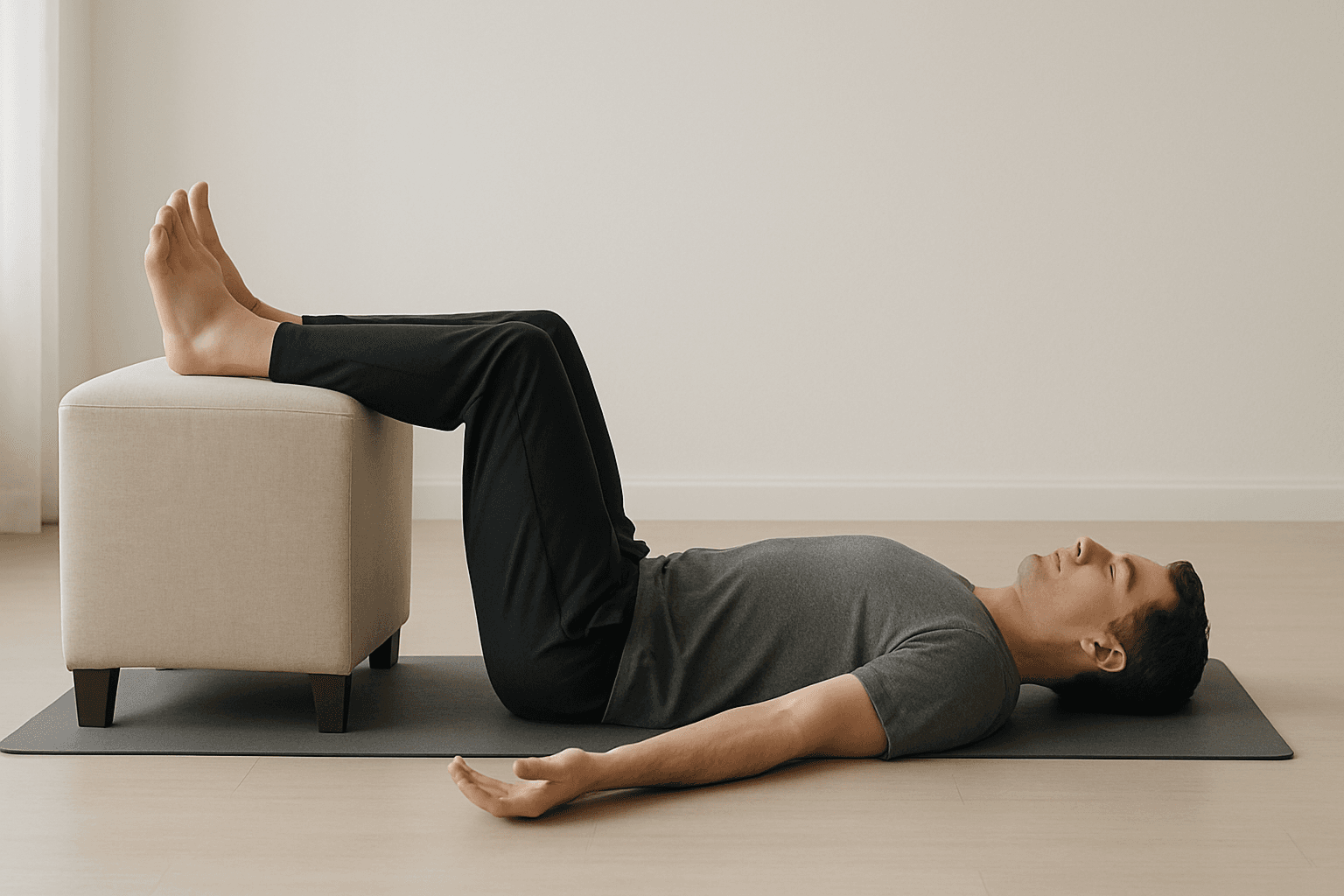
What the Static Back Position Is
The static back position is exactly what it sounds like: you lie on your back, place your calves on a chair or ottoman so your hips and knees are at 90-degree angles, and you stay there. Arms rest at your sides, palms up. You do nothing.
That is the entire exercise. There is no movement, no contraction, no stretching. You lie still and let gravity work.
It sounds too simple to do anything meaningful. That reaction is understandable and completely wrong. The static back is one of the most effective tools in corrective exercise, and its simplicity is exactly why it works so well. It removes every variable that interferes with the body returning to its natural alignment and lets physics do the job.
Why It Works: The Biomechanics
To understand why lying on your back with your legs on a chair produces real structural change, you need to understand what is happening to your pelvis, spine, and hip flexors when you are upright.
The Hip Flexor Problem
The hip flexors, primarily the psoas major and the iliacus, are the muscles that connect your lumbar spine and pelvis to your femur (thighbone). They are active when you walk, run, climb stairs, or sit. In modern life, they are active most of the day.
When you sit, your hip flexors are in a shortened position. Spend eight or more hours a day in this position, across years, and the hip flexors adapt by staying short and tight even when you stand up. Tight hip flexors pull the front of the pelvis downward, creating anterior pelvic tilt, compressing the lumbar spine, and turning off the glutes through reciprocal inhibition.
This single pattern - tight hip flexors driving anterior pelvic tilt - is the root of an enormous amount of lower back pain, hip pain, and postural dysfunction.
What the 90-Degree Position Does
When you place your legs on a chair at 90 degrees, you put the hip flexors in a position where they cannot generate tension. The muscle is neither stretched nor contracted. It is completely slack.
With the hip flexors slack, the pelvis is free to settle back toward its neutral position under the influence of gravity. The lumbar spine, which was being pulled into an excessive arch by the tight hip flexors, can decompress and lengthen. The muscles of the lower back, which were working overtime to stabilize the pelvis against the hip flexor pull, can release.
None of this requires any effort from you. The position creates the conditions, and gravity does the rest. Five minutes is enough for the muscles to release their holding pattern and the pelvis to shift.
The Seven Benefits of Static Back
1. Spinal Decompression
When you stand or sit, gravity compresses the spine. The discs between your vertebrae are under load all day, and they lose height - you are literally shorter at the end of the day than when you woke up. The static back position eliminates gravitational compression on the spine. With the pelvis in neutral and the lumbar spine supported by the floor, the discs are free to rehydrate and expand. This is why the position produces immediate relief for many people with disc-related lower back pain.
2. Hip Flexor Deactivation
This is the primary mechanical benefit. The 90-degree position takes the hip flexors completely offline. This matters because tight, overactive hip flexors are the upstream cause of anterior pelvic tilt, lumbar compression, glute inhibition, and the cascade of compensation patterns that flow from those problems. You cannot effectively activate your glutes, reset your pelvic position, or decompress your lumbar spine while the hip flexors are firing. Static back shuts them down so the correction can happen.
3. Pelvic Reset
With the hip flexors deactivated and gravity pulling the lumbar spine gently toward the floor, the pelvis is free to return to its neutral position. For most people, this means the anterior tilt reduces: the front of the pelvis lifts and the lower back arch decreases toward its natural, healthy curve.
This pelvic reset is temporary after a single session. But done daily, it interrupts the tightening cycle. The hip flexors do not get the chance to fully re-establish their shortened holding pattern before the next reset. Over weeks, the cumulative effect is a lasting change in resting pelvic position.
4. Lower Back Muscle Release
The muscles of the lower back, particularly the erector spinae and quadratus lumborum, are chronically overworked in people with anterior pelvic tilt. They are constantly fighting to stabilize a pelvis that is being pulled forward by tight hip flexors. In the static back position, these muscles have nothing to stabilize against. The floor supports the spine, gravity is neutral, and the back muscles can fully relax.
Many people feel their lower back "melt" into the floor during the first two minutes. That sensation is the back muscles releasing a holding pattern they have been maintaining all day.
5. Nervous System Reset
The static back position is not just a mechanical intervention. It is a neurological one. The position signals the nervous system to shift from a sympathetic (fight-or-flight) state to a parasympathetic (rest-and-digest) state.
The mechanism is straightforward: when the body is fully supported and the muscles are not working, the nervous system interprets the environment as safe and downregulates the stress response. Heart rate decreases, breathing deepens and slows, muscle tension throughout the body reduces.
This is why static back is an excellent tool for people who carry tension in their back and shoulders due to stress. The position addresses both the mechanical and neurological components of that tension simultaneously.
6. Improved Breathing
When the pelvis tips into anterior tilt and the lower back arches excessively, the diaphragm is compromised. The ribs flare, the diaphragm cannot dome properly, and breathing becomes shallow and chest-dominant.
In the static back position, with the pelvis neutral and the ribs settling downward toward the floor, the diaphragm can function in its full range. Many people notice that their breathing naturally deepens and slows within the first minute or two. This improved diaphragm position is one reason the position feels so calming - full diaphragmatic breaths directly stimulate the vagus nerve and promote parasympathetic activation.
7. Foundation for Corrective Exercise
Static back is not just a standalone exercise. It is the starting position for a corrective sequence. By resetting the pelvis and deactivating the hip flexors first, every exercise that follows works from a better starting point.
Glute bridges done after static back activate the glutes more effectively because the hip flexors are not competing. Core exercises done after static back engage the deep stabilizers rather than the superficial muscles. Stretches done after static back are more effective because the muscles are starting from a more neutral position.
This is why static back appears at the beginning of most corrective exercise programs, including the programs at Posture Guy Mike. It is the reset button that makes everything else work better.
Free - 60 seconds
Not sure which program you need?
Take the free posture quiz and get a personalized recommendation based on your pain and goals.
How to Do It Correctly
The position is simple, but small details matter.
Setup
- Find a chair, ottoman, or couch with a seat height that allows your hips and knees to be at approximately 90-degree angles when you lie on your back with your calves resting on the seat. Perfect 90 degrees is not critical - anywhere between 85 and 95 degrees works.
- Lie on your back on the floor (not a bed - you need a firm surface). Place your calves on the chair so that your lower legs are fully supported from knee to heel.
- Position your arms at your sides, palms facing up. The palms-up position externally rotates the shoulders, opening the chest and counteracting the rounded-shoulder position most people carry.
- Let your head rest on the floor. If your head pushes backward uncomfortably or your chin tilts up, place a thin towel under your head - just enough to bring the chin to neutral, not a pillow that pushes the head forward.
Duration
Five minutes is the standard. Set a timer and commit to the full five minutes. The hip flexors need time to fully deactivate, and most of the release happens between minutes two and five, not in the first minute.
If you have significant hip flexor tightness or acute back pain, 10 to 15 minutes provides additional benefit. There is no harm in staying longer.
Breathing
Breathe through your nose, allowing the belly to expand on the inhale and fall on the exhale. Do not force deep breaths. Just let the breathing settle into its natural rhythm. The position will deepen your breathing automatically as the diaphragm settles into its proper position.
Frequency
Daily is ideal. Twice daily (morning and evening) is excellent for people with significant hip flexor tightness or chronic lower back pain. At minimum, do it after every prolonged sitting session.
Common Mistakes
Using a Surface That Is Too High or Too Low
If the chair is too high, your hips will be in more than 90 degrees of flexion, and the hip flexors will not fully release. If the chair is too low, your legs will slide off or your knees will extend past 90 degrees. The 90-degree angle is the position of minimum hip flexor tension.
Placing a Pillow Under the Head
A thick pillow pushes the head forward, which puts the cervical spine into flexion and works against the alignment reset that the position is creating. If you need head support, use a thin folded towel - just enough to bring the chin level, no more.
Fidgeting
The urge to move, adjust, scratch, or check your phone is the nervous system resisting the transition from sympathetic to parasympathetic mode. The first time you do static back, you may feel restless for the first two minutes. Stay with it. The restlessness passes, and the release deepens once you stop fighting it.
Doing It on a Soft Surface
A bed or thick carpet allows the pelvis to sink and shift. The floor provides the firm, flat feedback that the pelvis needs to find its neutral position. Use a yoga mat or thin carpet for comfort, but the surface beneath must be firm.
Treating It as Optional
The most common mistake is skipping static back because it seems too simple or passive to "count" as exercise. It does not look impressive. It does not burn calories. It does not build visible muscle. What it does is reset the structural foundation that makes every other exercise more effective. Skipping the reset is like trying to build on a crooked foundation.
When to Use Static Back
As a Daily Reset
The best time for most people is at the end of the workday, after the hip flexors have been shortened and loaded from sitting. Five minutes of static back before your evening activities can undo much of the positional damage from the day.
Before a Workout
Five minutes of static back before strength training or a run resets the pelvis and deactivates the hip flexors, allowing the glutes to fire properly during the workout. This is one of the simplest performance hacks available: better glute activation means better squat form, faster running, and reduced injury risk.
For Acute Back Pain
When your lower back is in spasm or acute pain, static back is one of the safest and most effective first-response positions. It decompresses the spine, releases the muscles in spasm, and does not require any movement or loading of the painful area. Many people with acute back pain report significant relief within five to ten minutes in the position.
Before Bed
Static back before sleep resets the spine and activates the parasympathetic nervous system, improving sleep quality. The combination of spinal decompression, muscle relaxation, and nervous system calming makes it an excellent pre-sleep ritual, particularly for people who carry tension into bed.
As Part of a Corrective Sequence
In a structured corrective exercise program, static back typically comes first, followed by abdominal engagement exercises, then progressive strengthening. The Lower Back Pain program and the Lower Back Daily Fix program both use static back as the foundation exercise for exactly this reason.
How Static Back Fits Into the Bigger Picture
The static back position does not exist in isolation. It is the reset that makes correction possible. By deactivating the hip flexors and resetting the pelvis, it creates a window where the body can learn a new pattern.
What you do after static back matters. If you stand up and sit right back in the same hunched position for eight hours, the hip flexors will re-shorten and the pattern will re-establish. But if you follow static back with targeted activation exercises (glute bridges, core stabilization, postural strengthening), the corrected position is reinforced and gradually becomes the new default. The supine groin stretch is the natural next step after static back for deeper hip flexor release.
This is the core principle of corrective exercise: reset, then reinforce. Static back is the reset. The exercises that follow are the reinforcement. Together, they produce lasting change.
The position has been used in postural therapy for decades because it works. It costs nothing, requires no equipment beyond a chair, takes five minutes, and produces measurable changes in pelvic position, muscle tension, and pain levels. There is no good reason not to do it daily.
For a structured program that builds on the static back foundation, the Lower Back Daily Fix is a 15-minute daily routine designed around the reset-then-reinforce principle. And if you are not sure where your posture is breaking down, the free posture quiz will tell you.

Mike
Corrective Exercise Specialist · Posture Guy Mike
Mike Boshnack grew up skateboarding and surfing, trained MMA, and rode road bikes competitively. A shoulder injury put him on a path to discover corrective exercise. He has since helped thousands of people fix the structural patterns causing their pain, without surgery or passive treatments.
Keep Reading
Related Conditions
Related Programs
Free tool
See where your posture stands right now.
Upload a photo and get an instant AI-powered posture analysis with personalized recommendations. Free, no account required.
Try the Free Posture CheckTake the next step
Fix the structural root cause, not just the symptom.
Mike's programs apply this corrective method to your specific condition. No gym, no equipment. Just a floor and 15 minutes. Buy once, own forever.
Discussion
Discussion is a Pro member feature. Visit the community for more.