

Why You Slouch
Slouching is not laziness. It is physics.
Four specific muscles are pulling your body into a slouched position, and the muscles that should be holding you upright have been switched off by years of sitting and screen use. That imbalance creates a structural pull into flexion that you cannot overcome with willpower alone.
When someone tells you to sit up straight, you are essentially being asked to manually override the tension of shortened muscles that have been adapting for years. You can do it for a few minutes. Then your attention shifts, the tight muscles take over, and you are right back where you started.
Understanding which muscles are driving the slouch is the first step to actually fixing it.
The 4 Muscles That Cause Slouching
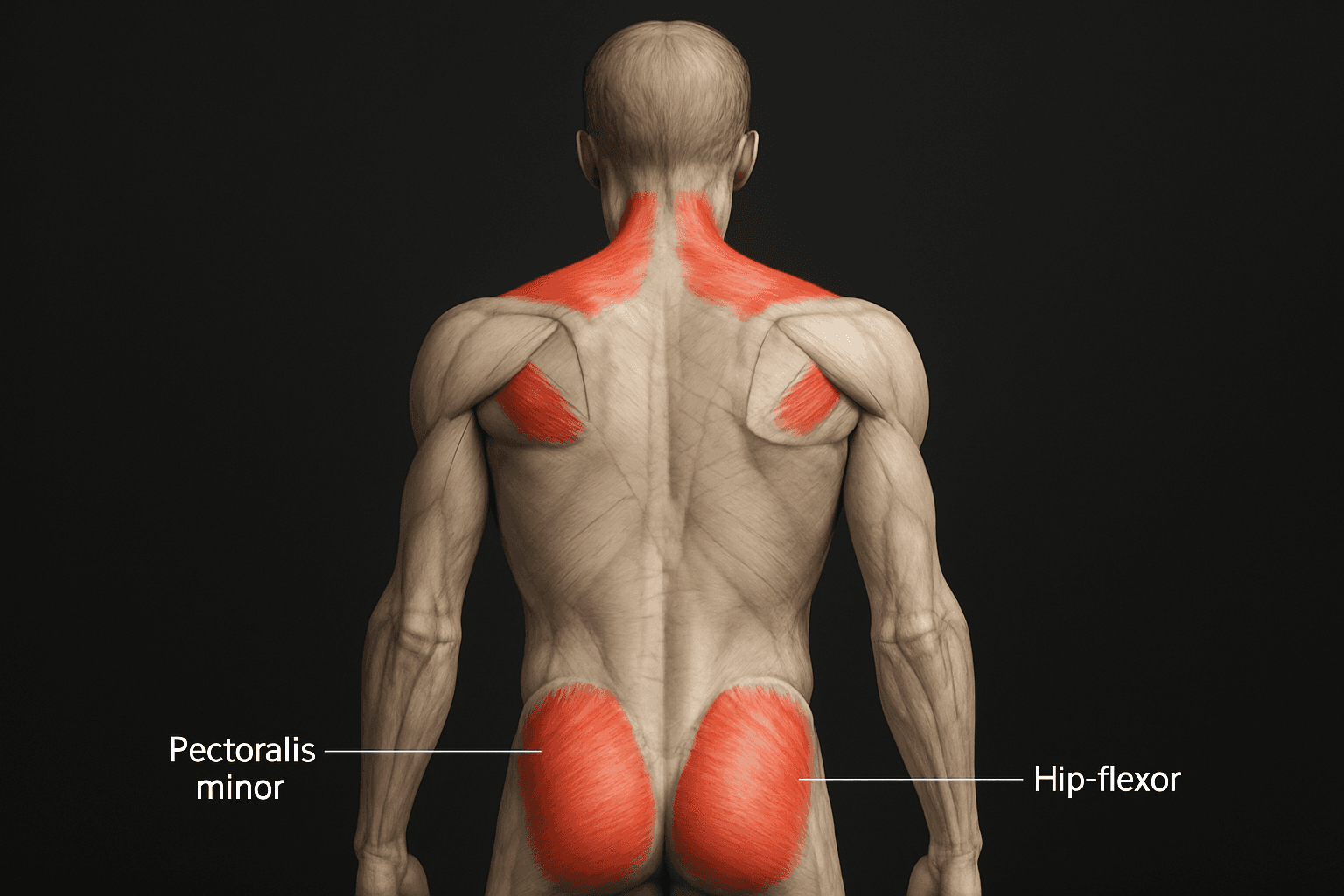
1. Pectoralis Minor
The pec minor runs from your ribs to the front of your shoulder blade. When it shortens from years of forward arm positioning (typing, driving, scrolling), it pulls the shoulder blade forward and down, rotating the entire shoulder girdle into internal rotation. This is the primary driver of rounded shoulders.
2. Upper Trapezius
The upper traps run from the base of your skull to the outer edge of your shoulder. In a slouched position, the upper traps become chronically shortened and overactive. They hike the shoulders up toward the ears and contribute to the neck tension and headaches that slouchers experience constantly.
3. Hip Flexors (Iliopsoas)
The hip flexors connect the lumbar spine to the femur. When shortened from sitting, they tilt the pelvis forward into anterior pelvic tilt, which creates a compensatory rounding of the thoracic spine above. You cannot fix upper body slouching without addressing the pelvis. The chain starts at the bottom.
4. Suboccipitals
These small muscles at the base of the skull extend the head backward to keep the eyes level when the upper back rounds. They become chronically shortened and overactive in slouchers, creating tension headaches and that constant tight feeling at the back of the skull.
What Gets Switched Off
The opposite side of the equation matters just as much. While those four muscles shorten and pull you forward, the muscles that should hold you upright become inhibited.
Lower and mid trapezius - these muscles pull the shoulder blades down and back. In a sloucher, they are lengthened and neurologically inhibited. They are not just weak, they are switched off.
Deep cervical flexors - the small stabilizers along the front of the neck that hold the head over the shoulders. Forward head posture inhibits these completely.
Glutes - the main controllers of pelvic position. Sitting for hours every day inhibits glute activation, which lets the pelvis tilt forward and starts the whole chain.
You cannot fix slouching by only stretching the tight muscles or only strengthening the weak ones. Both sides of the imbalance need to be addressed simultaneously.
Free - 60 seconds
Not sure which program you need?
Take the free posture quiz and get a personalized recommendation based on your pain and goals.
Why Common Solutions Fail
Sitting up straight is conscious override of a structural problem. It requires constant mental effort, which is unsustainable, and it does not change the underlying muscle balance.
Posture braces do the job the muscles should be doing, which makes the muscles weaker over time. Read more about posture corrector side effects.
Standing desks change the environment but not the structure. If your pec minor is short and your lower traps are inhibited, you will slouch while standing too.
Ergonomic chairs support you in a better position but do not change the muscles. As soon as you sit somewhere else, the slouch returns.
What Actually Works
The fix follows a specific sequence: release the tight muscles, then activate the inhibited ones.
Release
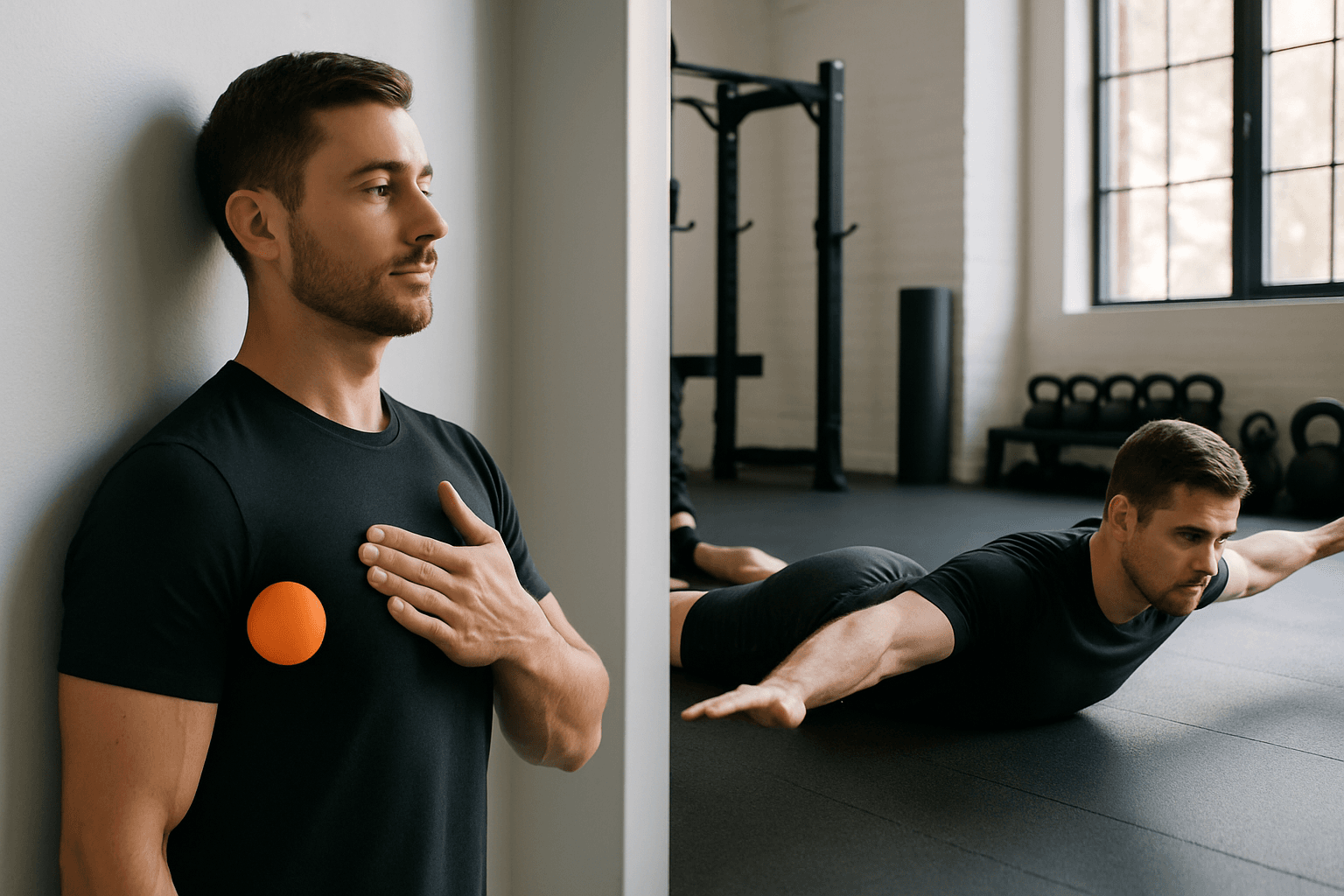
Start with the muscles that are pulling you forward.
Hip flexor release - the static back position deactivates the hip flexors passively. Lie on your back with your calves up on a chair, hips and knees at 90 degrees, for 5 minutes. This is the foundational corrective position. Learn why it is so effective in static back exercise benefits.
Chest release - the doorway chest stretch lengthens the pec minor. Stand in a doorway with your forearm on the frame, elbow at shoulder height, and lean through. Hold 60 seconds per side.
Neck release - gentle chin tucks lengthen the suboccipitals while activating the deep cervical flexors. Pull your chin straight back as if making a double chin. Hold 5 seconds, repeat 10 times. Full guide in chin tuck exercise.
Activate
Once the tight muscles are released, wake up the inhibited ones.
Glute activation - glute bridges restore the glutes' control over the pelvis. 3 sets of 10, driving through the heels.
Lower trap activation - prone cobra activates the thoracic extensors and lower traps. Lie face down, lift your chest and arms off the floor, squeeze the shoulder blades together. 3 sets of 10.
Scapular control - wall angels retrain the shoulder blades to move properly against a stable thoracic spine. If you cannot keep your arms flat against the wall, your pec minor is still too short.
The Daily Anti-Slouch Routine
This takes 12 minutes:
- Static back - 5 minutes
- Doorway chest stretch - 1 minute per side
- Chin tucks - 10 reps
- Glute bridge - 3 sets of 10
- Prone cobra - 3 sets of 10
Do this daily. Within 3 to 4 weeks, your default position will shift. Within 6 to 8 weeks, holding yourself upright will feel natural rather than effortful.
Follow Along: A Daily Routine for a Rounded Upper Back
If years of slouching have already turned into a rounded upper back, this short video is a good place to start. It uses three exercises: cat-cow, the doorway chest stretch and the prone Y raise. It takes under five minutes and you can do it every day.
The Structural Fix
If you want a structured program that addresses all of these patterns in the right sequence, the Desk Worker Posture Fix and Rounded Shoulders Fix programs are designed specifically for slouching patterns. Not sure which one fits? Take the free posture quiz or try the AI posture check for a visual analysis of where your alignment is breaking down.

Mike Boshnack
Corrective Exercise Specialist · Posture Guy Mike
Mike Boshnack grew up skateboarding and surfing, trained MMA, and rode road bikes competitively. A shoulder injury put him on a path to discover corrective exercise. He has since helped thousands of people fix the structural patterns causing their pain, without surgery or passive treatments.
Keep Reading
Related Programs
Free tool
See where your posture stands right now.
Upload a photo and get an instant AI-powered posture analysis with personalized recommendations. Free, no account required.
Try the Free Posture CheckTake the next step
Fix the structural root cause, not just the symptom.
Mike's programs apply this corrective method to your specific condition. No gym, no equipment. Just a floor and 15 minutes. Buy once, own forever.
Discussion
Discussion is a Pro member feature. Visit the community for more.