
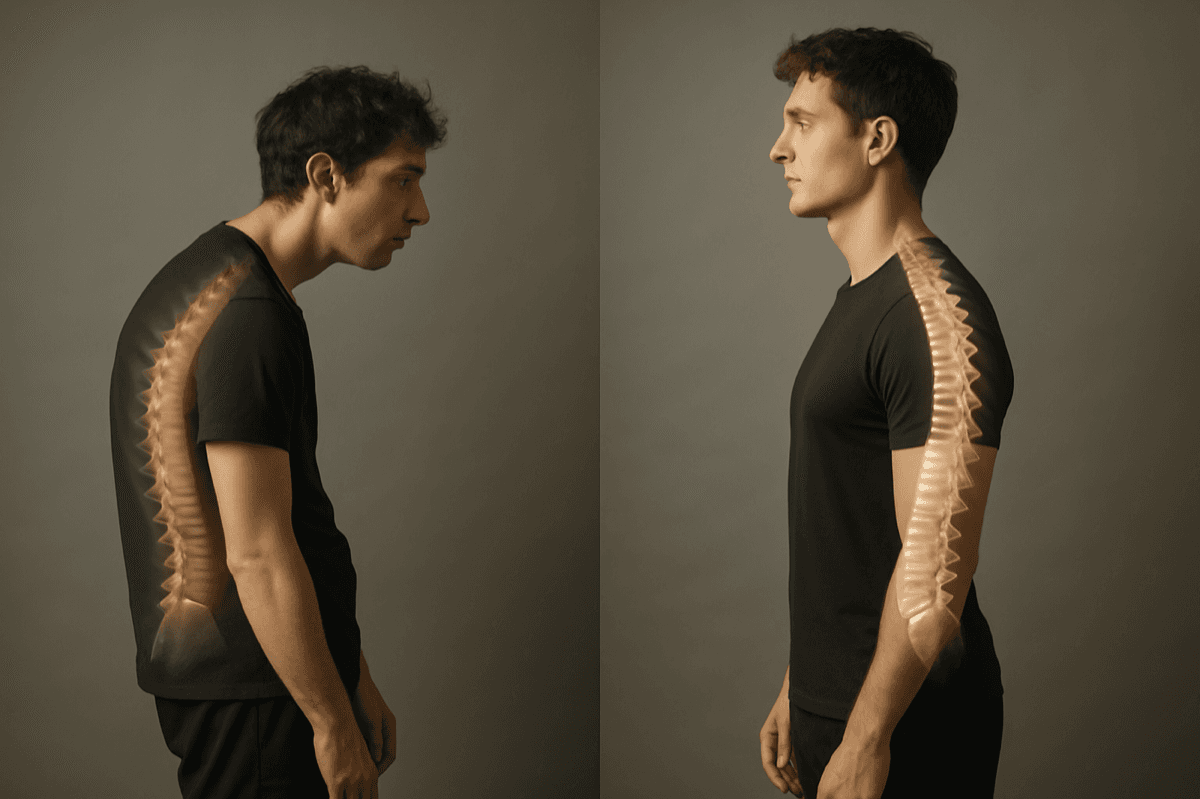
What Rounded Shoulders Actually Are
Stand sideways in a mirror. Your ears, shoulders, hips, knees, and ankles should form a vertical line. If your shoulders are in front of that line, you have rounded shoulders. If your palms face backward instead of inward toward your thighs, you have internal rotation combined with forward shoulder position. These two problems almost always come together.
The common name is "rounded shoulders." The accurate biomechanical description is forward scapular tilt with humeral internal rotation, driven by thoracic kyphosis and pec minor shortening. That distinction matters because the name makes people think it is a shoulder problem. It is not.
Why It Develops
The mechanism is not mysterious. It is the predictable result of how modern adults spend most of their waking hours.
Every hour you spend with your arms in front of you — typing, driving, using your phone, cooking — you are holding the pec minor in a shortened position. The pec minor is a small muscle that attaches from the front of the shoulder blade (the coracoid process) to ribs three, four, and five. Its job is to depress and anteriorly tilt the shoulder blade. When it is chronically shortened, that is exactly what it does at rest: it pulls the shoulder blade forward and down, tipping the glenoid toward the floor.
At the same time, the thoracic spine is rounding. Sustained sitting and forward head posture positioning cause the thoracic extensors to disengage and the anterior chest to tighten. As the mid-back rounds, the shoulder blades are carried forward on the ribcage they sit on. The scapulae tip forward. The shoulders follow.
The serratus anterior — the muscle along the side of your ribcage that holds the inside edge of the shoulder blade flat against the ribcage — becomes inhibited in this posture. When it stops working, the inside edge of the shoulder blade wings outward. This looks like poor posture. The deeper problem is that an inhibited serratus means the shoulder blade cannot upwardly rotate properly, which closes the subacromial space and creates impingement with every arm raise.
This is why chest stretches alone do not fix rounded shoulders. You can stretch the pec minor until it is genuinely lengthened, but if the thoracic spine is still kyphotic and the serratus anterior is still offline, the shoulder blade will return to its forward tipped position the moment you stand up. The structural context has not changed.
The Real Cause: Three Layers
Rounded shoulders have three structural drivers that must all be addressed.
Thoracic Kyphosis
The foundation of the problem. When the thoracic spine rounds, the entire shoulder girdle is carried forward on the ribcage. You cannot correct shoulder position without first restoring thoracic extension. The thoracic spine is the platform the shoulders sit on.
Pec Minor Shortening
The specific anterior structure pulling the shoulder blade into forward tilt. The pec minor is almost universally shortened in adults who use computers, phones, or drive regularly. When it shortens, it mechanically prevents the shoulder blade from sitting in its correct position regardless of what the thoracic spine is doing.
Serratus Anterior Inhibition
The muscle that should be holding the shoulder blade flat and facilitating upward rotation is inhibited when the shoulder is in a forward, internally rotated position. Without the serratus anterior doing its job, the shoulder blade cannot move correctly during arm elevation, and any strengthening of the rotator cuff or deltoid makes the impingement pattern worse rather than better.
Free - 60 seconds
Not sure which program you need?
Take the free posture quiz and get a personalized recommendation based on your pain and goals.
The Five Exercises That Actually Work
Thoracic Extension Over a Foam Roller
Place a foam roller horizontally across the mid-thoracic spine at the shoulder blade level. Cross your arms over your chest or support your head. Extend gently over the roller, allowing the thoracic spine to open. Spend 30 to 60 seconds at each position and move the roller up and down the thoracic spine in two-inch increments.
This directly restores the thoracic extension range that rounding has eliminated. It is the first exercise in the sequence because without it, everything else is working on a compromised foundation.
Pec Minor Doorway Stretch
Stand in a doorway with your forearm against the frame, elbow at shoulder height or slightly below. Step your feet through until you feel a stretch across the front of the chest and anterior shoulder. Hold 60 to 90 seconds each side. The key is not to flare the ribs or arch the lower back, both of which substitute lumbar and thoracic extension for the actual pec minor stretch.
Prone Y Raises
Lie face down on the floor, arms extended overhead in a Y shape, thumbs up. Squeeze your shoulder blades together and down as you lift your arms two to three inches off the floor. Hold three seconds, lower slowly. Do 15 repetitions.
This activates the lower trapezius, the muscle that must be working to hold the shoulder blade in a retracted and depressed position. The lower trap is chronically inhibited in rounded shoulder posture. Without restoring it, the shoulder blade slides forward whenever you are not consciously thinking about it.
Serratus Anterior Wall Slides
Stand facing a wall with your forearms against it, elbows at shoulder height. Press the back of your shoulder blades away from the wall — a protraction movement — while keeping your elbows in contact. Hold the protracted position for three seconds. Return and repeat 12 times.
The serratus anterior is the protractor of the shoulder blade. This exercise restores its activation pattern specifically, in the range where it must function to control the shoulder blade during arm elevation.
Static Back with External Rotation
Lie on your back with legs at 90 degrees on a chair, arms at 45 degrees from your sides, palms up. Stay for five minutes. The palms-up position places the humerus in external rotation, which is the opposite of the internal rotation that accompanies rounded shoulders. Held passively, this position begins to restore the external rotation range of the glenohumeral joint while the static back position decompresses the thoracic spine and lumbar from below.
Watch: A Short Daily Routine
Two of the exercises above, the doorway chest stretch and the prone Y raise, are in this follow-along video, along with cat-cow to get the mid-back moving first. Rounded shoulders and a rounded upper back usually show up together, so the same routine helps both. It takes under five minutes and you can do it every day.
What to Expect
The combination of thoracic extension, pec minor release, lower trap activation, and serratus restoration addresses rounded shoulders at every structural level. Done daily, most people notice visible shoulder position change within three to four weeks. Shoulder pain associated with rounded posture typically reduces as the scapular mechanics improve.
For a structured program that walks through this sequence in order, including the specific corrective exercises that address each layer, the Rounded Shoulders Fix program covers the full sequence in 20 progressive sessions.
Mike Boshnack
Corrective Exercise Specialist · Posture Guy Mike
Mike Boshnack grew up skateboarding and surfing, trained MMA, and rode road bikes competitively. A shoulder injury put him on a path to discover corrective exercise. He has since helped thousands of people fix the structural patterns causing their pain, without surgery or passive treatments.
Keep Reading
Conditions & Pain
Dentists and Hygienists: Your Neck Is Paying for Every Patient You Lean Over
4 min read
Conditions & Pain
Why Your Neck Cracks When You Turn Your Head (And What It's Really Telling You)
4 min read
Conditions & Pain
Levator Scapulae Pain: Why That Knot Between Your Neck and Shoulder Blade Won't Quit
4 min read
Related Conditions
Free tool
See where your posture stands right now.
Upload a photo and get an instant AI-powered posture analysis with personalized recommendations. Free, no account required.
Try the Free Posture CheckTake the next step
Fix the structural root cause, not just the symptom.
Mike's programs apply this corrective method to your specific condition. No gym, no equipment. Just a floor and 15 minutes. Buy once, own forever.
Discussion
Discussion is a Pro member feature. Visit the community for more.