
The Lower Back Is Not the Problem
Here is something most back pain sufferers never hear: your lower back is almost certainly not the cause of your lower back pain. It is the site where the pain shows up, but the cause is above and below it.
The lumbar spine sits between two structures that directly control its position - the pelvis below and the thoracic spine above. When those structures are out of alignment, the lumbar spine is forced to compensate. It arches too far, compresses on one side, rotates slightly, or holds itself rigid to stabilize a chain that is unstable. That compensation produces pain.
This is why treatments that target the lower back directly - massage, heat, ice, lumbar stretches, even injections - provide temporary relief but do not solve the problem. The relief fades because the structural forces driving the compensation are still there.
Fix the pelvis and the thoracic spine, and the lumbar spine has nothing to compensate for. The pain resolves because the cause resolves. I have seen this pattern in thousands of clients. The lower back is the victim, not the criminal.
The Three Structural Problems Behind Most Back Pain
Tight Hip Flexors and Anterior Pelvic Tilt
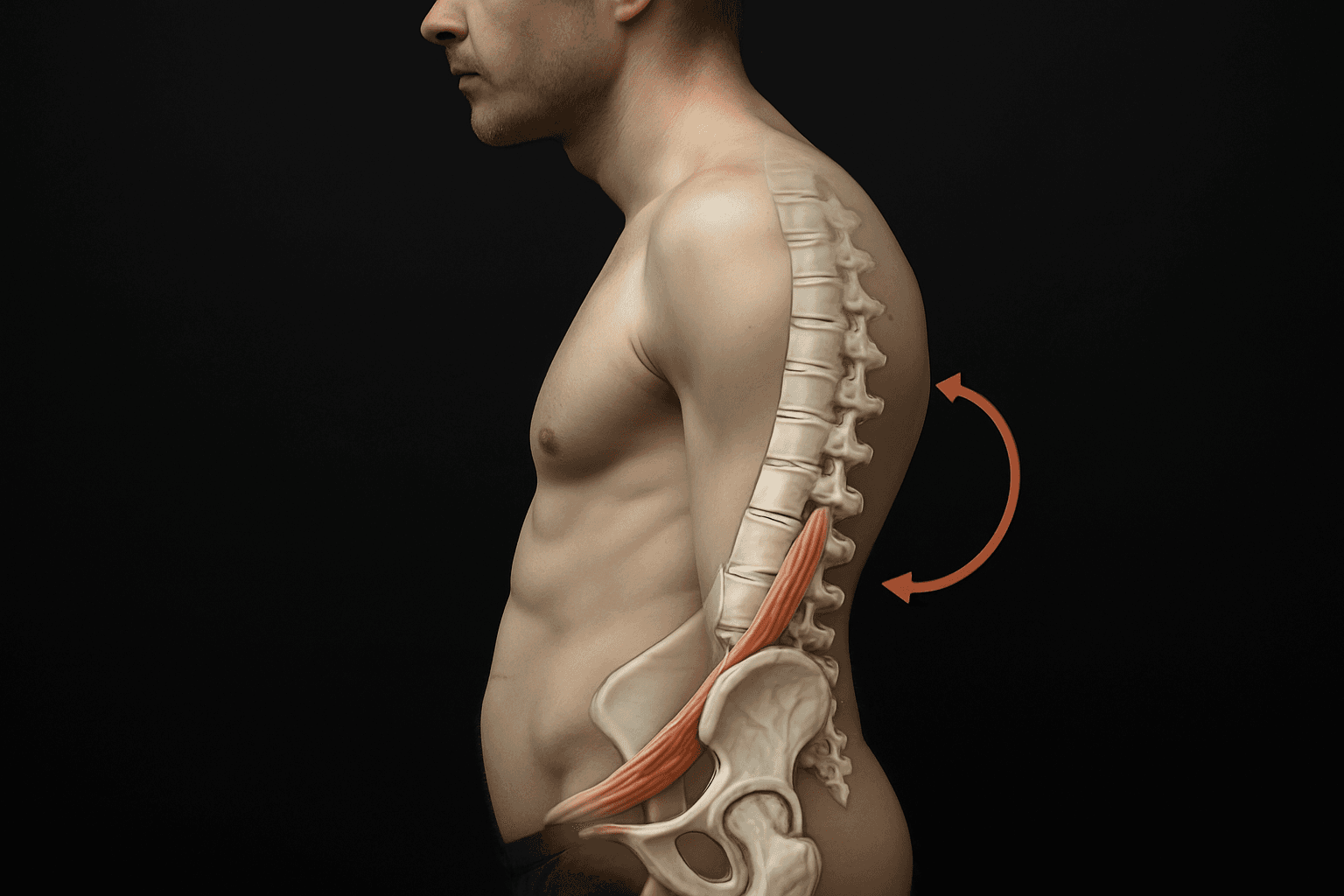
When you sit, your hip flexors (specifically the iliopsoas) shorten to the angle your chair creates at your hip. Over years, this shortened position becomes their default resting length. The shortened hip flexors pull the front of the pelvis downward, tipping it into anterior pelvic tilt.
Anterior pelvic tilt creates an exaggerated arch in the lumbar spine. The facet joints of the lumbar vertebrae, small joints at the back of each vertebra, are compressed. The muscles of the lower back are held in constant contraction to manage the increased arch. The discs are loaded unevenly, with more compression at the back.
This is the single most common structural cause of lower back pain in adults who sit for work. And it is entirely correctable.
Weak and Inhibited Glutes
The glutes are the primary stabilizers of the pelvis. In a properly functioning system, the glutes hold the pelvis in neutral and control its position during movement - walking, standing, bending, lifting.
In people with anterior pelvic tilt, the glutes are inhibited through a mechanism called reciprocal inhibition. When the hip flexors are chronically tight and shortened, the nervous system dials down the glutes to prevent a muscular tug-of-war. The glutes do not just get weak. They get neurologically switched off.
Without glute stabilization, the lower back takes over as the primary pelvic stabilizer. It is not designed for this role. It fatigue quickly, compresses under the load, and eventually produces pain.
Locked Thoracic Spine
The thoracic spine (mid-back) is designed to rotate and extend. In people who sit at desks, drive, or use phones for extended periods, the thoracic spine progressively loses its ability to move. It locks into a rounded, stiff position.
When the thoracic spine cannot extend or rotate, the lumbar spine picks up the slack. Every twist, reach, or extension that should come from the mid-back is instead forced through the lower back. The lumbar spine is not built for this range of motion. It has roughly 5 degrees of rotation per segment compared to the thoracic spine's 7 to 9 degrees per segment. Forcing rotation through the lumbar spine compresses the discs and facet joints.
This is why golfers, tennis players, and anyone who rotates frequently gets lower back pain - the rotation that should come from the thoracic spine is being dumped into the lumbar.
Why Core Exercises Alone Do Not Fix It
This is one of the most persistent misconceptions in back pain management. "Strengthen your core" is the default recommendation, and it is incomplete at best and counterproductive at worst.
Here is the problem: if your pelvis is tilted forward from tight hip flexors and your thoracic spine is locked, adding core strength reinforces the compensating pattern. You are strengthening muscles around a misaligned structure. The core becomes stronger at holding a dysfunctional position.
Planks, crunches, and sit-ups performed with anterior pelvic tilt actually increase the compression on the lumbar spine. The hip flexors, which are already dominant, are heavily recruited during most traditional core exercises. You end up with tighter hip flexors, more pelvic tilt, and a stronger core that is working harder to stabilize a structure that is farther out of alignment.
The correct approach is to fix the alignment first, then strengthen the core to hold the corrected position. Release the hip flexors. Activate the glutes. Mobilize the thoracic spine. Then train the core in the context of a pelvis that is neutral and a spine that can move properly. The dead bug is a core exercise that works in this corrected context because it trains anti-extension, the exact pattern needed to prevent the pelvis from tipping forward again.
Free - 60 seconds
Not sure which program you need?
Take the free posture quiz and get a personalized recommendation based on your pain and goals.
The 5 Exercises That Address the Actual Cause
These exercises are listed in the order they should be performed. The sequence matters because each exercise creates the conditions that make the next one more effective.
1. Static Back - 5 Minutes
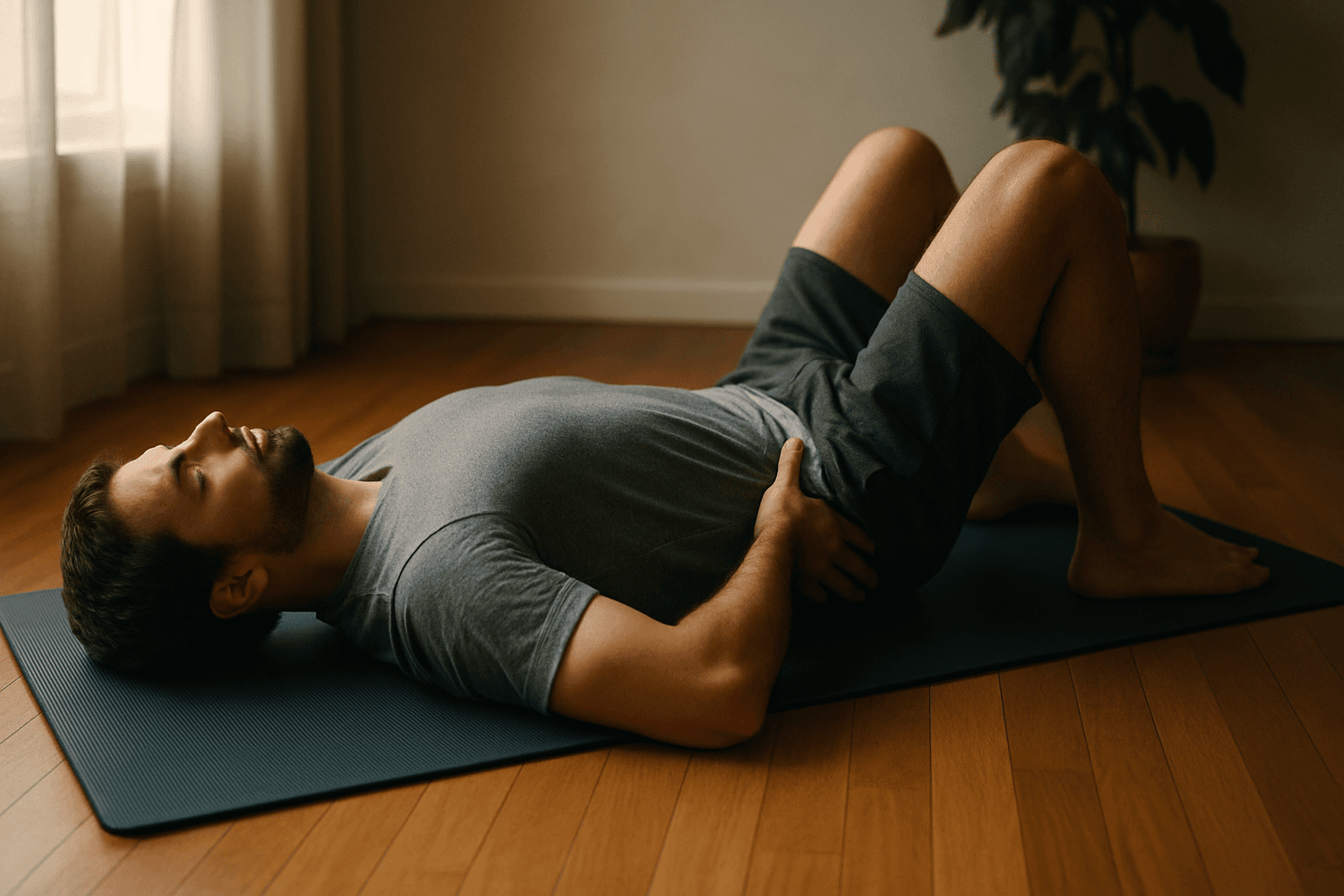
Lie on your back with your calves resting on a chair, knees and hips at 90 degrees. Arms at 45 degrees from your sides, palms up. Let your entire body relax.
What it does: Deactivates the hip flexors by removing gravity's pull on the pelvis. The lumbar spine drops toward the floor as the hip flexors release their grip. This is the fastest way to decompress the lower back, and most people feel relief within the first 2 to 3 minutes. Read more about static back and why it works.
2. Supine Groin Stretch - 15 to 20 Minutes Per Side
Lie on your back, one leg on a chair with the knee bent at 90 degrees, the other leg extended flat on the floor. Hold and let the hip flexors of the extended leg release passively.
What it does: The supine groin stretch is the deepest hip flexor release available without a therapist. The extended position under passive hold allows the iliopsoas to lengthen in a way that quick stretches cannot achieve. The lower back flattening toward the floor is the indicator that the release is working. For the full technique breakdown, read the supine groin stretch guide.
3. Glute Bridge - 3 Sets of 12
Lie on your back, knees bent, feet flat on the floor. Press through your heels and lift your hips until your body forms a straight line from knees to shoulders. Squeeze the glutes at the top for 2 to 3 seconds. Lower slowly.
What it does: After the hip flexors have been released, the glute bridge reactivates the glutes that were suppressed by reciprocal inhibition. The timing matters - glute bridges performed before hip flexor release are significantly less effective because the hip flexors are still inhibiting glute activation. After the release, the glutes can fire fully and begin to take over pelvic stabilization from the lower back.
4. Hip Crossover Stretch - 30 Seconds Each Side
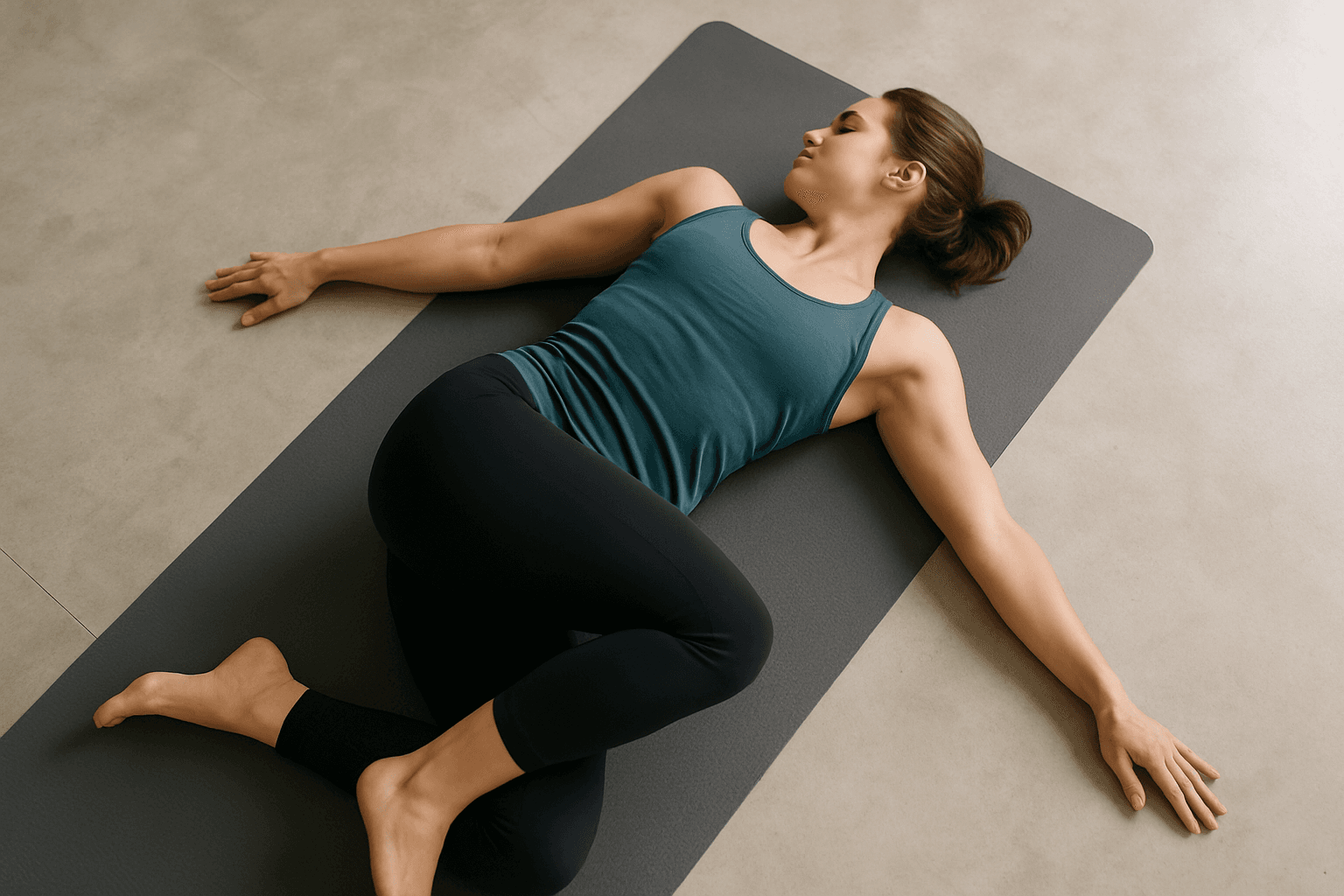
Lie on your back, knees bent, feet flat and wider than hip-width. Let both knees fall to one side while keeping the opposite shoulder on the floor. Hold until the hip settles. Switch sides.
What it does: The hip crossover stretch restores rotation in the hip joint and releases the deep hip rotators that become tight from sitting. When the hips cannot rotate, the lumbar spine is forced to rotate in their place - a primary cause of lower back pain during walking, bending, and any twisting movement.
5. Thoracic Extension Over a Foam Roller - 2 Minutes
Place a foam roller horizontally across your mid-back at the shoulder blade line. Hands supporting your head, elbows pointing forward. Gently extend over the roller, opening the chest toward the ceiling. Move the roller up and down the thoracic spine, pausing at stiff segments for 15 to 30 seconds.
What it does: Restores the thoracic spine's ability to extend and rotate, which removes the compensatory demand on the lumbar spine. Each stiff segment you mobilize is a segment that was dumping its workload into your lower back. This exercise has the most immediate impact on people whose back pain worsens with twisting or reaching.
What to Expect Week by Week
Week 1 to 2: The fastest changes happen here. Lower back tension decreases noticeably after the first few sessions. The static back and supine groin stretch provide the most immediate relief because they directly decompress the structures that are under load. Many people report waking up with less stiffness and finishing the workday with less pain.
Week 2 to 4: The glutes begin activating during daily movement. Walking feels more stable. Standing for long periods becomes less painful because the glutes are now sharing the stabilization work with the lower back. The pelvis begins to shift toward neutral.
Week 4 to 8: Visible and measurable postural change. The lumbar arch normalizes. The pelvis sits closer to neutral without conscious effort. Back pain during activities that previously triggered it - bending, lifting, twisting, long drives - decreases significantly or resolves.
Week 8 to 12: The corrected posture becomes the default. The nervous system has adopted the new muscle balance as its baseline. The back pain is not being managed. It is resolved because the cause is resolved.
When to Worry vs. When to Do Corrective Work
The vast majority of lower back pain in adults without a history of trauma or diagnosed structural pathology responds to corrective exercise. However, certain symptoms warrant medical evaluation:
- Pain radiating below the knee (possible nerve involvement)
- Numbness or tingling in the legs or feet
- Loss of bladder or bowel control (medical emergency)
- Pain from a specific fall, impact, or accident
- Pain that wakes you from sleep and does not change with position
If none of those apply and your back pain is related to prolonged sitting, standing, or repetitive movement, the structural approach described above addresses the cause in the majority of cases.
The Full Program Approach
These five exercises form the foundation, but a full corrective program sequences additional exercises, builds progressions, and addresses individual variation. The Lower Back Pain program is built specifically around this structural approach, with daily sessions that progress from release to activation to integration.
If you want a daily maintenance routine rather than a full correction program, the Lower Back Daily Fix provides a shorter daily sequence designed to keep the hip flexors released and the glutes active.
Not sure where your posture is breaking down? Take the free posture quiz to identify your primary pattern and get matched to the right starting point.

Mike Boshnack
Corrective Exercise Specialist · Posture Guy Mike
Mike Boshnack grew up skateboarding and surfing, trained MMA, and rode road bikes competitively. A shoulder injury put him on a path to discover corrective exercise. He has since helped thousands of people fix the structural patterns causing their pain, without surgery or passive treatments.
Keep Reading
Related Conditions
Related Programs
Free tool
See where your posture stands right now.
Upload a photo and get an instant AI-powered posture analysis with personalized recommendations. Free, no account required.
Try the Free Posture CheckTake the next step
Fix the structural root cause, not just the symptom.
Mike's programs apply this corrective method to your specific condition. No gym, no equipment. Just a floor and 15 minutes. Buy once, own forever.
Discussion
Discussion is a Pro member feature. Visit the community for more.