
The Most Common Overuse Injury in Swimming
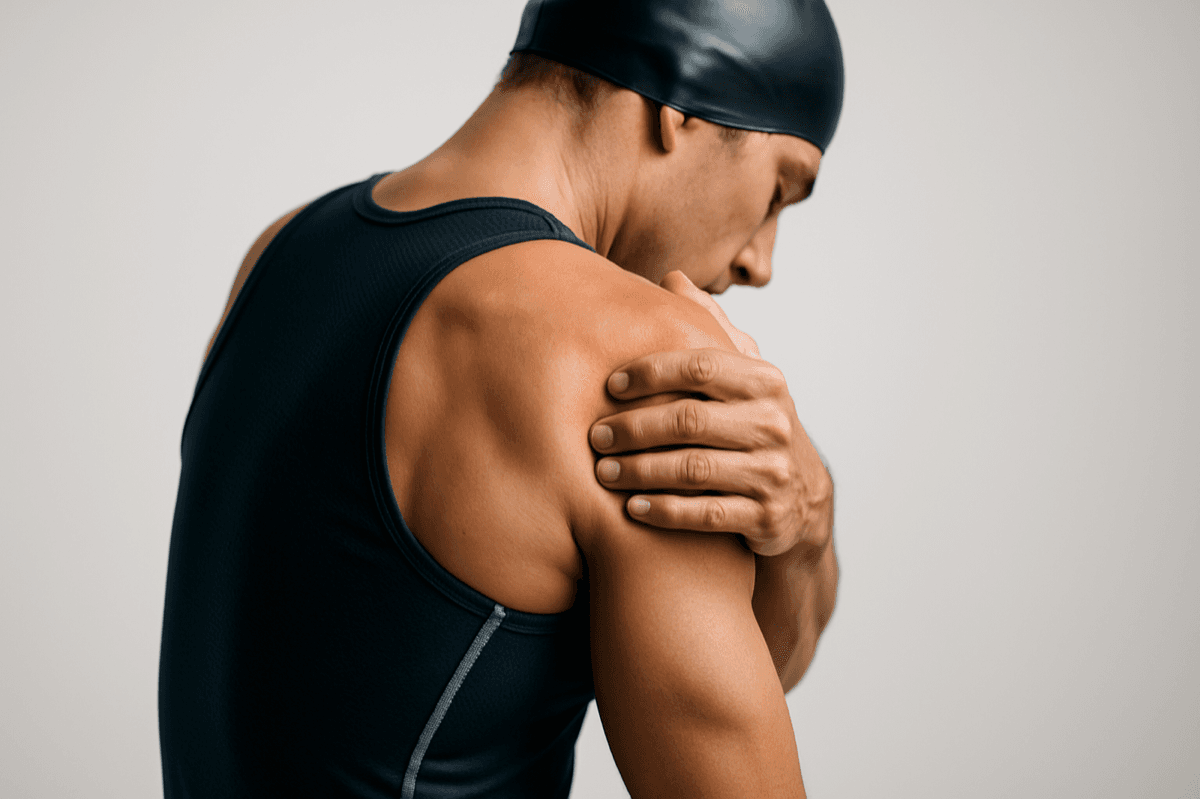
Swimmer's shoulder is the term for shoulder pain in competitive and recreational swimmers, affecting an estimated sixty to ninety percent of elite swimmers at some point in their careers. It typically presents as pain in the front or side of the shoulder during the catch phase of freestyle, when the arm is extended forward and beginning the pull, and often during the recovery phase as well.
The standard diagnostic pathway involves imaging: X-rays to rule out fracture, then MRI to assess the rotator cuff and labrum. When imaging reveals tendinopathy or a partial thickness tear in the supraspinatus, the treatment becomes rotator cuff strengthening, external rotation exercises, and relative rest. This is the point at which most swimmers stall: the rotator cuff gets stronger, the shoulder continues to hurt, and the return to full training is delayed indefinitely.
The problem is not the rotator cuff.
The Actual Mechanism
The shoulder impingement that produces swimmer's shoulder pain happens in the subacromial space, the gap between the top of the humerus and the undersurface of the acromion. During arm elevation, this space narrows. When the shoulder joint is in optimal position, the scapula retracted, the humeral head centered in the glenoid, there is sufficient space. When the scapula tips forward and the humeral head migrates anteriorly and superiorly, the space closes and the supraspinatus tendon is pinched with every arm elevation.
Swimming makes this worse because of bilateral training volume. A competitive swimmer performs approximately one million arm cycles per year. Each cycle loads the shoulder. In a shoulder with optimal scapular positioning, one million cycles is manageable stress. In a shoulder with a forward-tipped scapula and elevated humeral head, one million cycles creates relentless impingement. The tendon does not fail because of a traumatic event. It fails because the mechanical environment makes every repetition a compressive load rather than a neutral one.
The scapula tips forward because the thoracic spine is rounded. The thoracic spine is rounded because swimmers develop dominant anterior chains, the chest and anterior shoulder muscles used in the pull phase, without proportional development of the thoracic extensors and posterior shoulder muscles used in retraction.
The Fix That Works for Swimmers
The intervention that actually resolves swimmer's shoulder addresses the scapulothoracic mechanics, not the rotator cuff directly.
Thoracic extension restoration is the first priority. A swimmer who cannot extend through the thoracic spine cannot achieve and hold the scapular position that prevents impingement. Foam roller thoracic extension, prone Y-T-W raises, and extension-based work restore the thoracic range that high-volume swimming training eliminates.
Scapular posterior tilt and retraction training, lower trapezius activation specifically, repositions the scapula on the ribcage. This directly increases the subacromial space that impingement has closed. When the lower trap is working and holding the scapula in its posterior tilted position, the humeral head is centered, the supraspinatus has clearance, and the impingement mechanism is removed.
External rotation exercises, the standard swimmer's shoulder treatment, are not wrong, but they are addressing a secondary imbalance. The rotator cuff is overworked because the shoulder is in a mechanically disadvantaged position. Correct the position first, then the rotator cuff work produces meaningful results.
The Shoulder Pain Relief program applies this thoracic-first, scapular-second sequence, the same approach used in high-performance sports medicine for returning competitive swimmers to full training without recurrence. The pattern applies whether you swim competitively or experience shoulder pain from any sport with overhead or anterior-dominant loading.

Mike Boshnack
Corrective Exercise Specialist · Posture Guy Mike
Mike Boshnack grew up skateboarding and surfing, trained MMA, and rode road bikes competitively. A shoulder injury put him on a path to discover corrective exercise. He has since helped thousands of people fix the structural patterns causing their pain, without surgery or passive treatments.
Keep Reading
Related Conditions
Related Programs
Free tool
See where your posture stands right now.
Upload a photo and get an instant AI-powered posture analysis with personalized recommendations. Free, no account required.
Try the Free Posture CheckTake the next step
Fix the structural root cause, not just the symptom.
Mike's programs apply this corrective method to your specific condition. No gym, no equipment. Just a floor and 15 minutes. Buy once, own forever.
Discussion
Discussion is a Pro member feature. Visit the community for more.