
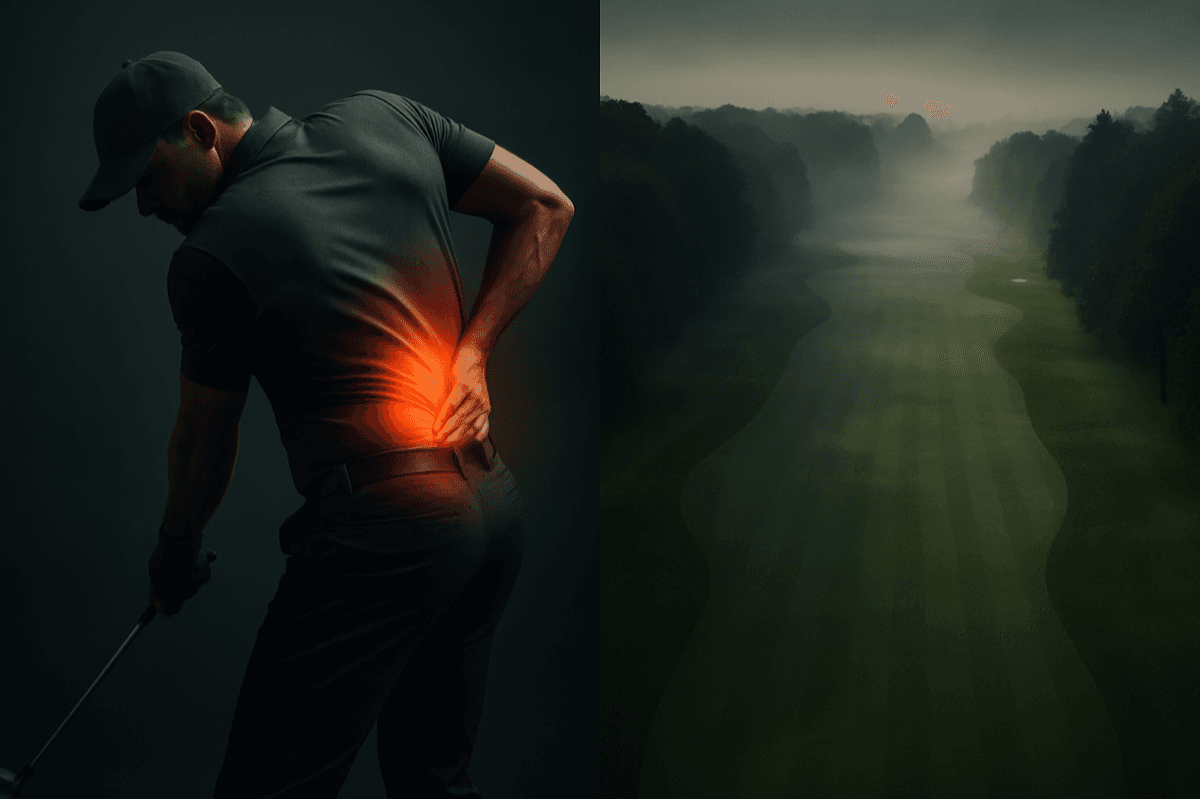
The Golf Swing Is a Hip Rotation Exercise
The golf swing, stripped to its mechanical essentials, is a rotation of the pelvis around the lumbar spine. The lower body initiates the downswing; the hips rotate toward the target; the thoracic spine and arms follow; the club accelerates through impact. At no point in a properly sequenced swing does the lumbar spine rotate significantly. The lumbar spine is designed for flexion and extension, not rotation. Its facet joint orientation actively limits rotation to roughly five degrees per vertebral segment.
The pelvis and hips rotate. The thoracic spine rotates. The lumbar spine, ideally, transmits force between them without rotating itself.
The problem is that most golfers, recreational players who sit for eight hours a day before walking eighteen holes on the weekend, have hips that do not rotate sufficiently. The hip external rotators are inhibited from anterior pelvic tilt. The hip internal rotation range of motion is restricted from years of sitting. The glutes, which should be generating the rotational power that drives the swing, are not activating efficiently.
When the hips cannot rotate through the range the swing demands, the lumbar spine compensates. It provides the rotation the hips cannot. Multiply this compensation by a hundred swings per round, several rounds per week, across decades of play, and you have the most common injury in golf: lumbar facet joint syndrome, disc herniation at L4-S1, and the chronic lower back tightness that every recreational golfer normalizes as part of the game.
The Setup Position Sets the Pattern
Before the first rotation occurs, the setup position has already determined how the swing will distribute load.
The address position requires a hip hinge, a forward lean from the hips rather than a rounding of the lower back. A proper hip hinge maintains the lumbar lordosis (the natural inward curve of the lower back) while the trunk angles forward over the ball. The hip flexors are engaged; the glutes are loaded in a lengthened position; the lumbar spine is neutral.
In a golfer with tight hip flexors and anterior pelvic tilt, the hip hinge is impossible to execute correctly. The pelvis anteriorly tilts further under the load of the forward lean, the lumbar spine hyperextends rather than maintains neutral, and the posterior lumbar joints begin the round already under compression. This is the structural starting position for every swing that follows.
Swing analysis and coaching can identify the fault, the inability to maintain lumbar neutral in the setup, but cannot correct it. The structural limitation in the hip flexors and glutes is not a technique problem. It requires structural corrective work off the course.
Why Distance Decreases Before Pain Begins
The hip mobility deficit that eventually produces lower back pain has a measurable performance consequence that appears earlier: reduced rotational power and inconsistent impact position.
hip rotation range of motion is directly correlated with clubhead speed. The longer the hip turn in the backswing and the earlier the hip leads in the downswing, the more rotational energy is available to be transmitted through the thoracic spine and into the arms at impact. When the hips cannot complete their range, the backswing shortens, the downswing sequence is disrupted, and the clubhead speed at impact is reduced.
This is why many recreational golfers who begin working on hip mobility through corrective exercise report improved distance before they report reduced pain. The distance improvement is immediate because the range of motion improvement is immediate. The pain reduction follows as the lumbar spine is no longer being asked to provide the rotation the hips could not.
Free - 60 seconds
Not sure which program you need?
Take the free posture quiz and get a personalized recommendation based on your pain and goals.
The Three Structural Problems
Anterior Pelvic Tilt
Anterior pelvic tilt, the forward tipping of the pelvis caused by shortened hip flexors, is the primary structural driver of golf back pain. In anterior tilt, the lumbar spine is in chronic extension, the glutes are inhibited, and the facet joints of L4 and L5 are chronically compressed.
Every swing from this position loads the already-compressed facet joints further into extension during the backswing follow-through. The cumulative compression across a round, a season, and a career is what produces the degenerative changes seen on imaging in experienced golfers.
Restricted Hip Internal Rotation
The trail hip (right hip for a right-handed golfer) needs to internally rotate through the backswing. The lead hip needs to internally rotate through the downswing and into impact. Both movements are limited by the tight posterior hip capsule and external rotator muscles that develop from sustained sitting and are never specifically addressed.
When internal rotation is restricted on the trail side, the pelvis cannot complete the backswing turn. The shoulders continue rotating past the pelvis, disconnecting the kinematic chain, and the lumbar spine provides the rotation to compensate. When internal rotation is restricted on the lead side, the hip cannot fully open to the target in the downswing, which forces the lead knee and lumbar spine to compensate through impact.
Thoracic Rotation Restriction
The thoracic spine is designed to rotate. It has eighteen to twenty-two degrees of rotation per vertebral segment, far more than the lumbar spine, and should be the primary source of the upper-body rotation in the golf swing. In golfers with thoracic kyphosis from desk work, this rotation is restricted.
When thoracic rotation is restricted, the swing either shortens (reducing power) or the lumbar spine and cervical spine compensate for the missing thoracic range (producing injury risk). Thoracic restriction is the most commonly overlooked driver of golf back pain because it presents far from the site of pain.
The Off-Course Fix
The structural correction that resolves golf back pain and improves swing mechanics simultaneously:
Restore pelvic neutrality by releasing the hip flexors. The static back and supine groin progressive are the two most effective interventions. Three to five minutes per exercise, daily, produces measurable change in hip flexor length within two to three weeks.
Activate the glutes through hip extension work. The glute bridge, particularly the single-leg variation, trains the glute to fire from a posteriorly tilted pelvis, which is the structural position the swing should originate from. Most golfers with back pain discover their glutes are functionally absent during a single-leg bridge test.
Restore hip internal rotation through targeted hip mobility work. Pigeon pose progressions and seated hip crossover stretches restore the internal rotation that backswing and downswing mechanics require.
Restore thoracic rotation through thoracic rotation drills in the seated or quadruped position. These drills isolate thoracic rotation from lumbar and hip contribution, training the thoracic spine to provide what the swing demands of it without lumbar compensation.
The corrective work takes fifteen to twenty minutes per day. Most golfers see functional improvement within two to four weeks, both in terms of pain reduction and in terms of the ease and depth of their rotation. The Golf Posture Fix program covers the full corrective sequence in structured daily sessions.
The swing did not cause the back pain. The structural state the body brought to the swing did. Fixing the structure fixes both.

Mike Boshnack
Corrective Exercise Specialist · Posture Guy Mike
Mike Boshnack grew up skateboarding and surfing, trained MMA, and rode road bikes competitively. A shoulder injury put him on a path to discover corrective exercise. He has since helped thousands of people fix the structural patterns causing their pain, without surgery or passive treatments.
Keep Reading
Free tool
See where your posture stands right now.
Upload a photo and get an instant AI-powered posture analysis with personalized recommendations. Free, no account required.
Try the Free Posture CheckTake the next step
Fix the structural root cause, not just the symptom.
Mike's programs apply this corrective method to your specific condition. No gym, no equipment. Just a floor and 15 minutes. Buy once, own forever.
Discussion
Discussion is a Pro member feature. Visit the community for more.