
Golf & Posture
Thoracic rotation deficit, lower back compensation, hip mobility
Updated May 2025
What Golf Does to Your Body
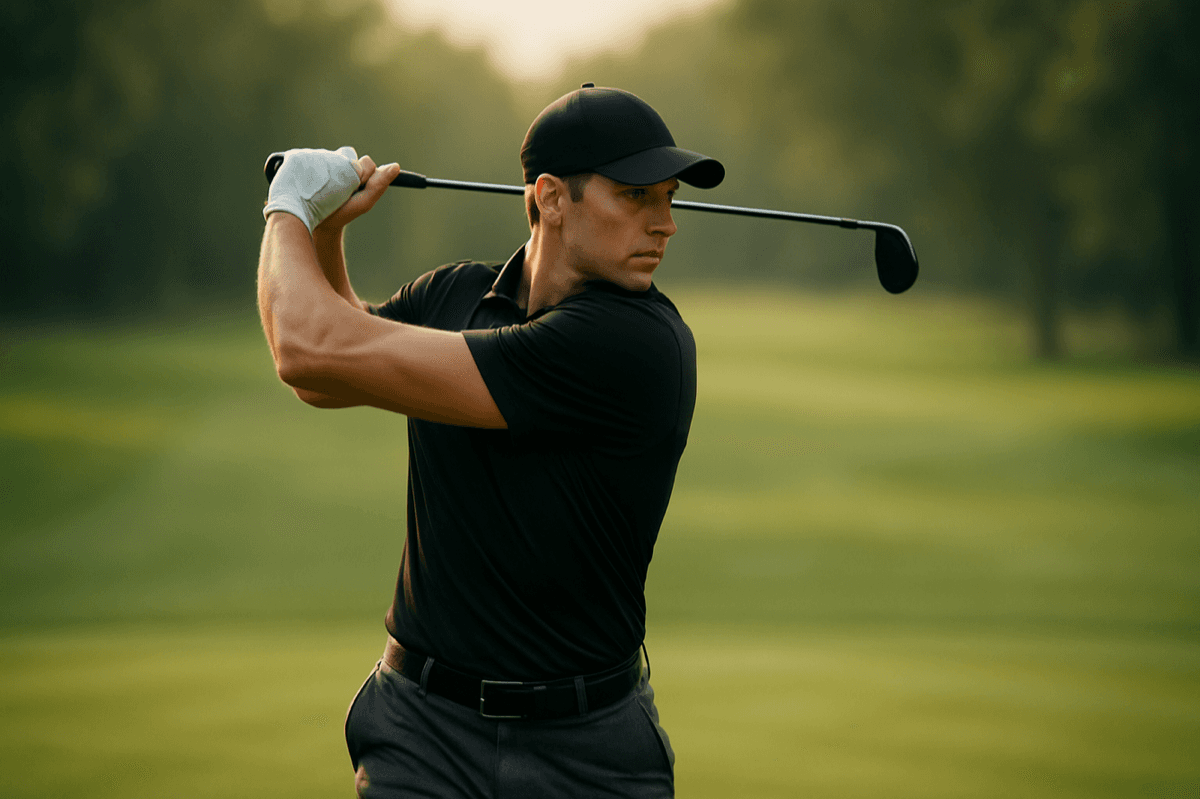
Golf may look like a low-impact sport, but it places more demand on thoracic rotation than almost any other athletic movement. If your thoracic spine can't rotate freely, your lower back will compensate on every single swing, and the lower back is not designed to be the primary rotator. The result is one of the most common injury patterns in sports.
The Specific Structural Changes
T-spine restriction forces lumbar compensation
The golf swing requires approximately 90 degrees of thoracic rotation. Most people who sit at desks all day have 30–40 degrees. The gap has to come from somewhere, and it comes from the lumbar spine, which is anatomically built for forward-backward motion, not rotation. Every swing compounds this compensation.
Hip mobility determines swing plane
The hip turn in the backswing and the hip drive through impact require full hip external rotation on both sides. Tight hip flexors (from sitting) limit this rotation and force the spine to make up the difference, again through the lumbar, where damage accumulates.
Lead hip takes asymmetrical load
The left hip (for right-handed golfers) is the pivot point for thousands of swings. Without specific hip mobility work, it progressively loses external rotation range, the exact motion the golf swing demands most. This is the root of most golfer's hip pain.
Cervical strain from address and ball tracking
The address position holds the neck in a downward flexed position for hours of practice. Ball tracking involves quick cervical rotation at high speed. Over years of rounds, this creates cervical tightness and restriction that affects the entire upper kinetic chain.
Common Injuries in Golf
These aren't random injuries. They're the predictable result of the structural patterns golf creates.
- Lower back disc herniation
- Lumbar stress fractures
- Lead hip labral tears
- Golfer's elbow (medial epicondylitis)
- Cervical disc compression
- Rib stress fractures (from rotation load)
Why posture matters for performance
Thoracic rotation is swing rotation. Every degree of additional T-spine mobility translates directly into club head speed. Hip mobility creates the ground-force transfer that drives power. Golf is a precision sport built on postural foundations, the better your structure, the more consistent your ball striking.
The Golf Program
The Golfer's Posture Fix unlocks thoracic rotation, opens bilateral hip mobility, addresses the lead-hip loading pattern, and restores cervical alignment from the address position. Most golfers feel the difference in their backswing within 2 weeks.
What Golf Athletes Actually Deal With
These are the injuries and pain patterns that come up in every golfforum, group ride conversation, and training camp. Here's how each one connects back to structural alignment, and what you can do about it.
Golfer's back, lumbar disc and facet pain from the swing
The golf swing is a violent rotation that compresses the lumbar spine at impact. Amateur golfers who lead with the lower back rather than the hips, because their thoracic rotation is limited, put enormous shear force on the lumbar discs and facets. "Golfer's back" is one of the most common sports injuries in the 40+ demographic.
Posture connection: Lower back pain in golfers almost always involves limited thoracic rotation, when the thoracic spine can't rotate freely, the lumbar spine compensates. Restoring thoracic rotation is the single most impactful structural intervention for golf-related back pain, because it allows the rotation to happen where it's supposed to rather than where it shouldn't.
Lead hip impingement from downswing rotation
The lead hip (left hip for right-handed golfers) moves into internal rotation and extension at the bottom of the downswing, a demanding range that, combined with thousands of practice swings, loads the hip labrum and anterior hip capsule. Many golfers describe a "clicking" or "catching" in the lead hip that worsens through a round.
Posture connection: Hip impingement in the lead side is directly related to hip flexor tightness and anterior pelvic tilt. When the pelvis is tilted forward, the femoral head sits more anteriorly in the socket, and the impingement at internal rotation becomes more pronounced. Hip flexor release and neutral pelvic positioning reduce the compressive force in the downswing.
"Golfer's elbow" (medial epicondylitis)
Despite the name, golfer's elbow affects plenty of non-golfers, but in golfers it develops from the wrist flexion load at impact and the grip forces through the swing. The medial epicondyle becomes inflamed and tender to touch. High handicappers who hit the ground frequently are especially prone because of the impact shock transmitted to the elbow.
Posture connection: Golfer's elbow is often worsened by forward shoulder posture. When the shoulders are internally rotated and rounded, the forearm pronation pattern through the swing changes, placing more stress on the medial structures. Restoring shoulder alignment and thoracic extension changes the arm mechanics in the swing.
Loss of distance from thoracic restriction
The 19-handicap golfer who can't break 90 despite constant practice often has a thoracic spine that won't rotate past 30 degrees. Distance comes from clubhead speed, which comes from rotational velocity, which comes from thoracic mobility. Golfers who gain thoracic rotation often gain 20-30 yards without changing their swing at all.
Posture connection: Thoracic rotation is the primary physical determinant of swing speed in players who aren't limited by strength. corrective thoracic rotation work specifically addresses the facet joint restrictions that accumulate from sedentary work and previous injury, restoring the mobility that's been lost rather than building new strength on a restricted foundation.
Questions from the Golf Community
Why does my lower back hurt after 18 holes even when I walk and use a trolley?
Walking 18 holes doesn't cause golf back pain, the swing does. Specifically, the lumbar spine loading that occurs when thoracic rotation is limited and the low back compensates. Four hours of swinging with this compensation pattern is a substantial dose of lumbar stress. Thoracic mobility work is the fix.
My pro says my backswing is restricted. Is that a flexibility issue or something else?
Usually something else. A restricted backswing is almost always a thoracic rotation and hip mobility problem, not a flexibility deficiency you can stretch away. The thoracic spine needs to be able to rotate 45+ degrees in each direction for a full backswing, and years of desk work progressively limit this. Structural work restores this rotation.
Why do I keep injuring my lead hip even though I've had a swing lesson?
Because the swing lesson addresses what the hip does in the swing, not why it can't do it without pain. Lead hip impingement is a structural issue, the hip flexors on the lead side are often tight, the pelvis is tilted forward, and the hip joint is compressed in the impact position. Structural hip work addresses the cause rather than the movement pattern.
Can I improve my golf posture without changing my swing?
Yes, and better structural alignment often improves the swing without any technique work. Setup posture in golf depends on being able to hinge at the hip with a neutral spine. When the hip flexors are tight and the thoracic spine is rounded, achieving address position requires compensations. Fix the structure, and the setup often corrects itself.
Why does my back get worse with more practice, not better?
More practice means more reps of the compensation pattern that's causing the pain. If your swing relies on lumbar rotation because thoracic rotation is limited, every swing adds to the cumulative disc stress. More practice makes the structural problem worse until the underlying mobility restriction is addressed.
Frequently Asked Questions
I play 3–4 times a week. How does this fit in?
The program takes 15 minutes. The best time is the morning before a round or the evening after. Consistent daily work compounds, occasional work doesn't.
Will this actually add yards?
If your swing is currently limited by T-spine rotation or hip mobility, which it almost certainly is, yes. More rotation range equals more swing arc. More swing arc equals more club head speed.
I have a bad back. Is this safe?
The program is designed to decompress and restore, not load. The static back and thoracic work are specifically chosen to be gentle on the lumbar spine while addressing the structures that are causing it stress.
Written by Mike Boshnack
Corrective Exercise Specialist · Posture Guy Mike
Mike Boshnack grew up skateboarding and surfing, trained MMA, and rode road bikes competitively, before a shoulder injury put him on a path to postural correction. He's since helped thousands of athletes fix the specific postural patterns their sport creates, without surgery or passive treatments.
The mobile app is here.
Do your program on your phone, anywhere. Download free on iPhone or Android, or keep using it in your browser.
Related Conditions