
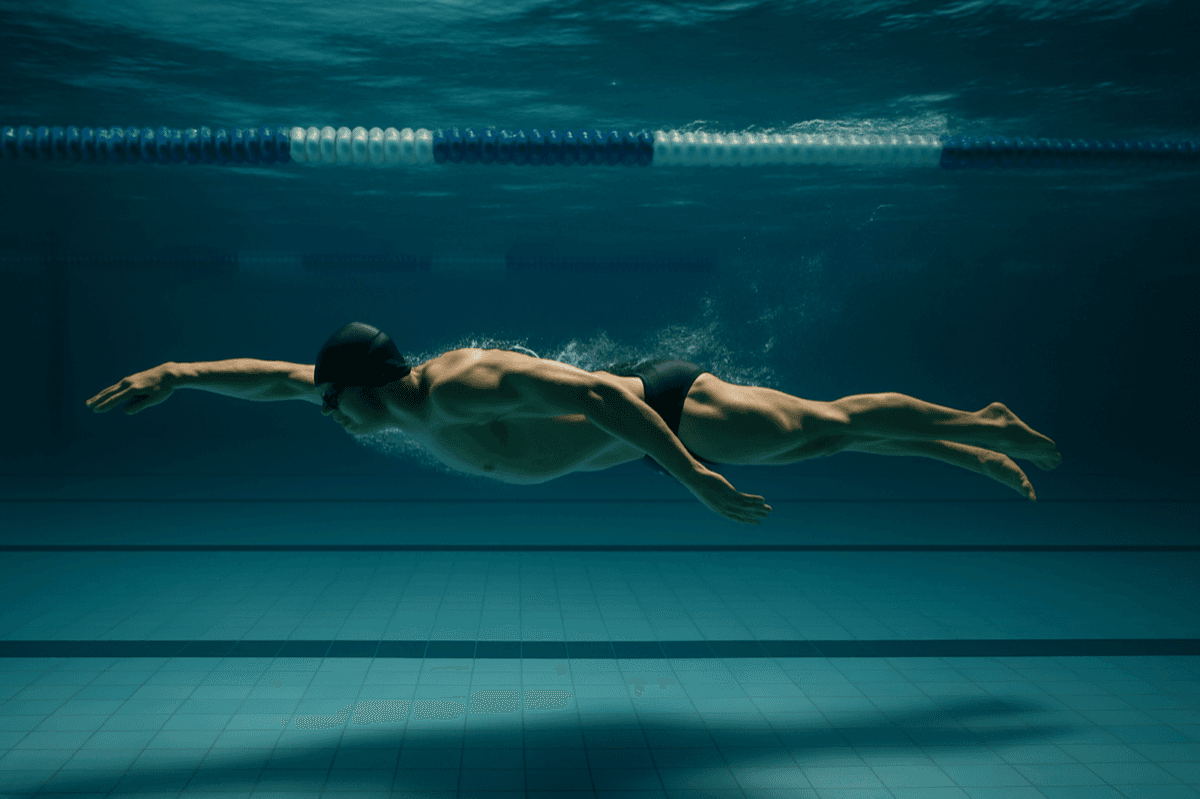
Swimming & Posture
Pull-dominant shoulder pattern, thoracic kyphosis, internal rotation
Updated May 2025
What Swimming Does to Your Body
Competitive swimming is almost entirely a pulling sport. Freestyle, backstroke, butterfly, every lap trains the lats, pec minor, and subscapularis in internal rotation. Without opposing work, the result is the classic swimmer's posture: rounded shoulders, forward head, and a thoracic spine that can't extend.
The Specific Structural Changes
Pulling dominance creates internal shoulder rotation
Every freestyle stroke pulls the arms through an internally rotated pattern. Over hundreds of thousands of meters, this builds the pulling muscles at the expense of the external rotators. The result is the characteristic swimmer's shoulder: internally rotated, forward-positioned, and vulnerable to impingement.
Thoracic spine loses extension from prone position
Competitive swimmers spend hours in a prone position with the spine in slight flexion. Combined with the pulling muscle dominance, the thoracic spine progressively loses its ability to extend, creating a kyphosis that follows swimmers out of the pool.
Breathing pattern affects thoracic mobility
Bilateral breathing in freestyle requires thoracic rotation, but only in the pattern dictated by the stroke. Swimmers who breathe predominantly to one side develop a thoracic rotation asymmetry that mirrors what tennis players and baseball pitchers develop.
Common Injuries in Swimming
These aren't random injuries. They're the predictable result of the structural patterns swimming creates.
- Shoulder impingement (swimmer's shoulder)
- Rotator cuff tears
- Pec minor syndrome (thoracic outlet compression)
- Cervical disc issues from breathing rotation
- Knee pain in breaststrokers
Why posture matters for performance
Thoracic extension is stroke length. A swimmer who can extend the thoracic spine reaches further on every stroke. Shoulder external rotation strength determines how long the rotator cuff lasts at high volume. Pool time builds the dysfunction, land time has to address it.
The Swimming Program
The Swimmer's Posture Program restores thoracic extension, balances the pull-dominant shoulder pattern, addresses bilateral rotation asymmetry, and builds the posterior chain strength that the freestyle pattern never trains.
What Swimming Athletes Actually Deal With
These are the injuries and pain patterns that come up in every swimmingforum, group ride conversation, and training camp. Here's how each one connects back to structural alignment, and what you can do about it.
Swimmer's shoulder (rotator cuff impingement from freestyle)
Swimmer's shoulder is the collective term for shoulder pain in swimmers, and it affects up to 70% of competitive swimmers. The repetitive overhead pulling motion, 10,000+ strokes per week for serious swimmers, trains the internal rotators without adequate external rotation balance. The subacromial space narrows progressively and the rotator cuff gets impinged on every entry.
Posture connection: Swimmer's shoulder is a thoracic kyphosis problem as much as a shoulder problem. The pulling motion progressively rounds the upper back, which tips the scapula forward and narrows the subacromial space. Thoracic extension and posterior shoulder strengthening maintains the structural space the cuff needs to function without impingement.
"Swimmer's neck", cervical pain from bilateral breathing
Competitive swimmers rotate to breathe on a dominant side, and over hundreds of thousands of breathing repetitions, this creates measurable cervical rotation asymmetry. The suboccipital muscles on the non-breathing side develop dominant tone, and the cervical spine loses rotation range in the non-dominant direction. Neck pain is common, headaches are common, and nobody connects them to breathing mechanics.
Posture connection: Cervical rotation asymmetry from breathing mechanics is addressable through cervical mobility work that specifically targets the non-dominant rotation direction. Bilateral breathing training helps, but for masters swimmers or those with established asymmetry, structural cervical work restores the rotation balance.
Hip flexor overuse from flutter and dolphin kick
The flutter kick is a hip flexor-dominant movement, the hip flexes to initiate the downbeat and the hip extensors passively decelerate the leg. Hours of flutter kick progressively shortens the hip flexors, creating anterior pelvic tilt that persists out of the pool. Butterfly swimmers have this even more acutely from the repetitive hip flexion of the dolphin kick.
Posture connection: Hip flexor shortening from kicking mechanics creates the same anterior pelvic tilt and lumbar loading pattern seen in cyclists and desk workers. The mechanism is different but the structural outcome is similar: shortened hip flexors tip the pelvis forward and chronically load the lumbar spine. Hip flexor lengthening work is equally important for swimmers as for any other athlete.
Questions from the Swimming Community
Is it normal for my neck to hurt after swimming?
Common, but not normal. Neck pain after swimming usually comes from breathing mechanics and the cervical position during freestyle. Rotating to breathe places asymmetrical load on the cervical spine, and if you breathe on one side, this asymmetry compounds over thousands of repetitions. Cervical rotation work and addressing the structural asymmetry resolves it.
Why do my shoulders hurt when I swim high mileage but feel fine otherwise?
High mileage means high repetition of the internal rotation pulling pattern, which progressively tightens the pec minor and anterior shoulder without adequate posterior counter. The pain at high mileage is the cumulative effect reaching the impingement threshold. Posterior shoulder and thoracic extension work raises that threshold.
Can swimming improve posture or does it make it worse?
Recreational swimming has mixed postural effects, the water decompresses the spine, but the freestyle pulling motion trains the thoracic kyphosis pattern over time. Competitive swimming volume consistently worsens thoracic kyphosis and forward head posture. The fix is not to swim less but to add corrective work that addresses what the sport creates.
Frequently Asked Questions
When should I do this, before or after practice?
After practice is ideal. The thoracic extension work is most effective when the body is warm. It also accelerates recovery for the next session.
I have shoulder impingement. Is this safe?
The program avoids overhead loading. The scapular work and thoracic extension directly address the underlying cause of most swimmer's impingement. Consult your physio for timing if post-surgical.

Written by Mike Boshnack
Corrective Exercise Specialist · Posture Guy Mike
Mike Boshnack grew up skateboarding and surfing, trained MMA, and rode road bikes competitively, before a shoulder injury put him on a path to postural correction. He's since helped thousands of athletes fix the specific postural patterns their sport creates, without surgery or passive treatments.
The mobile app is here.
Do your program on your phone, anywhere. Download free on iPhone or Android, or keep using it in your browser.
Related Conditions