
Basketball & Posture
Hip flexors, ankle instability, thoracic compression
Updated May 2025
What Basketball Does to Your Body
Basketball players are explosive athletes who run, jump, cut, and defend at high intensity, and most of them carry chronic hip flexor tightness, ankle instability, and thoracic compression that limits their athleticism and predisposes them to injury. The sport demands structural integrity that the sport itself gradually erodes.
The Specific Structural Changes
Constant sprinting and cutting compresses the hip flexors
Basketball players sprint and cut hundreds of times per game. Every sprint loads the hip flexors in flexion. Without systematic lengthening work, the hip flexors progressively shorten, the pelvis tips forward, and the lower back takes load it shouldn't.
Jumping and landing stress the ankles and knees
The vertical demand of basketball, jump balls, rebounding, shot-blocking, places repeated eccentric load on the patellar tendon and ankle. Ankle sprains are the most common injury in basketball, and they occur more frequently when the ankle lacks mobility and the hip lacks stability.
Taller players develop forward head from looking down
This sounds counterintuitive, but very tall players habitually look down at shorter opponents, officials, and conversation partners for years. This trains a forward head pattern that affects the entire upper kinetic chain.
Defensive stance loads the hips and lower back
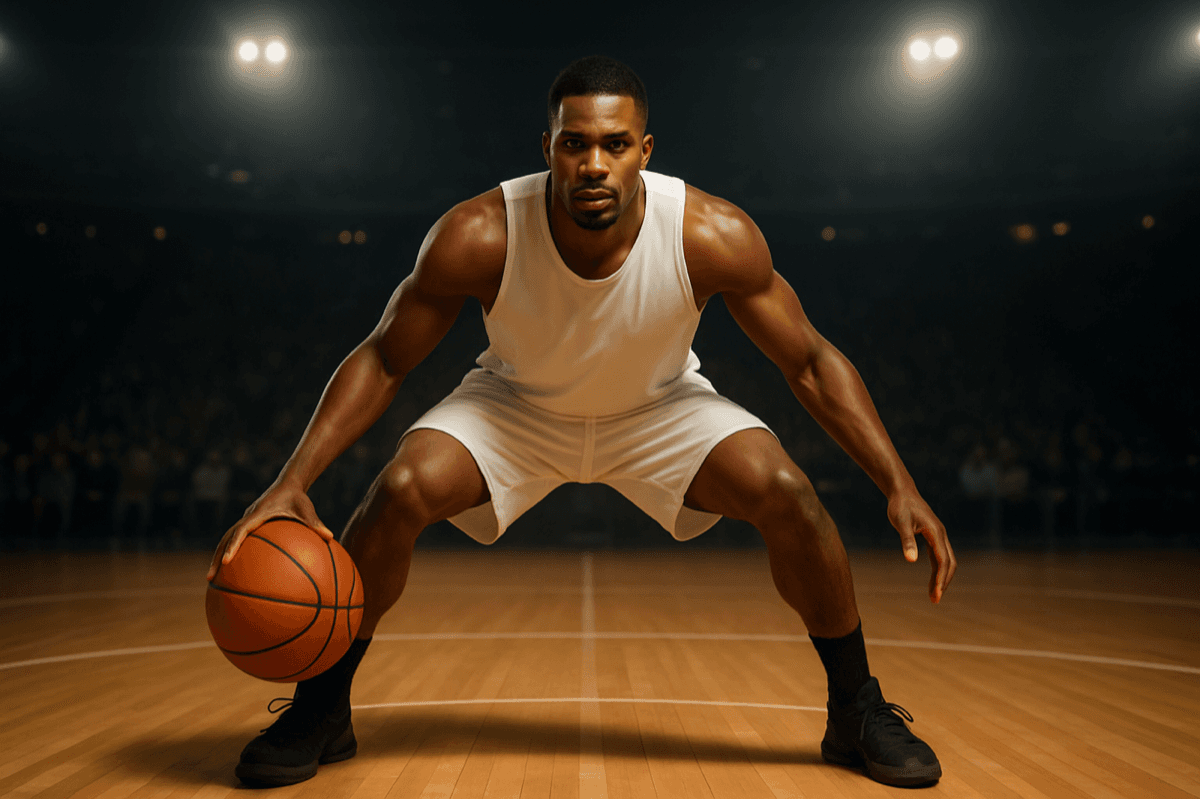
The defensive stance, feet wide, hips low, spine forward, is a sustained hip flexion position. Defenders in this stance for extended possessions are essentially doing sustained hip flexor loading without any corrective counterbalance.
Common Injuries in Basketball
These aren't random injuries. They're the predictable result of the structural patterns basketball creates.
- Ankle sprains
- Patellar tendinitis (jumper's knee)
- Hip flexor strains
- ACL tears
- Lower back pain
- Achilles tendinitis
Why posture matters for performance
A basketball player with proper hip alignment generates more explosive first-step power. Better ankle mobility means more stable landings and fewer sprains. Thoracic mobility translates directly into more efficient shoulder rotation for shooting mechanics. Posture is the foundation of athleticism.
The Basketball Program
The Basketball Player's Posture Fix targets the hip flexors, ankle mobility, thoracic spine, and cervical alignment, the four areas that basketball progressively degrades.
What Basketball Athletes Actually Deal With
These are the injuries and pain patterns that come up in every basketballforum, group ride conversation, and training camp. Here's how each one connects back to structural alignment, and what you can do about it.
Jumper's knee (patellar tendinopathy)
Patellar tendinopathy is the basketball injury that ends seasons, the progressive pain just below the kneecap that worsens with jumping and squatting. It's a load-tolerance failure of the patellar tendon, developing when jumping volume exceeds the tendon's capacity to recover. NBA players call it the "career-ender in waiting" because it rarely resolves with rest alone.
Posture connection: Patellar tendinopathy is dramatically worse with anterior pelvic tilt. When the pelvis tips forward, the quadriceps are placed in a mechanically disadvantaged position that increases tendon stress on every jump landing. Neutralizing pelvic position through hip flexor release and gluteal activation reduces patellar tendon load measurably.
Ankle sprains (the basketball injury)
Basketball has the highest ankle sprain rate of any team sport. Coming down on another player's foot, landing on a plantarflexed ankle in inversion, is the mechanism. After the first sprain, the ligaments are compromised and the proprioception is impaired, making re-sprain significantly more likely. Many basketball players develop chronic ankle instability.
Posture connection: Ankle sprain prevention is fundamentally a proprioception and hip control problem. When the hip doesn't stabilize the pelvis on landing, the ankle compensates for the instability, increasing the likelihood of inversion injury. Single-leg landing mechanics and hip stability work changes the neuromuscular response to off-balance landing situations.
Achilles tendon rupture (especially in 30+ players)
The Achilles rupture is the devastating injury, often described as someone kicking the back of the leg. It disproportionately affects players in their 30s who have reduced tendon collagen quality but maintain high-intensity play. The Achilles is the most loaded tendon in the body, and basketball's explosive stop-start demands are specifically what causes rupture.
Posture connection: Achilles tendon load is increased by forward trunk lean (which increases push-off demand), hip flexor tightness (which reduces hip extension and overloads the calf-Achilles), and reduced ankle dorsiflexion. All three are addressable structural issues that reduce tendon stress without limiting performance.
Questions from the Basketball Community
Why does my knee hurt when I jump but not when I walk?
Jumping-specific knee pain is almost always patellar tendon-related, the tendon can handle walking loads but fails under the higher forces of jumping and landing. The key variable is pelvic position: anterior pelvic tilt increases quad dominance in landing mechanics, overloading the patellar tendon. Addressing the hip and pelvic alignment changes the landing mechanics.
My ankle keeps rolling even with high-top shoes and taping. What do I do?
External support helps, but it doesn't restore the internal proprioception that prevents rolling before it starts. The ankle needs to be able to sense and respond to instability faster than the sprain occurs, which requires retraining the neuromuscular system through progressive single-leg balance and perturbation training.
Why do I feel stiff and slow in the first quarter but fine after that?
Early-session stiffness in basketball players is often thoracic restriction combined with hip flexor tightness from sitting. The warm-up gradually overcomes these structural limitations. Players who address thoracic mobility and hip flexor length structurally often report feeling "ready" from the opening tip rather than needing a quarter to get going.
Frequently Asked Questions
When is the best time to do this during a basketball season?
The most effective time is after practice or games when the body is warm. It functions as active recovery and reduces next-day stiffness.
I have jumper's knee. Can this help?
Patellar tendinitis is usually driven by anterior pelvic tilt and hip flexor tightness that overloads the quad. The hip work in this program directly addresses the structural root.

Written by Mike Boshnack
Corrective Exercise Specialist · Posture Guy Mike
Mike Boshnack grew up skateboarding and surfing, trained MMA, and rode road bikes competitively, before a shoulder injury put him on a path to postural correction. He's since helped thousands of athletes fix the specific postural patterns their sport creates, without surgery or passive treatments.
The mobile app is here.
Do your program on your phone, anywhere. Download free on iPhone or Android, or keep using it in your browser.
Related Conditions