
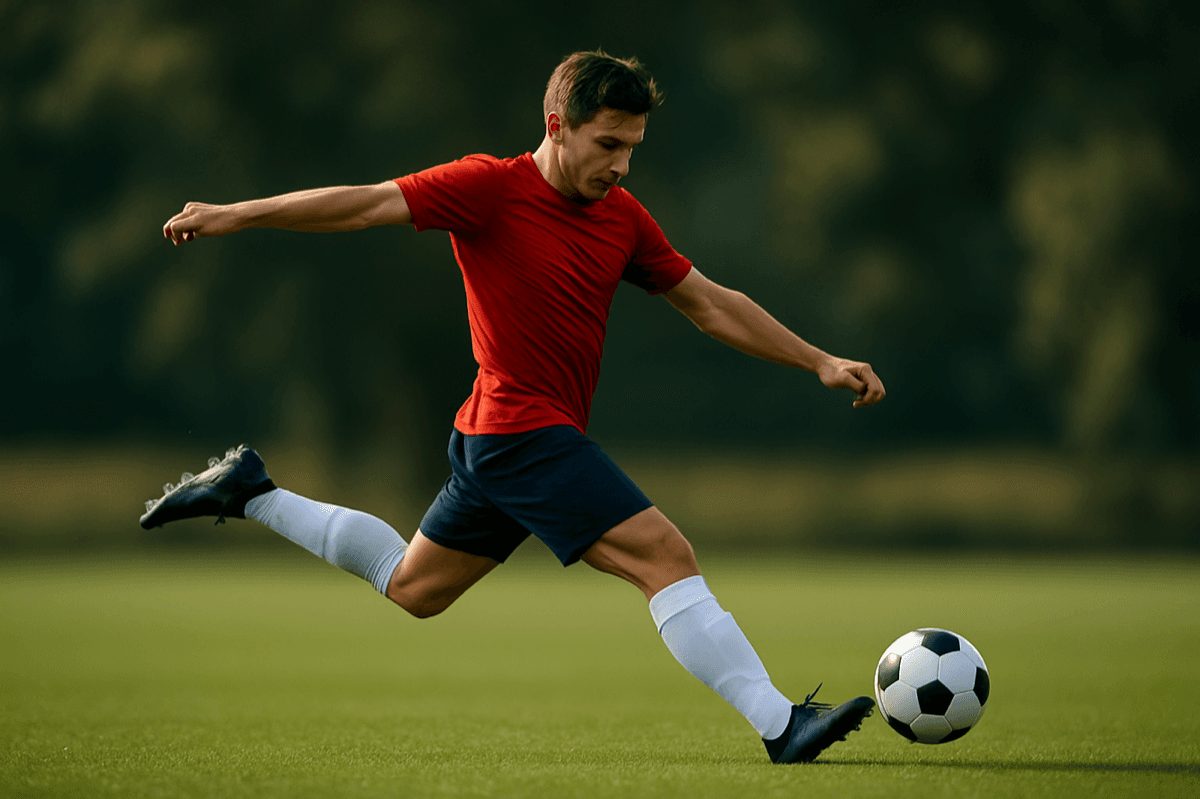
Soccer & Posture
Anterior pelvic tilt, hip asymmetry, ankle instability
Updated May 2025
What Soccer Does to Your Body
Soccer players run 7–9 miles per game and execute thousands of kicking, cutting, and striking movements that bias the hip in one direction, the dominant side. Over a career, this creates anterior pelvic tilt, tight hip flexors, asymmetrical hip rotation, and ankle instability that lead to the groin, hamstring, and lower back injuries that end seasons.
The Specific Structural Changes
Anterior pelvic tilt from high-volume running
Running at soccer intensity for 90 minutes trains the hip flexors into shortening. Most soccer players sit between training and games, compounding the problem. The result is a chronically tilted pelvis that loads the lower back on every stride and inhibits the glutes.
Dominant leg kicking creates hip asymmetry
The dominant leg drives thousands of kicks per season. The hip flexors and adductors of the kicking leg are stronger and tighter than the non-dominant side. This bilateral asymmetry in hip mobility is a direct precursor to groin strains, which are the most common soccer injury.
Ankle instability from high-speed direction changes
Soccer requires rapid deceleration and direction change on unpredictable surfaces. Without adequate ankle dorsiflexion and arch control, the ankle rolls, creating the sprain cascade that affects stability up the entire kinetic chain.
Common Injuries in Soccer
These aren't random injuries. They're the predictable result of the structural patterns soccer creates.
- Groin strains
- Hamstring tears
- Ankle sprains
- ACL tears
- Hip flexor injuries
- Lower back pain
- Shin splints
Why posture matters for performance
Hip mobility is passing power. Ankle stability is change-of-direction speed. Bilateral hip symmetry is injury prevention. The most durable and explosive soccer players are the ones who address the structural patterns the sport creates.
The Soccer Program
The Soccer Player's Posture Fix targets anterior pelvic tilt, bilateral hip rotation, ankle mobility, and single-leg stability, the foundational structure for safe, powerful soccer.
What Soccer Athletes Actually Deal With
These are the injuries and pain patterns that come up in every soccerforum, group ride conversation, and training camp. Here's how each one connects back to structural alignment, and what you can do about it.
Sports hernia / "footballer's groin" (athletic pubalgia)
The footballer's groin, technically athletic pubalgia, is a chronic groin and lower abdominal pain that's notoriously difficult to diagnose. It develops from the repetitive kicking motion placing enormous stress on the pubic symphysis and the soft tissue attachments around it. Professional players often play through it for months before it's identified.
Posture connection: Athletic pubalgia is worsened by anterior pelvic tilt, the tilted pelvis changes the angle at which the adductors and abdominals attach to the pubis, increasing stress at the symphysis with every kick. Pelvic neutral positioning and specific hip strengthening reduces the asymmetric loading that leads to this injury.
Hamstring tears (the sprint injury)
Soccer hamstring tears happen in the same way every time: explosive sprint acceleration, usually in the second half of a match when fatigue is high. The hamstring has to both extend the hip and decelerate the lower leg, a massive demand that exceeds the tissue's capacity when it's already fatigued and structurally compromised by anterior pelvic tilt.
Posture connection: Anterior pelvic tilt places the hamstring in a chronically lengthened position, which means it's already working near end range before the sprint even begins. Players with anterior pelvic tilt have significantly higher hamstring injury rates. Pelvic position correction is the most impactful structural intervention for hamstring tear prevention.
Heading-related cervical pain and concussion accumulation
Heading is increasingly discussed as a cumulative trauma concern in soccer. Beyond concussion risk, the repetitive cervical loading from heading, especially contested headers where the neck absorbs impact from multiple directions, creates cervical disc stress and suboccipital tightness over a career.
Posture connection: The cervical spine's ability to absorb heading impact is significantly reduced by forward head posture, the head sits farther forward of the center of gravity, increasing the lever arm on the cervical vertebrae. Deep neck flexor strengthening and cervical retraction work both improves heading mechanics and reduces disc loading.
Questions from the Soccer Community
Why do soccer players get so many hamstring injuries?
Sprint-speed hamstring demands combined with anterior pelvic tilt from hip flexor tightness is the primary answer. The kicking motion itself progressively shortens the hip flexors on the dominant side, tilting the pelvis and placing the hamstring in a chronically lengthened, vulnerable position. This is why hamstring injury rates in soccer are highest in the second half when fatigue amplifies the structural compromises.
I have chronic groin pain that my doctor can't explain. Could this be from soccer?
Chronic groin pain in soccer players that doesn't have a clear diagnosis is often athletic pubalgia (sports hernia) or hip flexor pathology. Both are directly related to the repetitive kicking motion and its effect on pelvic alignment. Getting a specific diagnosis from a sports medicine doctor familiar with athletic pubalgia is important before starting any treatment program.
Why does one hip feel tighter than the other from playing soccer?
The dominant leg kicking pattern creates asymmetrical hip flexor loading, the dominant side hip flexors are trained harder and shorter than the non-dominant side. This creates a measurable pelvic tilt toward the dominant side. Bilateral hip flexor work that specifically addresses the dominant side asymmetry restores pelvic level.
Frequently Asked Questions
I play year-round. Is daily posture work necessary?
Year-round play without corrective work is the highest-risk scenario. Daily 15-minute sessions are the minimum investment to stay structurally healthy through a full season.
Will this help prevent groin injuries?
Groin strains in soccer are almost always preceded by hip asymmetry and anterior pelvic tilt. The program directly addresses both.

Written by Mike Boshnack
Corrective Exercise Specialist · Posture Guy Mike
Mike Boshnack grew up skateboarding and surfing, trained MMA, and rode road bikes competitively, before a shoulder injury put him on a path to postural correction. He's since helped thousands of athletes fix the specific postural patterns their sport creates, without surgery or passive treatments.
The mobile app is here.
Do your program on your phone, anywhere. Download free on iPhone or Android, or keep using it in your browser.
Related Conditions