
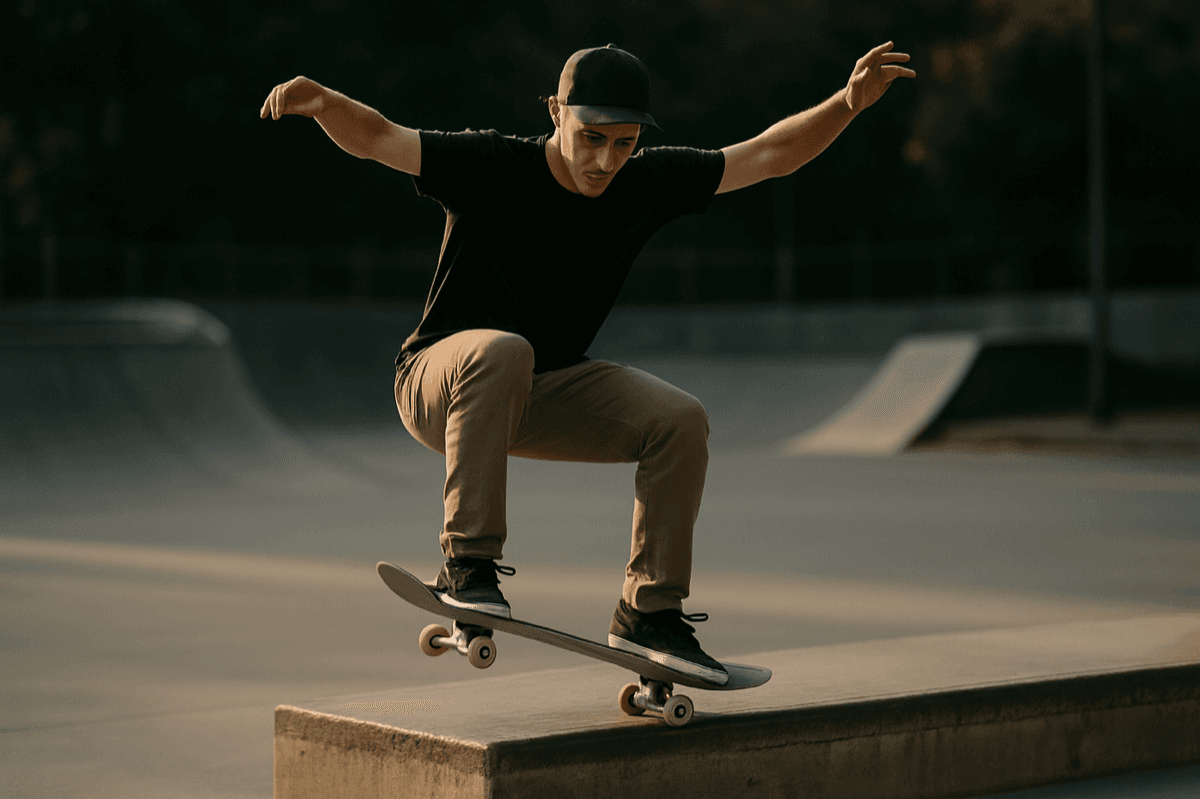
Skateboarding & Posture
Hip compression, ankle instability, and thoracic collapse
Mike grew up skating. This program is personal.
Updated May 2025
What Skateboarding Does to Your Body
Skateboarding is one of the most physically demanding action sports in the world. The combination of explosive movement, impact absorption, asymmetrical stances, and years of repetitive training creates a unique set of postural dysfunctions that most skaters never address, until something breaks down.
The Specific Structural Changes
Hips compress from repeated impact
Every landing absorbs force through the hips, knees, and spine. Over time, the hip flexors shorten and the pelvis anteriorly tilts, loading the lumbar spine even when you're standing still. This is why many skaters complain of chronic lower back tightness.
Ankle mobility deteriorates
Skating's constant dorsiflexion demands on landing, combined with the stiff sole of skate shoes, gradually reduces ankle mobility. Less ankle mobility means the knee and hip have to compensate on every movement, a cascade that leads up the kinetic chain.
Thoracic spine locks into flexion
The forward-lean of the skating stance and the rounding that happens when absorbing trick impacts trains the thoracic spine into kyphosis. Skaters who have been at it for 10+ years often have a noticeable thoracic curve even when they're trying to stand upright.
One-sided dominance creates asymmetry
Your regular or goofy stance means one hip leads everything. The lead hip rotates internally on every trick, while the back hip does something different. Over thousands of repetitions, this creates measurable asymmetry in hip rotation range of motion between sides.
Common Injuries in Skateboarding
These aren't random injuries. They're the predictable result of the structural patterns skateboarding creates.
- Chronic lower back pain
- Hip flexor strains
- Knee pain (patellar tendinitis)
- Ankle instability and recurring sprains
- Shoulder impingement from arm-waving balance
- Wrist injuries from falls
Why posture matters for performance
Posture is the foundation of trick consistency. When your hips are compressed and your thoracic spine is locked, your body can't rotate properly through tricks. Skaters who fix their structural alignment report better balance, more consistent pop, and less chronic pain after sessions.
The Skateboarding Program
The Skateboarder's Posture Fix addresses hip compression, ankle mobility, thoracic rotation, and single-leg balance, the four specific areas skating degrades over time. No gym, no equipment. Just a floor and 15 minutes.
What Skateboarding Athletes Actually Deal With
These are the injuries and pain patterns that come up in every skateboardingforum, group ride conversation, and training camp. Here's how each one connects back to structural alignment, and what you can do about it.
Ankle sprains and chronic instability ("going over")
Every skater has rolled an ankle. The problem isn't the individual sprain, it's what happens after the fifth or sixth one. The ligaments stretch out, the ankle becomes chronically unstable, and the brain stops trusting it. Skaters compensate by subtly shifting weight away from the bad ankle on every landing, which loads the knee and hip asymmetrically for years.
Posture connection: Ankle instability is rarely just an ankle problem. The foot arch collapses to compensate, the knee rotates inward, and the hip drops on that side, a chain reaction that shows up as knee pain or hip flexor tightness long before anyone realizes the ankle started it. Restoring ankle strength and arch function through corrective exercise addresses the root of this cascade.
Wrist fractures from falls (distal radius)
Wrists take the fall every time. The instinctive FOOSH (fall on outstretched hand) response means the wrist absorbs impact that should spread through the whole body. After a fracture heals, the wrist mechanics are rarely the same, leading to compensations in elbow, shoulder, and even cervical positioning.
Posture connection: Post-fracture, the body guards the wrist by internally rotating the shoulder and rounding forward. This protective posture becomes structural if it's not addressed. Thoracic extension work and shoulder stabilization restore normal arm mechanics so the compensations don't become permanent.
Skater hip / hip impingement (FAI)
Femoroacetabular impingement is the thing most skaters have but don't know the name for. It's the deep groin pinch you feel at the bottom of a deep squat or when you ollie low and compress the hip. Years in the skating stance, hips flexed, internally rotated, absorbing impact, gradually changes the hip joint's load pattern.
Posture connection: FAI symptoms are dramatically reduced when the pelvis is in neutral, anterior pelvic tilt is the main driver that compresses the front of the hip joint. Hip flexor release and posterior chain activation bring the pelvis back to neutral and take the impingement pressure off the femoral head.
"Back knee" pain from stance asymmetry
Whether you're regular or goofy, your back knee does more work than the front. It's slightly bent on every trick, absorbs the initial pop, and takes more impact on heelside landings. Over years of skating, the back knee develops overuse patterns the front knee never sees, meniscus wear, patellar tracking issues, and chronic aching after long sessions.
Posture connection: Back knee overuse almost always traces to the hip above it. When the back hip is internally rotated (which the skating stance promotes), the femur rotates and the patella tracks laterally. Fixing the hip rotation pattern, not just stretching the knee, is what actually resolves chronic back-knee pain.
Thoracic kyphosis / hunched upper back from absorbing impacts
The protective instinct on every impact is to round forward, chin down, shoulders forward, core braced. This is smart for absorbing a bail. But after a decade of skating, the thoracic spine starts to live in this position all the time. Skaters who've been at it for 10+ years visibly carry their shoulders forward even when standing.
Posture connection: Thoracic kyphosis reduces rotational range, and rotation is everything in skateboarding, from kickflips to body varials. Thoracic extension work and posterior chain reactivation restore the chest-up position, which also improves balance and trick mechanics.
Questions from the Skateboarding Community
Why does my lower back hurt so much after a skate session?
The most common cause is anterior pelvic tilt from shortened hip flexors, the skating stance trains your hips into flexion, and over time they lose the ability to fully extend. When you're standing or walking, the pelvis tips forward and the lumbar spine compresses. Five sessions a week of this pattern, and the low back stays in a chronically loaded state. Addressing the hip flexors structurally, not just stretching them, is what actually fixes it.
Can skateboarding cause scoliosis or spine problems?
Skateboarding doesn't cause scoliosis, but it does create functional spinal asymmetry from one-sided stance loading. Regular skaters have measurable rotation differences between their hips, and over years this can create a functional scoliotic curve, where the spine appears curved because the pelvis is unlevel, not because of a structural deformity. This is fully addressable with corrective exercise.
Why do my tricks feel inconsistent even when I practice them constantly?
Trick inconsistency is often structural, not technical. If your hips are asymmetrical, one higher, one more internally rotated, your pop and rotation will vary based on which way the trick goes relative to your dominant side. Skaters who fix their hip alignment often report that previously inconsistent tricks suddenly "click" without additional practice.
My ankle keeps rolling even though I tape it. What's actually going on?
Taping supports the joint but doesn't restore the neuromuscular control that prevents rolling in the first place. Chronic ankle instability means the proprioceptive signals from the ankle are impaired, the brain isn't getting accurate feedback about where the foot is in space. Single-leg balance and foot intrinsic strengthening work restores this control.
Is the hip pain I get from skating something I just have to live with?
No. Most skating-related hip pain is either hip flexor tightness, anterior pelvic tilt compression, or early FAI, all of which respond well to corrective exercise. The key is addressing the structural cause rather than just treating the symptom. Skaters who work through hip-focused corrective programs report significant pain reduction within 4-6 weeks.
Frequently Asked Questions
Can this help with lower back pain from skating?
Yes. Most lower back pain in skaters comes from anterior pelvic tilt caused by shortened hip flexors. The program specifically targets hip flexor release and pelvic positioning.
How soon will I notice a difference?
Most skaters notice improved hip mobility within 1–2 weeks. Lower back pain typically improves within 3–4 weeks of consistent work.
Can I do this while still skating?
Absolutely, and you should. This program is designed to be done on off days or after sessions. It works with your skating, not against it.

Written by Mike Boshnack
Corrective Exercise Specialist · Posture Guy Mike
Mike Boshnack grew up skateboarding and surfing, trained MMA, and rode road bikes competitively, before a shoulder injury put him on a path to postural correction. He's since helped thousands of athletes fix the specific postural patterns their sport creates, without surgery or passive treatments.
The mobile app is here.
Do your program on your phone, anywhere. Download free on iPhone or Android, or keep using it in your browser.
Related Conditions