Prone T Raise
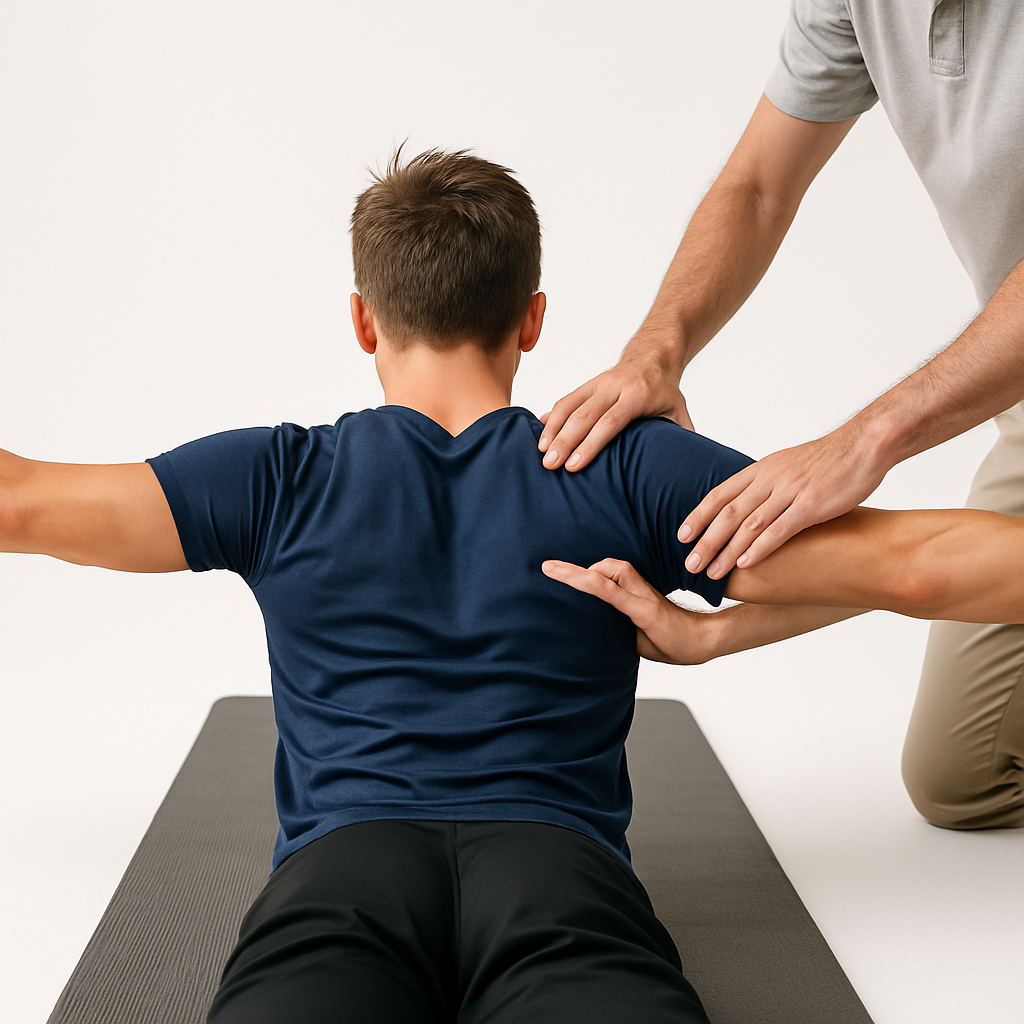
The prone T raise, or lying T raise, is a face-down exercise that strengthens your mid-traps and rhomboids to pull rounded shoulders back. With arms out in a T, squeeze your shoulder blades to lift your arms a few inches, pause, lower slowly, and do 3 sets of 12.
How to do it
- 1
1. Lie face down on a mat with your forehead resting on a towel roll or small pillow to keep your neck neutral.
- 2
2. Extend both arms out to the sides at shoulder height, forming a T shape with your body.
- 3
3. Engage your core and press your hips into the mat to stabilize your lower back.
- 4
4. Squeeze your mid-traps and rhomboids to lift both arms a few inches off the ground, leading with your thumbs.
- 5
5. Hold the top position for 1-2 seconds, then lower your arms back down with control.
- 6
6. Repeat for your target number of reps without jerking or using momentum.
Mike's coaching cues
- Roll up a towel and rest your forehead on it so your neck stays long and relaxed.
- Before you lift anything, engage your core and press your hips firmly into the mat.
- Squeeze like you're pinching a pencil between your shoulder blades, and let that squeeze lift your arms, not momentum.
- Don't shrug your shoulders up toward your ears, because that means your upper traps are doing the work.
- Lower slowly with control, stay patient, and feel it right between your shoulder blades.
Easier option
If lying face down is hard, do this standing while hinged slightly forward, or bend over a counter and raise your arms out to a T. Same muscles, easier setup.
Benefits
- Activates and strengthens mid-trap and rhomboid muscles to reverse rounded shoulder posture.
- Reduces upper back and neck tension by reinforcing proper scapular retraction patterns.
- Improves shoulder blade stability and posterior chain engagement for better postural alignment throughout the day.
Common mistakes
- Lifting arms too high or using your upper traps instead of your mid-traps, which defeats the purpose of correcting rounded shoulders.
- Arching your lower back or lifting your hips off the mat, which shifts load away from the target muscles.
- Moving too quickly or using momentum rather than controlled, deliberate contractions through the full range of motion.
Common questions
Is a prone T the same as a lying T raise?
Yes. Prone T, prone T raise, prone T lift and lying T raise all describe the same move: lying face down with your arms out in a T and lifting them by squeezing your shoulder blades.
What muscles does the prone T exercise work?
It targets your mid-traps and rhomboids, the muscles between your shoulder blades. It also builds shoulder blade stability, which is why it's used to correct rounded shoulders.
How many sets and reps of prone T raises should I do?
Do 3 sets of 12 reps, which takes about 2 minutes. Slow, controlled reps matter more than adding more of them.
Should I hold the prone T at the top?
Pause briefly at the top so you feel the squeeze between your shoulder blades, then lower with control. The goal is a deliberate contraction, not a long static hold.
Why do I feel prone T raises in my neck instead of my upper back?
You're probably shrugging or lifting your arms too high, which lets your upper traps take over. Keep your neck long, lift only a few inches, and think about pinching your shoulder blades together.
What if lying face down is uncomfortable?
Do it standing with a slight forward hinge, or bend over a counter and raise your arms out to a T. You work the same muscles with an easier setup.
Target areas
Used in these programs
Get the full guided program, with video walkthroughs for every exercise.
Find Your ProgramBrowse all programs →