Standing Hip Flexor March
Standing tall with hands at your sides, you alternately drive each knee upward toward your chest in a slow, controlled marching motion — emphasizing hip flexion strength and pelvis stability on the stance leg simultaneously. This exercise trains the hip flexors as prime movers while reinforcing upright spinal posture under dynamic load.
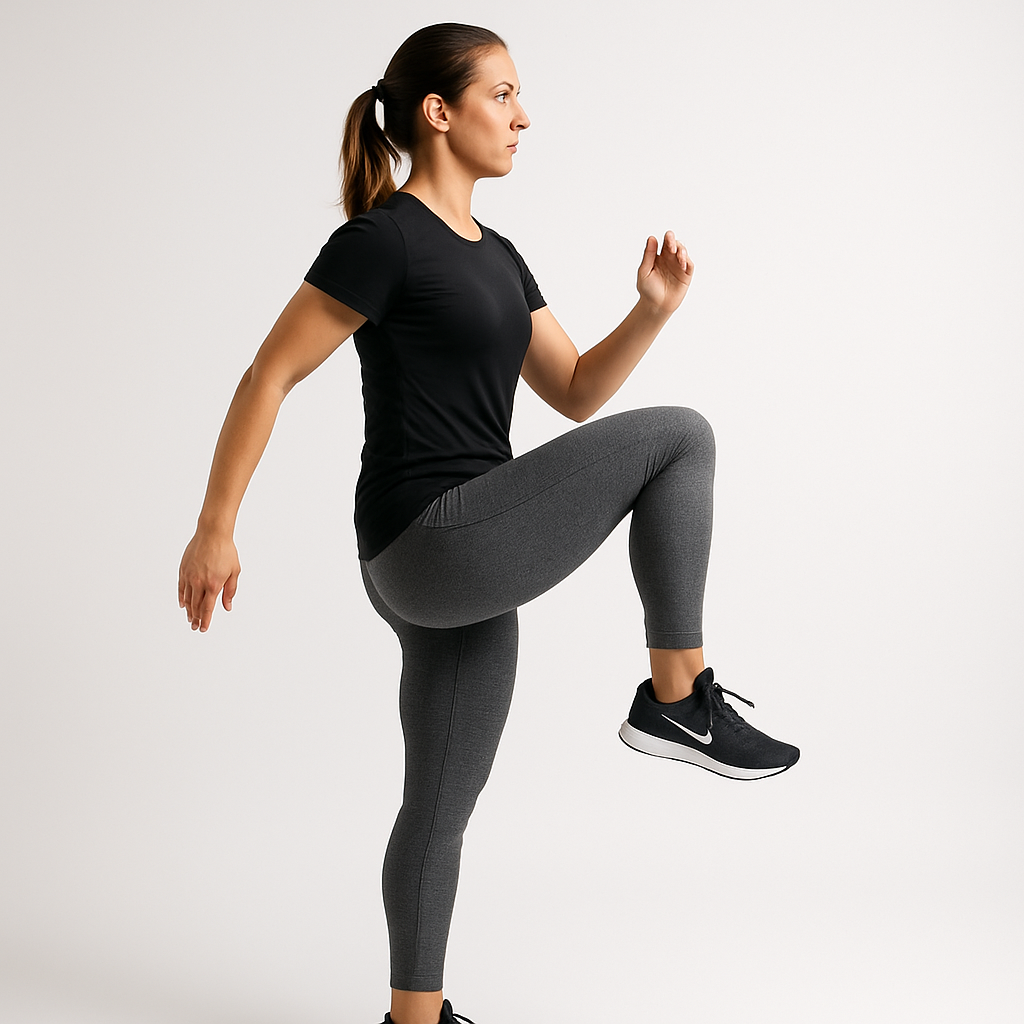
How to do it
- 1
1. Stand upright with feet hip-width apart, arms at your sides, and engage your core by gently drawing your navel toward your spine.
- 2
2. Shift your weight onto your right leg, ensuring your right knee stays slightly bent and your pelvis remains level.
- 3
3. Slowly drive your left knee upward toward your chest in a controlled manner, lifting it to a comfortable height (waist to chest level).
- 4
4. Lower your left leg back to the starting position with control, then repeat on the right side.
- 5
5. Continue alternating legs in a slow marching rhythm, maintaining an upright posture throughout and avoiding any forward lean or pelvic tilt.
- 6
6. Focus on stability in your stance leg while the opposite hip flexor actively lifts the moving leg.
Easier option
If marching feels unstable, hold a chair or counter with one hand and lift each knee only to a comfortable height. Steady beats high every time.
Benefits
- Strengthens hip flexors to counteract sitting-induced weakness, reducing anterior pelvic tilt and lower back strain.
- Improves dynamic spinal stability and posture control during movement, translating to better upright positioning throughout daily activities.
- Enhances single-leg balance and pelvic stability, reducing compensation patterns that contribute to hip and knee pain.
Common mistakes
- Leaning the torso forward or arching the lower back instead of maintaining neutral spine alignment throughout the movement.
- Moving too quickly or with momentum rather than performing slow, controlled lifts that fully engage the hip flexors.
- Allowing the pelvis to hike or rotate on the stance side, which reduces stability and diminishes the exercise's postural benefit.
Target areas
Good for
Used in these programs
Get the full guided program, with video walkthroughs for every exercise.
Find Your ProgramBrowse all programs →