
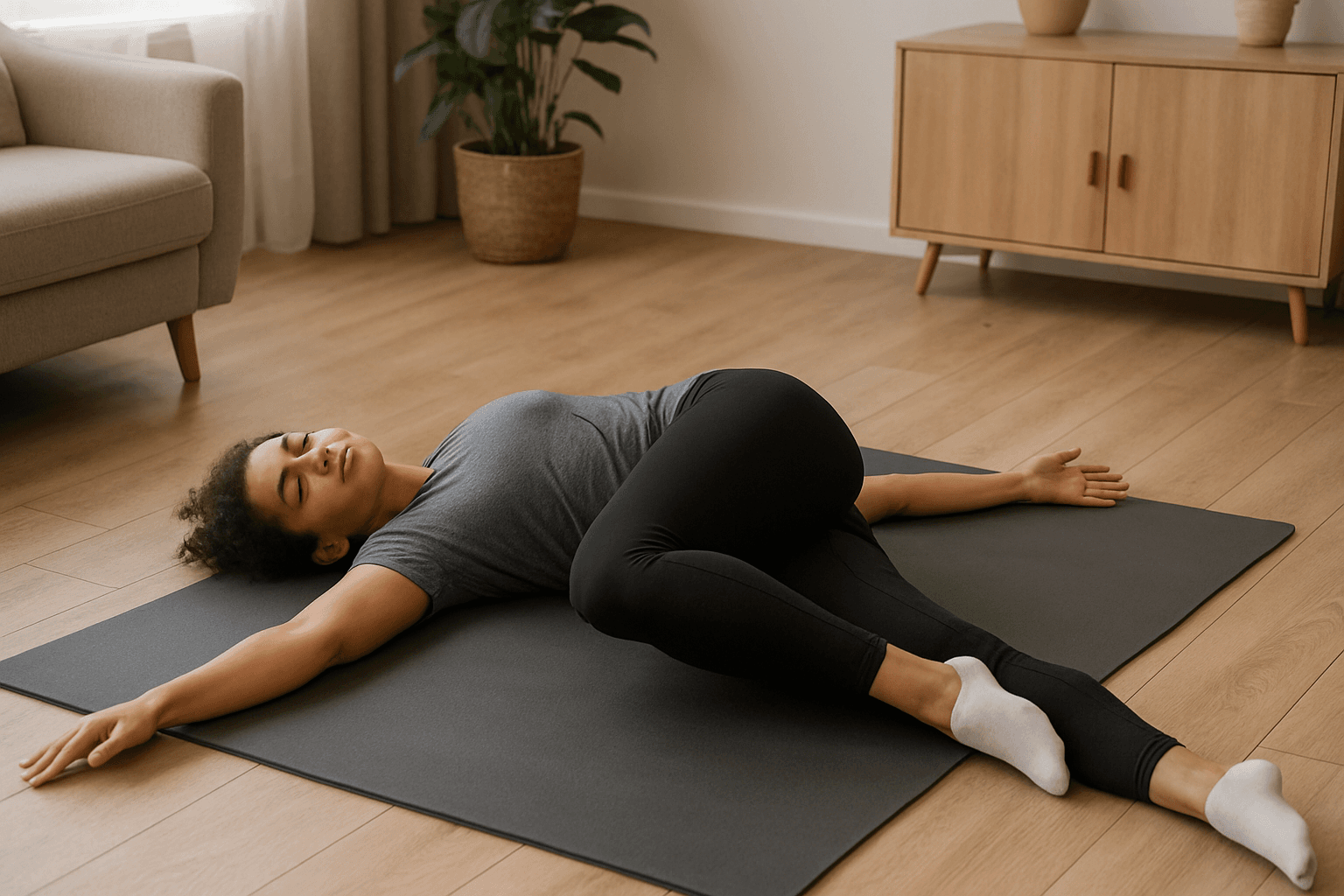
What the Hip Crossover Stretch Does
The hip crossover stretch is a supine rotational stretch that restores internal rotation range of motion in the hip joint and releases the deep external rotators of the hip, most notably the piriformis.
Here is why that matters: hip rotation is one of the first movement capacities to disappear in people who sit for a living. When you sit, your hips are locked in a flexed, non-rotating position for hours. The muscles that control rotation, particularly the deep external rotators on the back side of the hip, tighten and shorten. Over time, the hip joint loses its rotational range.
This lost rotation does not stay contained to the hip. The body has to rotate somewhere, so the lumbar spine picks up the slack. Every time you turn, twist, or walk, the lower back is doing rotational work that the hips should be handling. This is a primary driver of lower back pain, SI joint dysfunction, and even knee problems that seem unrelated to the hip.
The hip crossover stretch restores what sitting takes away. If the piriformis is the primary driver, this stretch is one of the most effective releases.
For the full exercise breakdown, visit the Hip Crossover Stretch exercise page.
Why Hip Rotation Matters for Posture
Most people think of posture as a front-to-back problem: head forward, shoulders rounded, back arched. But the rotational plane is just as important, and it is almost always overlooked.
Your pelvis needs to rotate freely during walking. Each stride involves a small rotation of the pelvis, and the hips need enough rotational range to absorb that movement. When the hips are locked up rotationally, the pelvis cannot rotate smoothly, and three things happen:
- The lower back compensates. It takes on rotational stress it was not designed to handle repeatedly under load.
- The gait shortens. The stride gets shorter because the hips cannot move through their full range, which changes how forces travel through the knees and ankles.
- The SI joint gets stressed. The sacroiliac joint sits right at the junction of the spine and pelvis. When the hips cannot rotate, the SI joint absorbs forces that should have been distributed across the hip, producing pain right at the base of the spine.
Restoring hip rotation with the crossover stretch addresses all three of these compensation patterns at their source.
How to Do It: Step-by-Step
Supine Hip Crossover (Primary Version)
- Lie on your back with both legs extended straight.
- Extend both arms out to your sides at shoulder height, palms down, to anchor your upper body.
- Lift your right leg and cross it over your body toward your left hand, keeping the leg as straight as comfortable.
- Let the right hip lift off the floor as the leg crosses over - this is where the rotation happens.
- Keep both shoulders pressed into the floor. The upper body stays anchored while the hips rotate.
- Lower the foot as close to the floor as your range of motion allows. You should feel a deep stretch in the right hip and glute area.
- Hold for 30 to 60 seconds, breathing slowly and allowing the hip to release deeper into the stretch with each exhale.
- Return the leg to the starting position slowly.
- Repeat on the other side.
Key Form Cues
Shoulders stay down. If your opposite shoulder lifts off the floor, you have gone past your current range. Back off until both shoulders maintain contact.
Breathe into the stretch. Each exhale allows the muscles to release a small amount further. Do not force the range - let it come over the course of the hold.
Leg position varies. If a straight leg creates too intense a stretch, bend the knee slightly. The rotational stretch is still happening at the hip joint regardless of knee position.
Control the return. Do not let the leg swing back quickly. Slowly returning to the starting position builds eccentric control in the rotators, which helps maintain the new range.
Free - 60 seconds
Not sure which program you need?
Take the free posture quiz and get a personalized recommendation based on your pain and goals.
Variations
Bent-Knee Hip Crossover
Same setup, but bend the crossing knee to 90 degrees. Cross the bent knee over toward the opposite side and let it lower toward the floor. This version shortens the lever arm, making it easier and more accessible for beginners or people with significant tightness.
This is often a better starting point for people who cannot get their straight leg past the midline without the opposite shoulder lifting.
Seated Hip Crossover
Sit in a chair with both feet flat on the floor. Cross your right ankle over your left knee (figure-four position). Keeping your back straight, lean your torso forward from the hips until you feel a stretch deep in the right glute and hip. Hold for 30 seconds.
This variation is ideal for the office or any time you cannot lie down. It targets the same muscles, particularly the piriformis, in a seated position.
Double-Leg Crossover (Windshield Wipers)
Lie on your back with both knees bent and feet flat on the floor, wider than hip-width apart. Let both knees drop to one side, then slowly to the other, like windshield wipers. This is a more dynamic variation that works both hips in alternation and is excellent as a warm-up or cooldown.
How It Fits Into a Corrective Routine
The hip crossover stretch works best when the hip muscles are already somewhat warm and the hip flexors have been addressed first.
In a corrective sequence, it typically falls in the middle:
- Static Back (deactivate hip flexors, decompress the spine)
- Supine Groin Stretch (release the hip flexors)
- Hip Crossover Stretch (restore rotational mobility)
- Glute Bridges (activate the glutes in the new range)
This order works because the hip flexor tightness often restricts rotational mobility as well. When the front of the hip is locked short, it limits how far the hip can rotate in every direction. Releasing the hip flexors first creates a wider window for the crossover stretch to work in.
For people dealing specifically with hip rotation deficits, piriformis tightness, or SI joint pain, the hip crossover is a daily essential. Pair it with hip alignment exercises for a complete rotational correction. Two to three sets of 30 to 60 seconds per side, done consistently, produces noticeable improvement in rotation range within 2 to 3 weeks.
For a structured program that integrates rotational work with the full hip correction sequence, check out the Hip Alignment program. And if you are not sure whether your hips are the primary issue driving your pain or posture problems, the free posture quiz will help you find out.

Mike Boshnack
Corrective Exercise Specialist · Posture Guy Mike
Mike Boshnack grew up skateboarding and surfing, trained MMA, and rode road bikes competitively. A shoulder injury put him on a path to discover corrective exercise. He has since helped thousands of people fix the structural patterns causing their pain, without surgery or passive treatments.
Keep Reading
Corrective Method
Why Your Ankles Are Stiff (And How They're Wrecking Your Squat and Your Posture)
4 min read
Corrective Method
Pigeon Pose for Hip Pain: What It Actually Releases and What It Misses
4 min read
Corrective Method
Side Plank for Posture: Fix the Lateral Weakness Behind Your Hip Shift
4 min read
Related Conditions
Free tool
See where your posture stands right now.
Upload a photo and get an instant AI-powered posture analysis with personalized recommendations. Free, no account required.
Try the Free Posture CheckTake the next step
Fix the structural root cause, not just the symptom.
Mike's programs apply this corrective method to your specific condition. No gym, no equipment. Just a floor and 15 minutes. Buy once, own forever.
Discussion
Discussion is a Pro member feature. Visit the community for more.