
Why the Morning Is the Best Time for Structural Work
During sleep, the body is in a sustained, largely static position for six to nine hours. The intervertebral discs rehydrate, absorbing fluid overnight and becoming measurably taller in the morning than at the end of the day. The muscles relax from their daytime activation patterns. The nervous system downregulates motor tone.
This is restorative, but it is also an extended period without postural input. Whatever structural dysfunctions exist, whether anterior pelvic tilt, thoracic kyphosis, or forward head position, the sleeping body does not correct them. It holds them passively.
The first movements of the morning are when the nervous system re-establishes its postural baseline for the day. If you rise from bed, sit hunched over your phone, and move directly to the car or the desk, that contracted, compressed position becomes the reference point the body organizes the rest of the day around.
A targeted fifteen-minute morning sequence before any of that happens changes what baseline the nervous system is working from. The effects compound across the day and, over weeks, across the structural changes that consistent corrective work produces.
The Sequence
These exercises come from corrective exercise. They are done in order, as each one prepares the body for the next. No equipment, no gym. Just a floor.
Static Back: 5 Minutes
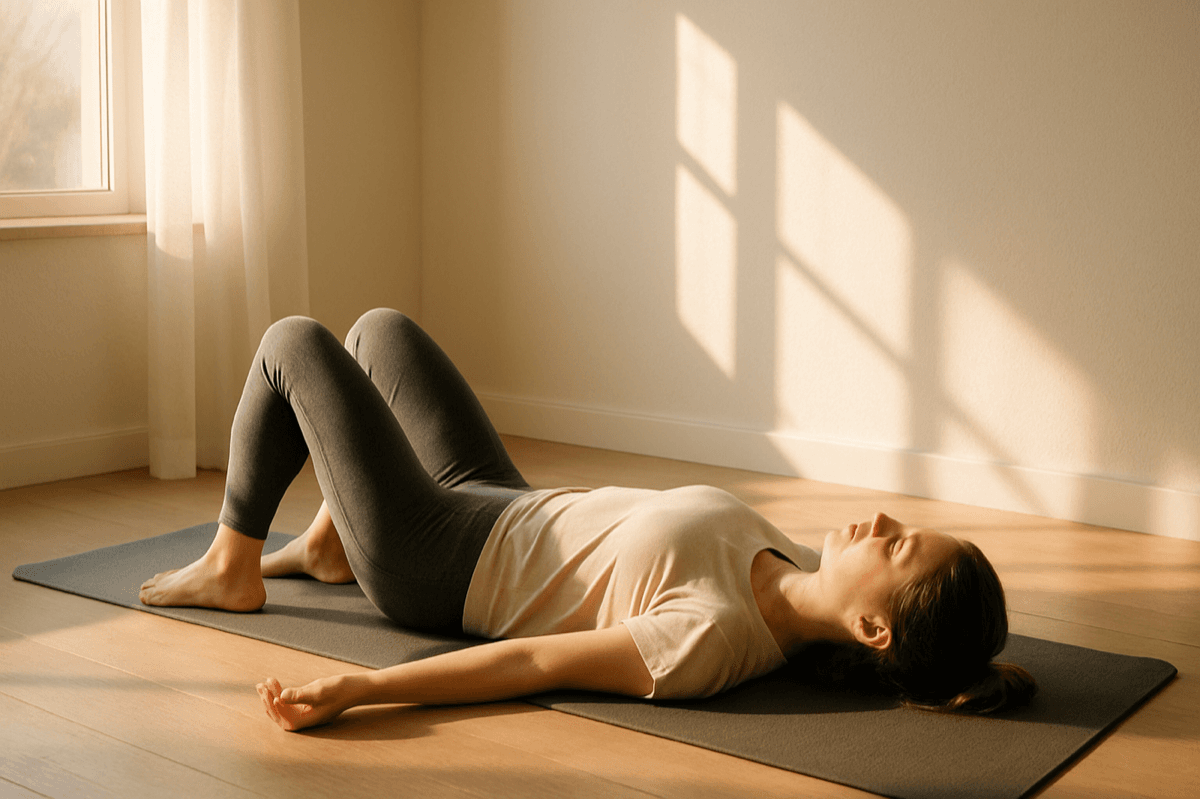
Lie on your back with your hips and knees at ninety degrees, calves resting on a chair, couch, or stack of pillows. Arms at forty-five degrees from your body, palms facing up. Do nothing. Simply allow gravity to work.
Static back uses the position of the legs to take the lumbar spine out of its habitual anterior tilt and allow it to drop flat against the floor. For most people, this takes two to three minutes. You will feel the lower back make contact with the floor as the hip flexors lengthen and the pelvis posteriorly tilts under gravity. By minute five, the lumbar should be fully in contact with the floor and the thoracic spine following.
This is the most important exercise in this system. It decompresses the posterior lumbar facet joints that carry disproportionate load when the spine is in anterior tilt. It also re-establishes what neutral pelvic position feels like, information the nervous system uses to calibrate upright posture.
Hip Crossover: 10 Repetitions Each Side
Remain on your back. Draw both knees to ninety degrees with feet flat on the floor. Drop both knees to the right while rotating your head to the left. Pause two to three seconds. Return to center. Drop both knees to the left while rotating your head to the right. Pause. Return.
The hip crossover restores thoracolumbar rotation, the ability of the lumbar spine and hips to rotate relative to the thoracic spine. This rotation is the first mobility quality lost to sustained sitting, and one of the last recovered. It also activates the obliques and internal hip rotators in a gentle, non-loading way that wakes up the stabilizing muscles before they are asked to do anything more demanding.
The head rotation in the opposite direction of the knees is deliberate. It maintains cervical mobility and prevents the cervical spine from bracing against the rotation, a compensation pattern common in people with forward head posture.
Cats and Dogs: 10 Repetitions
Come to all-fours with hands under shoulders and knees under hips. Slowly arch your lower back, allowing the pelvis to tip forward and the thoracic spine to extend as you look forward. This is the cat position. Then slowly reverse: round the lower back, tuck the pelvis, and drop the head for the dog position. Move slowly and deliberately. The transition should take four to five seconds in each direction.
Cats and dogs mobilizes the full spinal curve, lumbar, thoracic, and cervical, through both flexion and extension in a gravity-reduced, unloaded position. It is a neurological drill as much as a mobility drill: the slow movement trains the nervous system to control the full range of spinal movement, not just the compressed middle range that most people inhabit habitually.
After ten repetitions, pause in a neutral all-fours position and notice how your spine feels. For most people, the awareness of spinal position is noticeably improved from the beginning of this exercise.
Supine Groin Progressive: 3 Minutes Each Side
Lie on your back with one leg up on the couch or chair at ninety degrees (identical to static back). The other leg is extended flat on the floor. This is a position of maximum hip flexor length on the extended side. The foot of that leg will want to roll out, which is normal; allow it.
Stay for three minutes per side. The hip flexor on the extended leg gradually lengthens under the gentle stress of the position and gravity. This is not a stretch. You are not pulling the leg into anything. The muscle releases at its own pace, which is why time rather than force is the intervention.
The supine groin progressive addresses the hip flexor tightness that underlies anterior pelvic tilt, the structural driver of lower back pain, forward head posture, and most lower extremity dysfunction. Three minutes per side is the minimum to begin initiating genuine change rather than temporary relief.
Standing Arm Circles: 20 Forward, 20 Backward
Stand with feet hip-width apart and extend both arms out to the sides at shoulder height. Make slow, controlled circles, starting small and progressively larger. Twenty circles forward, then twenty backward.
Arm circles, done slowly and with full range, restore shoulder external rotation and thoracic extension through active movement rather than passive stretching. The backward circles are particularly important: they require the posterior shoulder muscles (lower trap, rhomboids, infraspinatus) to actively pull the arm into external rotation, which is the position chronically lost to desk and screen work.
By the end of twenty backward circles with intentional external rotation, most people notice their chest is slightly more open and their shoulders are slightly further back than at the start.
The 15-Minute Structure
Static back: 5 minutes Hip crossover: 2 minutes Cats and dogs: 3 minutes Supine groin progressive: 6 minutes (3 per side) Standing arm circles: 2 minutes Total: approximately 18 minutes at a relaxed pace, 15 minutes done efficiently.
Do this before looking at your phone, before coffee if you can, and before any work demands begin. The investment is small. The structural dividend compounds daily.
Free - 60 seconds
Not sure which program you need?
Take the free posture quiz and get a personalized recommendation based on your pain and goals.
What to Expect
In the first week: improved awareness of your spinal position throughout the day. Many people notice they catch themselves in poor posture more readily, not because the posture is worse, but because the contrast with the morning reset is more pronounced.
In weeks two through four: reduced morning stiffness. The overnight compression that used to take an hour to work through begins resolving within minutes because the morning sequence has prepared the body to decompress more efficiently.
By weeks six to eight: measurable structural improvement. Lower back pain that was chronic begins to be absent on some days. Shoulder position in the mirror shows visible change. The postural set-point that the nervous system defaults to throughout the day begins to shift.
The morning sequence is not the only work required for significant structural change. The targeted programs address specific conditions in more depth. But it is the daily foundation that makes all other corrective work more effective and more durable.

Mike Boshnack
Corrective Exercise Specialist · Posture Guy Mike
Mike Boshnack grew up skateboarding and surfing, trained MMA, and rode road bikes competitively. A shoulder injury put him on a path to discover corrective exercise. He has since helped thousands of people fix the structural patterns causing their pain, without surgery or passive treatments.
Keep Reading
Related Conditions
Free tool
See where your posture stands right now.
Upload a photo and get an instant AI-powered posture analysis with personalized recommendations. Free, no account required.
Try the Free Posture CheckTake the next step
Fix the structural root cause, not just the symptom.
Mike's programs apply this corrective method to your specific condition. No gym, no equipment. Just a floor and 15 minutes. Buy once, own forever.
Discussion
Discussion is a Pro member feature. Visit the community for more.