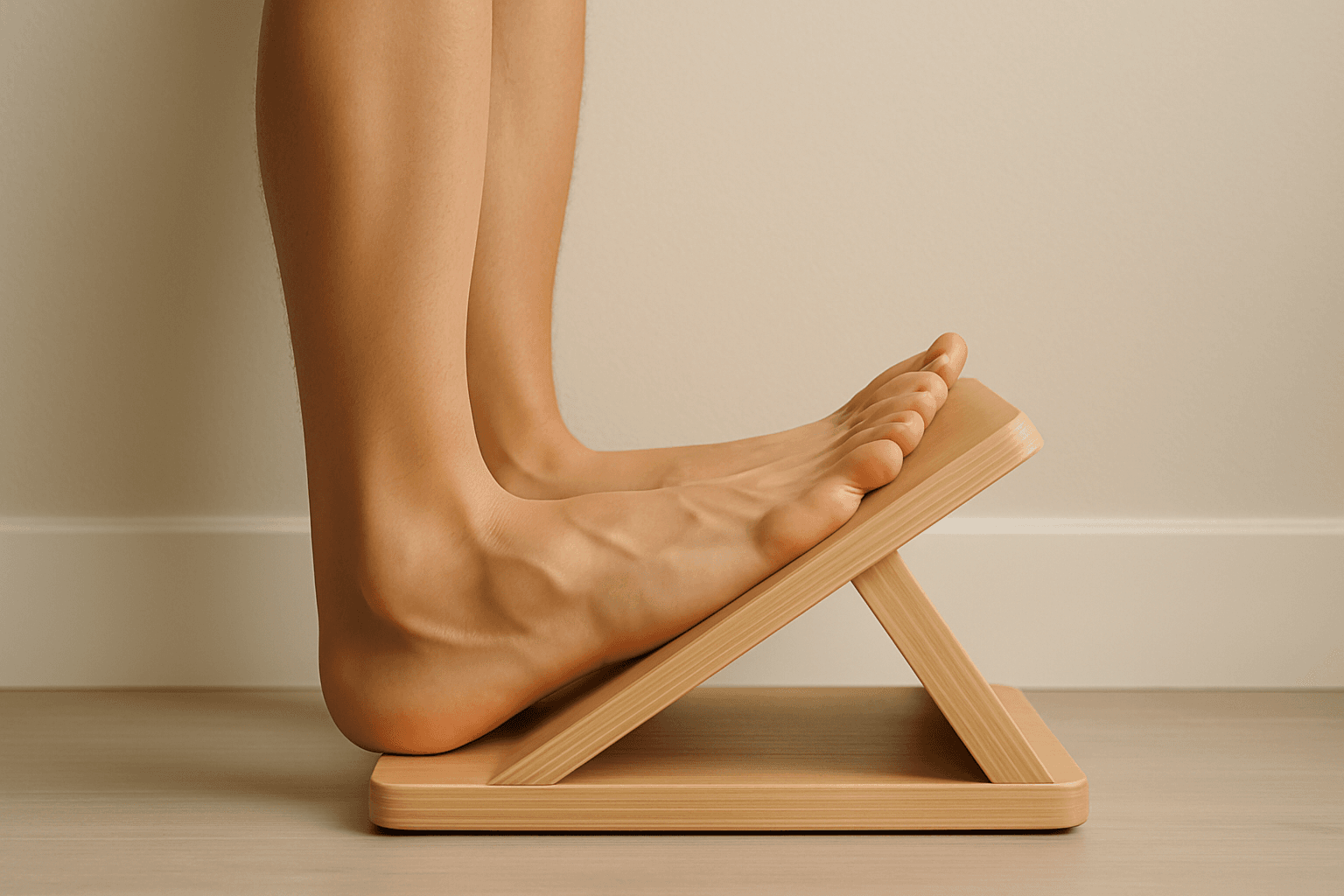
What a Posture Board Is
A posture board is a slightly inclined platform you stand on with your feet placed in a fixed position. The incline tips your weight back toward your heels and the fixed foot placement lines your feet up straight, square to each other, instead of letting them drift into the turned-out, collapsed position most people stand in by default.
It looks almost too simple to matter. There are no moving parts and nothing to strap on. You stand on it for a few minutes. But the reason it works is the same reason simple things often work best in posture correction: it changes the input your body is getting from the ground up.
Why Standing Position Matters So Much
Your posture is built on your feet. They are the foundation that everything above them stacks onto. When your feet turn out, roll inward, or carry your weight too far forward onto the balls instead of the heels, that misalignment travels up the chain. The knees rotate to follow the feet, the pelvis tips to compensate, and the spine adjusts above that.
Most people have spent years standing with their feet turned out and their weight pitched forward. The body treats that as normal because it is what you do all day. A posture board interrupts that pattern. By squaring the feet and shifting the load back toward the heels, it asks the whole chain above to realign: knees track forward, the pelvis settles toward neutral, and the spine stacks more vertically.
What It Actually Does
A posture board does three useful things.
**It resets your foot position.** Standing with squared, parallel feet for a few minutes a day reminds the body what aligned looks like. Over time that carries into how you stand the rest of the day.
**It shifts your weight back to your heels.** Carrying weight forward on the balls of the feet keeps the calves and the front of the body tight and pulls the posture forward. The incline gently loads the heels instead, which lets the back of the body lengthen.
**It gives the postural muscles a cue to fire.** Standing in good alignment, even passively, gives the muscles that hold you upright a clear position to organize around. It is a starting point, not a workout.
What It Is Not
A posture board is a tool, not a cure. This is the part people get wrong.
Standing on a board does not strengthen the muscles that hold your new alignment in place, and it does not lengthen the tight muscles that pulled you out of alignment to begin with. Step off the board and, without corrective exercise, your body drifts straight back to its old pattern because nothing about the underlying muscle balance has changed.
Think of it the way you would think of a posture brace. It positions you well while you use it, but positioning is not correcting. The value of a posture board is as a daily reset and an alignment cue that supports corrective work, not as a replacement for it.
How to Use One Well
The board earns its place when you pair it with corrective exercise. Use it as a two or three minute reset at the start of a session to feel squared, heel-loaded, and stacked, then do the actual corrective work that retrains the muscles to hold that position on their own.
If your feet turn out hard or collapse inward, the alignment has to be earned with mobility and strength work for the feet, ankles, and hips, not just stood into. The posture block is another tool that works alongside the board for targeted repositioning. The Foot and Ankle program addresses the foundation directly. If your posture pulls forward from the upper body, the Forward Head Posture Fix handles the chain above.
Who It Helps
A posture board is a reasonable addition for people who stand a lot, who feel their feet turning out or their weight pitching forward, or who want a simple daily cue to anchor a corrective routine. It is low effort and low risk, which is exactly why it is popular.
Just keep the expectation honest. The board shows your body what aligned feels like. The corrective exercise is what teaches your body to hold it without the board. Used together, they work. Used alone, the board is a nice few minutes that does not stick. Take the free posture quiz to find out which corrective program is right for your body.

Mike Boshnack
Corrective Exercise Specialist · Posture Guy Mike
Mike Boshnack grew up skateboarding and surfing, trained MMA, and rode road bikes competitively. A shoulder injury put him on a path to discover corrective exercise. He has since helped thousands of people fix the structural patterns causing their pain, without surgery or passive treatments.
Keep Reading
Free tool
See where your posture stands right now.
Upload a photo and get an instant AI-powered posture analysis with personalized recommendations. Free, no account required.
Try the Free Posture CheckTake the next step
Fix the structural root cause, not just the symptom.
Mike's programs apply this corrective method to your specific condition. No gym, no equipment. Just a floor and 15 minutes. Buy once, own forever.
Discussion
Discussion is a Pro member feature. Visit the community for more.