
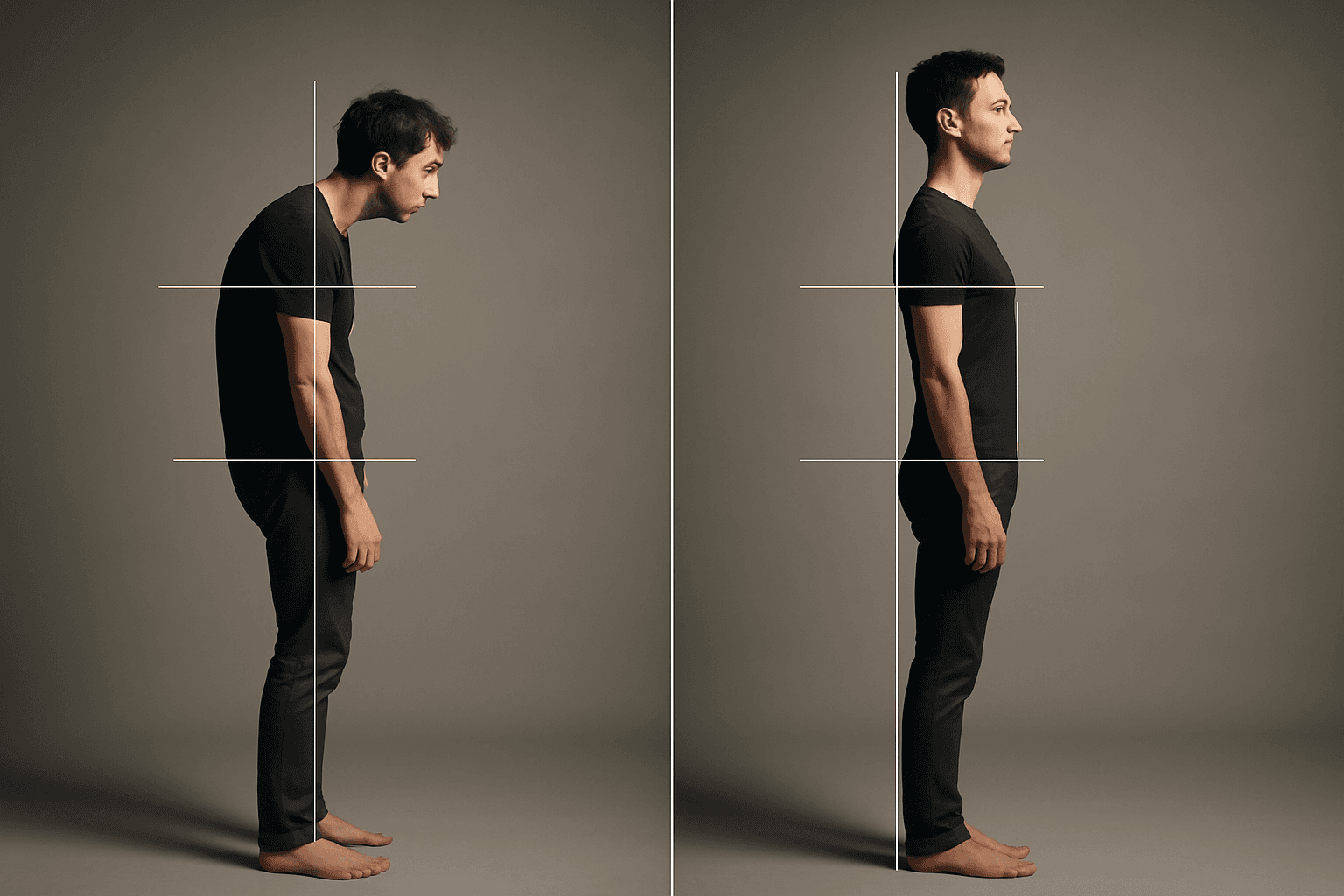
Why Your Posture Is Wrong
Bad posture is not a discipline problem. You do not have poor posture because you are lazy or because you are not trying hard enough to sit up straight.
Your posture is the result of muscle imbalances that have developed over years of modern life. Sitting shortens your hip flexors and switches off your glutes. Screens pull your head forward and round your shoulders. Driving, scrolling, and desk work train your body into flexion for 8 to 12 hours a day.
Over time, tight muscles on the front of your body pull you forward, and weak muscles on the back of your body cannot pull you upright. Your skeleton follows your muscles, and your posture follows your skeleton.
This is why telling yourself to sit up straight never works. You are fighting against the physical architecture of your own muscular system. The moment your attention goes elsewhere, the tight muscles win and pull you right back.
The Three Regions That Matter
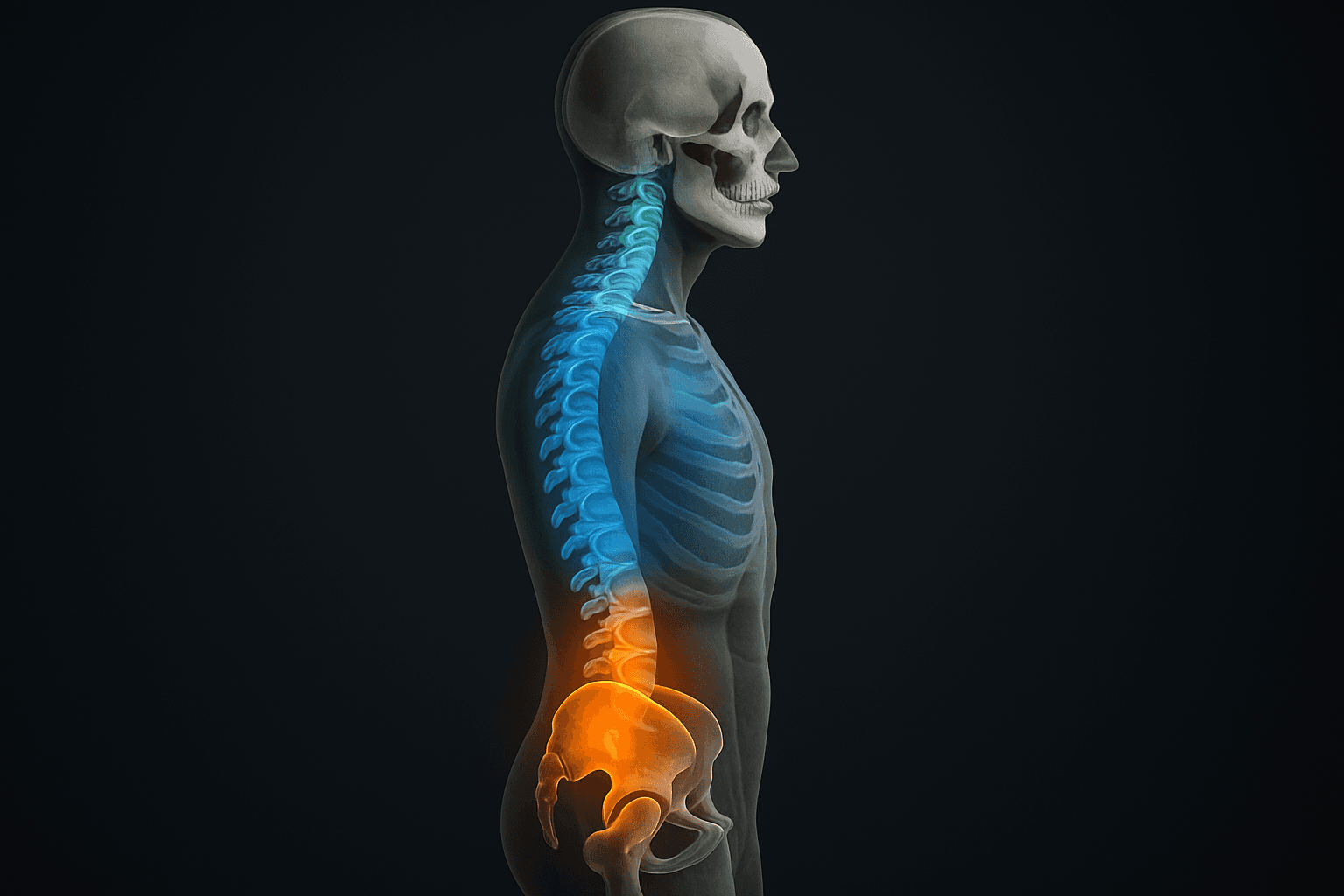
Posture is not one thing. It is a chain, and it breaks down in three specific regions.
The Pelvis
The pelvis is the foundation. When hip flexors shorten from sitting, the pelvis tips forward into anterior pelvic tilt. This creates an exaggerated lower back arch, compresses the lumbar discs, and forces everything above it to compensate. Fixing posture without addressing the pelvis is like straightening a building without fixing the foundation.
The Thoracic Spine
The thoracic spine is the mid-back region between the shoulder blades. When the pelvis tilts forward, the thoracic spine rounds to compensate, pulling the shoulders forward. Tight chest muscles (pec minor especially) reinforce this by pulling the shoulders into internal rotation. This is what most people recognize as rounded shoulders or kyphosis.
The Cervical Spine
The head follows the thoracic spine. When the upper back rounds, the head pushes forward to keep the eyes level. This is forward head posture, and it adds roughly 10 pounds of effective load to the neck for every inch the head moves forward. Neck pain, headaches, and jaw tension are downstream effects.
The chain flows upward: pelvis drives thoracic, thoracic drives cervical. Fix them in that order.
How Bad Is Your Posture? A 60-Second Self-Assessment
Stand naturally in front of a full-length mirror, sideways. Do not adjust your posture - stand the way you normally would. Check these four markers:
Pelvis: Place one finger on your front hip bone and one on your pubic bone. If the front hip bone is significantly lower, you have anterior pelvic tilt.
Thoracic spine: Does your upper back round forward? If your shoulder blades are not visible from the side, your thoracic spine is likely in kyphosis.
Shoulders: Do your palms face backward instead of toward your thighs? That indicates internal rotation and forward shoulder position.
Head: Is your ear in front of your shoulder? Every inch forward adds roughly 10 pounds of load to your cervical spine.
Most people have at least two of these four. The corrective sequence below addresses all of them in the right order.
Free - 60 seconds
Not sure which program you need?
Take the free posture quiz and get a personalized recommendation based on your pain and goals.
What Does Not Work
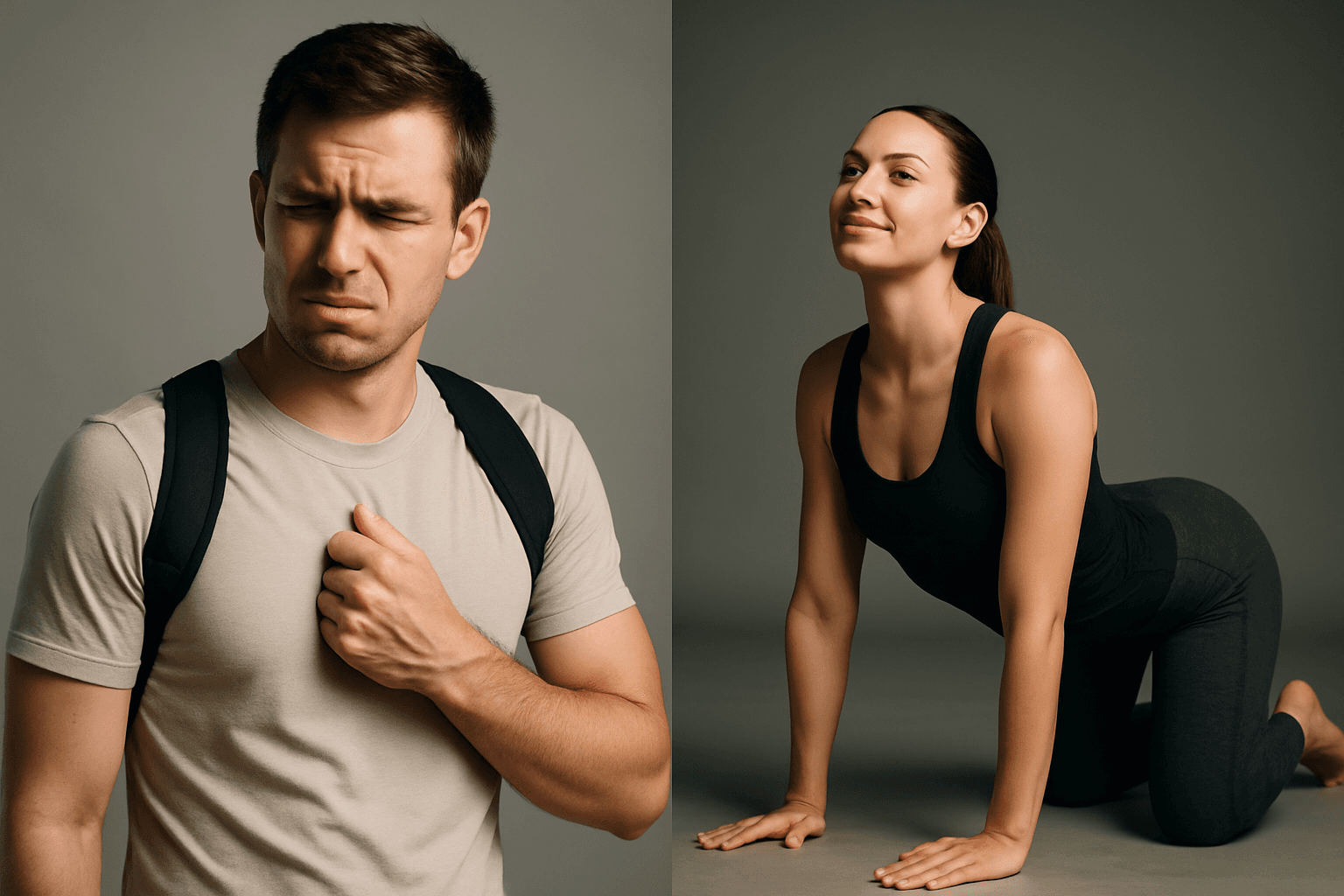
Before the corrective sequence, it helps to understand what wastes your time.
Posture braces and correctors hold you in position while you wear them but change nothing about the underlying imbalance. Read the full breakdown in do posture correctors actually work.
Standing desks change your environment but not your structure. You can have terrible posture standing up just as easily as sitting down. If your hip flexors are short and your thoracic spine is locked, you will stand in the same dysfunctional pattern.
Random stretching helps temporarily but without activating the weak muscles to hold the new position, the tight muscles pull you right back within hours.
Reminders and apps that buzz every 30 minutes create conscious override, not structural change. You should not need to think about posture any more than you think about breathing.
The Corrective Sequence
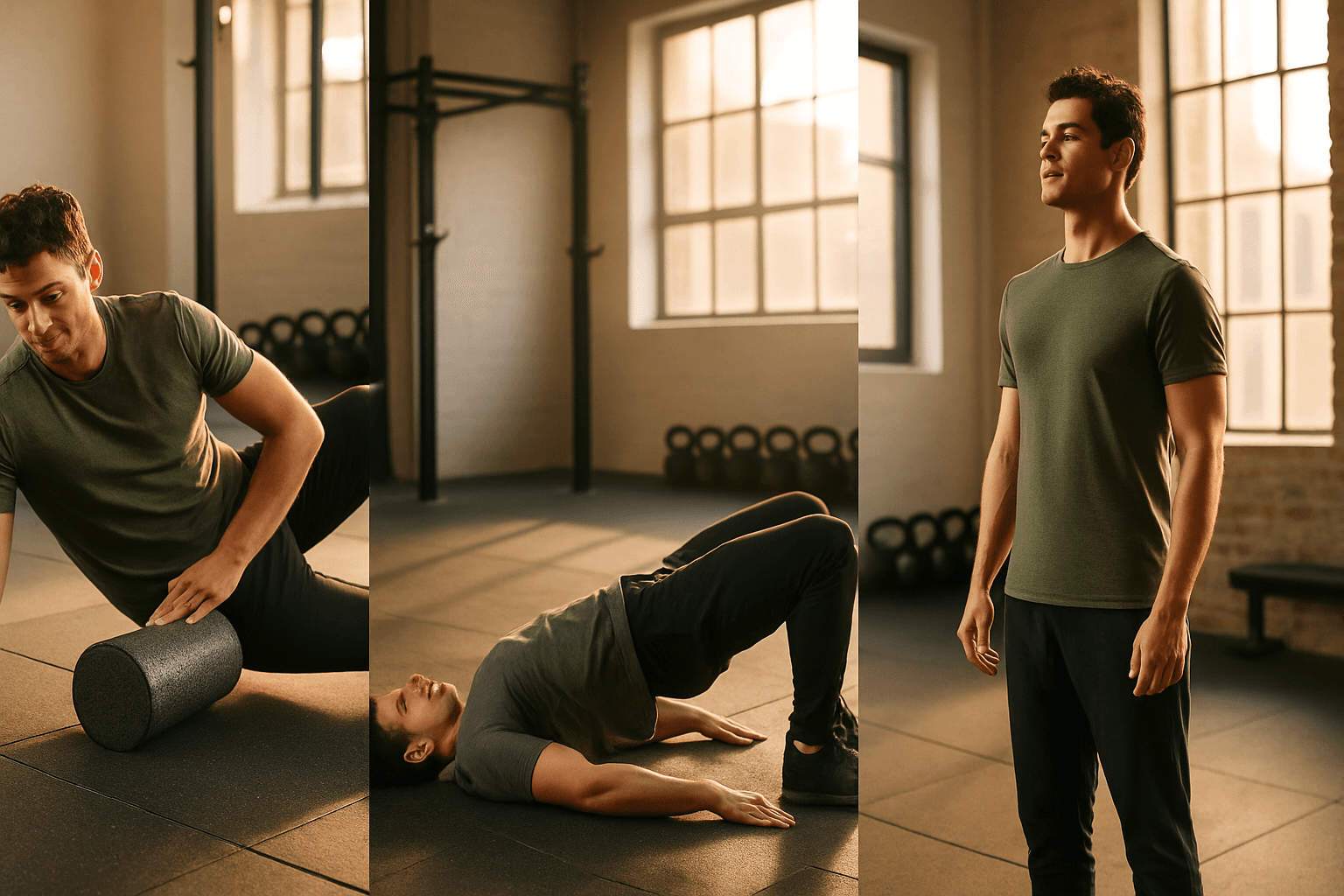
Lasting postural correction follows a specific order: release what is tight, activate what is weak, then retrain the pattern so it becomes automatic.
Step 1: Release the Tight Muscles
The muscles pulling you out of alignment need to be lengthened first. If you try to strengthen the weak muscles without releasing the tight ones, the tight muscles win.
Hip flexors - shortened from sitting, they tilt the pelvis forward. The static back position and supine groin stretch are the most effective releases because they work passively over time rather than forcing the muscle against its stretch reflex.
Chest and anterior shoulder - the pec minor and anterior deltoid pull the shoulders forward. The doorway chest stretch held for 60 seconds per side addresses this directly.
Upper traps and SCM - these neck muscles shorten with forward head posture. Chin tucks retrain cervical alignment and lengthen these muscles simultaneously.
Step 2: Activate the Weak Muscles
Once the tight muscles are released, the inhibited muscles need to be woken back up. These muscles have been switched off by the nervous system because they have been held in a lengthened, underused position for years.
Glutes - the most commonly inhibited muscles in people who sit. The glute bridge reactivates them and restores their control over pelvic position. Read the full guide in glute bridge for posture.
Lower and mid trapezius - these muscles hold the shoulder blades down and back. Prone cobra and prone YTW activate them against gravity.
Deep cervical flexors - the small muscles along the front of the cervical spine that hold the head in proper alignment. Chin tucks target these specifically.
Want to skip the guesswork? Take the free posture quiz to identify your specific pattern, or use the AI posture check for a visual analysis of your alignment. Both are free and take under two minutes.
Step 3: Retrain the Pattern
The nervous system has a postural set point. Even after releasing tight muscles and activating weak ones, the old pattern is habitual. The final step is teaching the nervous system to hold the corrected position as the new default.
Wall angels are one of the best retraining exercises because they force the thoracic spine, shoulders, and cervical spine into proper alignment against a wall while you move through a range of motion. If you cannot keep your arms, wrists, and head against the wall, you have a structural issue that needs more corrective work.
Daily repetition is what drives permanent change. The exercises do not need to take long, but they need to happen consistently.
The Daily Routine
A complete corrective routine can be done in 15 to 20 minutes:
- Static back position - 5 minutes (hip flexor release, spinal decompression)
- Doorway chest stretch - 60 seconds per side (chest and anterior shoulder release)
- Glute bridge - 3 sets of 10 (glute activation, pelvic control)
- Prone cobra - 3 sets of 10 (thoracic extension, lower trap activation)
- Chin tucks - 3 sets of 10 (cervical alignment, deep flexor activation)
- Wall angels - 3 sets of 8 (full chain retraining)
This sequence addresses the chain from bottom to top: pelvis, thoracic spine, cervical spine. The order matters.
Timeline
The body adapts faster than most people expect, but it adapts gradually, not overnight.
Week 1 to 2 - reduced pain and tension, improved body awareness, easier breathing
Week 3 to 4 - noticeable changes in how you hold yourself, reduced forward head position, less lower back tightness
Week 5 to 8 - visible postural improvement that others comment on, significantly less chronic pain
Month 3 to 4 - structural correction becomes the new default, you hold proper alignment without thinking about it
The key variable is consistency. Daily practice for 15 minutes produces results. Three times a week produces slower results. Once a week produces almost nothing.
Find Your Starting Point
Not everyone has the same postural dysfunction. Some people have severe anterior pelvic tilt with minimal upper body issues. Others have significant forward head posture but a neutral pelvis. The corrective approach should match your specific pattern.
Take the free posture quiz to identify which areas of your chain need the most work, or try the AI posture check to get a visual analysis of your alignment. From there, the corrective programs are structured to address your specific pattern with the right exercises in the right order.

Mike Boshnack
Corrective Exercise Specialist · Posture Guy Mike
Mike Boshnack grew up skateboarding and surfing, trained MMA, and rode road bikes competitively. A shoulder injury put him on a path to discover corrective exercise. He has since helped thousands of people fix the structural patterns causing their pain, without surgery or passive treatments.
Keep Reading
Corrective Method
Why Your Ankles Are Stiff (And How They're Wrecking Your Squat and Your Posture)
4 min read
Corrective Method
Pigeon Pose for Hip Pain: What It Actually Releases and What It Misses
4 min read
Corrective Method
Side Plank for Posture: Fix the Lateral Weakness Behind Your Hip Shift
4 min read
Free tool
See where your posture stands right now.
Upload a photo and get an instant AI-powered posture analysis with personalized recommendations. Free, no account required.
Try the Free Posture CheckTake the next step
Fix the structural root cause, not just the symptom.
Mike's programs apply this corrective method to your specific condition. No gym, no equipment. Just a floor and 15 minutes. Buy once, own forever.
Discussion
Discussion is a Pro member feature. Visit the community for more.