
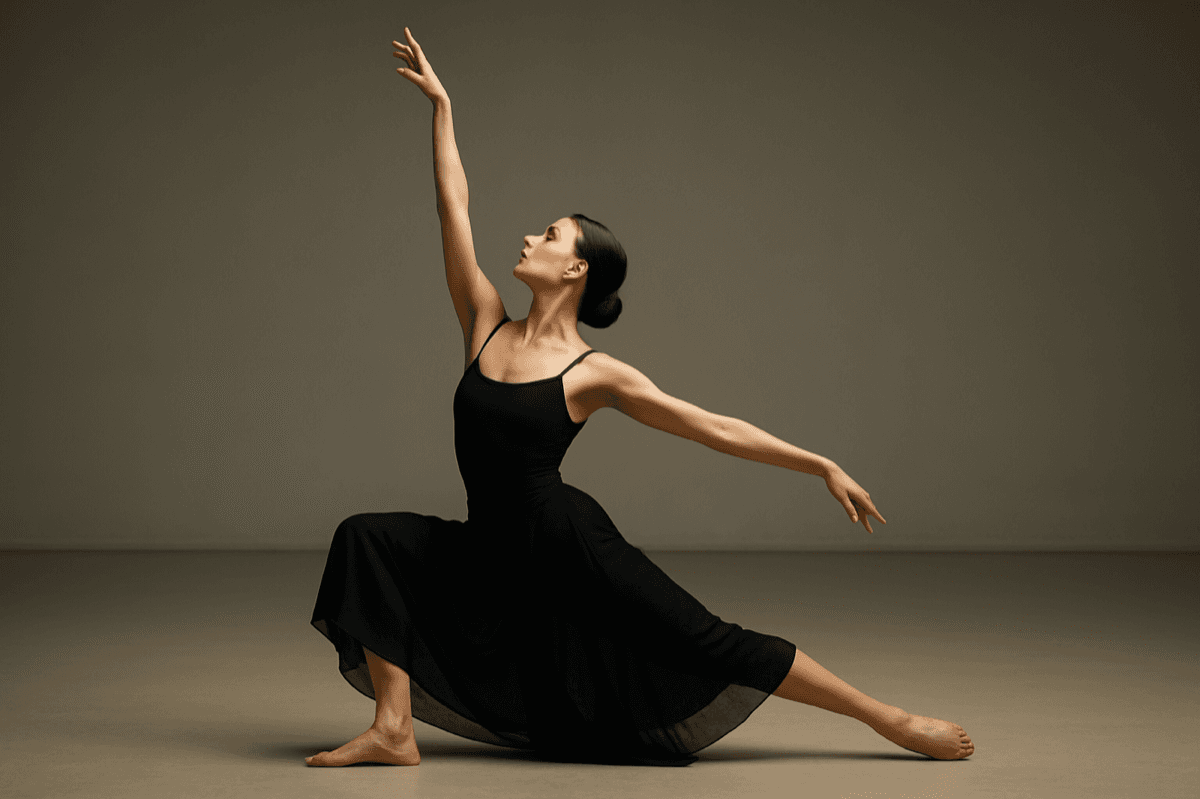
Dance & Posture
Forced turnout, thoracic rotation imbalance, single-leg stability
Updated May 2025
What Dance Does to Your Body
Dancers possess remarkable mobility, but often in directions the choreography demands and restricted in directions it doesn't. Forced turnout creates hip joint stress when it isn't structurally supported. Thoracic rotation in choreographed directions builds asymmetry. Years of training in specific movement patterns creates specific restrictions that affect both performance and long-term joint health.
The Specific Structural Changes
Forced turnout creates hip impingement risk
Classical dance demands external hip rotation beyond what many dancers' hip structure supports. When this rotation is forced rather than structurally available, the femoral head impinges on the acetabulum, creating labral tears that are extremely common in dancers.
Style-specific thoracic patterns create imbalance
Ballet trains thoracic extension. Contemporary often trains lateral flexion. Hip-hop involves repeated thoracic flexion. Whatever style is practiced predominantly builds thoracic mobility in those patterns at the expense of other ranges.
Single-leg demands require hip stability that training doesn't always build
Dance requires extraordinary single-leg balance and control. But the choreographic demands of dance don't always build the hip stability that underlies that control, they rely on it. When hip stability decreases from overuse or imbalance, ankle compensation increases.
Common Injuries in Dance
These aren't random injuries. They're the predictable result of the structural patterns dance creates.
- Hip labral tears
- Stress fractures (especially metatarsal)
- Ankle sprains and instability
- Knee pain from hip rotation imbalance
- Lower back pain
- Achilles tendinitis
Why posture matters for performance
Structural alignment is the foundation of dance aesthetics. A dancer with genuine thoracic mobility moves differently from one who forces range. True hip external rotation, not forced turnout, produces cleaner lines with less joint stress. Posture is the canvas on which technique is painted.
The Dance Program
The Dancer's Posture Program builds genuine thoracic rotation, restores hip external rotation mobility, develops single-leg stability from the hip rather than the ankle, and addresses the specific restrictions that choreographic training creates.
What Dance Athletes Actually Deal With
These are the injuries and pain patterns that come up in every danceforum, group ride conversation, and training camp. Here's how each one connects back to structural alignment, and what you can do about it.
"Dancer's hip", snapping hip syndrome (coxa saltans)
The snap or click that many dancers feel in the hip, sometimes painful, sometimes not, is usually the iliopsoas tendon snapping over the iliopectineal eminence, or the IT band snapping over the greater trochanter. Dancers call it "snapping hip," and while it's often painless early in a dancer's career, it can develop into painful tendinopathy with continued high-volume dancing.
Posture connection: Snapping hip syndrome is a hip flexor tension problem. The iliopsoas snaps because it's in a tight, shortened state, working near end range where the snap over the bony prominence is likely. Hip flexor lengthening and pelvic neutral positioning reduces the tension that causes the snap.
Stress fractures in feet and ankles from impact and relevé
Dancers, especially ballet dancers, have high rates of foot and ankle stress fractures, the second and third metatarsals for pointe work, the sesamoids from relevé, and the navicular from the repetitive loading of dance movements. These are fatigue fractures from bone stress exceeding remodeling capacity, often in lean dancers with suboptimal bone density.
Posture connection: Foot stress fractures are worsened by poor load distribution through the foot, when the arch mechanism isn't working properly, specific bones bear disproportionate stress. Foot intrinsic strengthening and proper arch mechanics distributes load across the foot more evenly, reducing peak stress at vulnerable sites.
Hip impingement from extreme range demand
Forced turnout beyond structural capacity, a common issue in dance training that demands external rotation the hip joint doesn't have, creates hip labral compression and FAI. The forced turnout rotates the femur externally in the socket, and when the hip doesn't have this range, the labrum bears the compressive force instead.
Posture connection: Hip impingement from forced turnout is a structural limitation that is partially addressable through pelvic neutral positioning, taking anterior pelvic tilt out of the equation reduces the compression the labrum experiences at end-range external rotation. Proper hip mobility work that respects structural limits, combined with pelvic alignment, reduces labral stress.
Questions from the Dance Community
My hip clicks every time I do a développé. Is this dangerous?
The click itself, snapping hip syndrome, isn't immediately dangerous but indicates the iliopsoas tendon is under high tension and working near end range. If it's painless, it can be managed through hip flexor work. If it develops pain, it's a signal that the tendon is developing tendinopathy and needs to be addressed structurally.
Why do I keep getting stress fractures in my feet despite being careful?
Stress fractures indicate that loading exceeds bone's remodeling capacity at a specific site. In dancers, this is often a combination of training volume, nutrition (bone density), and foot mechanics. If the foot is not loading evenly, specific bones carry excess stress that accumulates into fractures. Foot intrinsic strengthening changes load distribution.
Can good posture improve my lines in dance?
Yes, and this is one of the clearest examples of posture affecting performance. Thoracic extension directly improves the appearance of the back in arabesque and attitude. Hip alignment affects turnout. Cervical alignment affects the carriage of the head and neck. Dance lines are structural, posture is what determines them.
Frequently Asked Questions
Is this appropriate for classical ballet dancers?
Yes, with emphasis on the thoracic extension and hip external rotation work that ballet specifically demands.
I have hip pain from turnout. Will this help?
Hip pain from turnout is almost always a hip flexor tightness and acetabular impingement issue. The pigeon pose and hip crossover work directly addresses the structural restriction.

Written by Mike Boshnack
Corrective Exercise Specialist · Posture Guy Mike
Mike Boshnack grew up skateboarding and surfing, trained MMA, and rode road bikes competitively, before a shoulder injury put him on a path to postural correction. He's since helped thousands of athletes fix the specific postural patterns their sport creates, without surgery or passive treatments.
The mobile app is here.
Do your program on your phone, anywhere. Download free on iPhone or Android, or keep using it in your browser.
Related Conditions