
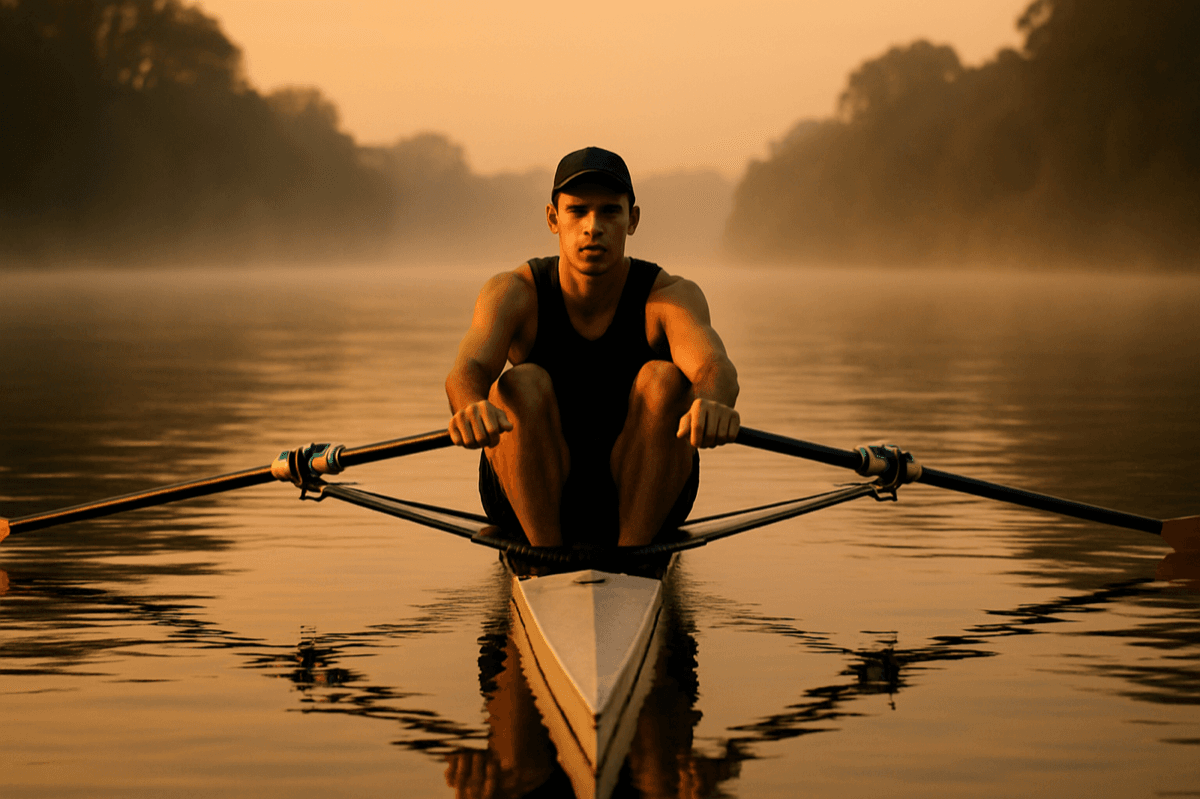
Rowing & Kayaking & Posture
Pulling dominance, thoracic flexion, seated hip flexion
Updated May 2025
What Rowing & Kayaking Does to Your Body
Rowing and kayaking are highly repetitive pulling sports that train the anterior chain, lats, pecs, and hip flexors, into dominance over the posterior chain. Thousands of strokes per session build a specific pattern of internal shoulder rotation, thoracic flexion, and hip flexor shortening that follows athletes off the water.
The Specific Structural Changes
Stroke repetition builds pulling dominance
A competitive rower takes approximately 30 strokes per minute. At a 2-hour practice, that's 3,600 pulls per session. Each pull trains internal shoulder rotation and thoracic flexion. The posterior chain, external rotators, mid-trap, rhomboids, is never comparably loaded, creating a progressive imbalance.
Seated rowing position shortens hip flexors
The catch position in rowing involves extreme hip flexion with the knees bent and the trunk leaning forward. At 30 strokes per minute, the hip flexors are in repeated contraction and shortening throughout every session. Off the water, this creates anterior pelvic tilt.
One-sided paddling in kayaking creates lateral imbalance
Canoeists and kayakers who primarily paddle on one side develop the same lateral asymmetry that baseball players and tennis players develop from their dominant-side loading.
Common Injuries in Rowing & Kayaking
These aren't random injuries. They're the predictable result of the structural patterns rowing & kayaking creates.
- Lower back pain from hip flexor tightness
- Rib stress fractures (from rotation load)
- Shoulder impingement
- Wrist tendinitis
- Knee pain from repetitive flexion
Why posture matters for performance
A rower with better thoracic extension achieves a longer catch and a stronger finish. Better hip flexor length means a more powerful drive. Shoulder health determines how many meters you can put on before breakdown.
The Rowing & Kayaking Program
The Rower & Paddler's Posture Fix balances the pull-dominant pattern: thoracic extension, chest opening, posterior shoulder work, and hip flexor release, the four structural requirements that rowing progressively degrades.
What Rowing & Kayaking Athletes Actually Deal With
These are the injuries and pain patterns that come up in every rowing & kayakingforum, group ride conversation, and training camp. Here's how each one connects back to structural alignment, and what you can do about it.
Rib stress fractures, the unique rowing injury
Rib stress fractures are so characteristic of rowing that they're sometimes called "rowing ribs." The serratus anterior and oblique muscles attach to the ribs, and the repetitive compressive and tensile forces of the rowing stroke, combined with high training volume on the water or erg, cause stress reactions that progress to fractures. Elite rowers often have multiple rib stress fractures over a career.
Posture connection: Rib stress fracture risk is significantly higher when the thoracic spine is restricted in extension, which causes the ribs to be loaded in a flexed, compressed position through the drive phase. Thoracic extension capacity distributes rib forces more favorably through the stroke and is the primary structural protective factor.
"Rowing back", lumbar disc injury from the stroke pattern
The catch position of the rowing stroke, forward lean with the lumbar spine flexed and loaded, is where most rowing back injuries originate. The lumbar disc is compressed and sheared simultaneously at the catch, thousands of times per training session. Rowers who maintain lumbar flexion through the drive (rather than sequencing hip extension before trunk extension) are most vulnerable.
Posture connection: Lumbar disc health in rowing depends on maintaining neutral lumbar spine through the catch, which requires adequate hamstring and hip flexibility to achieve forward lean without lumbar rounding. Hamstring and hip flexibility work that specifically targets the catch position changes the lumbar loading pattern.
Wrist extensor tendinopathy from feathering
The feathering motion, rotating the oar handle with the fingers and wrist, requires repetitive wrist extension against the resistance of the water. High-volume rowing builds wrist extensor tendinopathy that is exquisitely tender on the dorsal forearm. It's often worse on the outside (extensor carpi radialis) than the inside.
Posture connection: Forearm extensor overuse in rowing is partly a grip and technique issue and partly a shoulder alignment issue. When the shoulder is internally rotated from thoracic kyphosis, the forearm mechanics through the feathering motion change, increasing the stress on the extensor tendons. Thoracic and shoulder work changes the mechanical environment upstream.
Questions from the Rowing & Kayaking Community
Why do rowers get rib stress fractures? It seems like a bone problem, not a muscle problem.
Rib stress fractures in rowers are fatigue fractures from repetitive muscle pull, the serratus and obliques attach to the ribs and apply cyclic force with every stroke. At high training volume, the bone fatigues faster than it can remodel. Thoracic extension work distributes these forces more favorably across the rib cage.
My lower back always hurts after long pieces on the erg. Is this normal for rowing?
Common, but addressable. Erg back pain usually means the catch is being achieved through lumbar rounding rather than hip hinge, the difference between reaching forward with your spine versus reaching forward with your hips. This is partly technique but partly structural: hamstring and hip flexibility determines how much of the catch length can come from hip flexion rather than lumbar flexion.
Frequently Asked Questions
I row 6 days a week. Is daily corrective work realistic?
At 6 days of training, daily corrective work is not optional, it's what allows 6 days to be sustainable. 15 minutes after practice is the minimum investment.
Written by Mike Boshnack
Corrective Exercise Specialist · Posture Guy Mike
Mike Boshnack grew up skateboarding and surfing, trained MMA, and rode road bikes competitively, before a shoulder injury put him on a path to postural correction. He's since helped thousands of athletes fix the specific postural patterns their sport creates, without surgery or passive treatments.
The mobile app is here.
Do your program on your phone, anywhere. Download free on iPhone or Android, or keep using it in your browser.
Related Conditions