
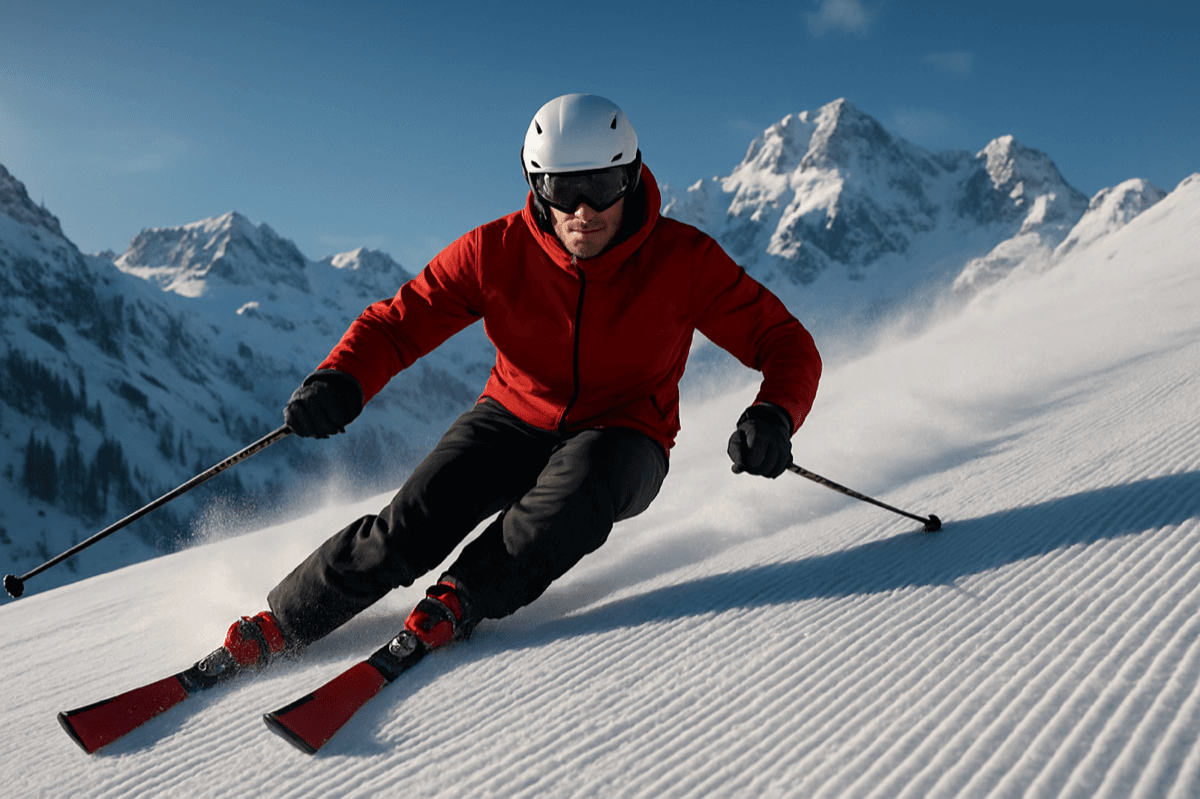
Skiing & Posture
Hip flexion, quad dominance, ankle loading, lumbar compression
Updated May 2025
What Skiing Does to Your Body
Alpine skiing requires sustained hip flexion, constant eccentric quad loading, and rotational hip control, all while wearing a boot that limits ankle movement and compounds lumbar loading with every run. A day on the mountain without corrective work leaves the body progressively more compressed and restricted.
The Specific Structural Changes
Ski boot alters ankle mechanics and forces compensation
The forward lean built into a ski boot keeps the ankle in dorsiflexion throughout the day. Post-boot, ankle dorsiflexion is often reduced, and the compensation patterns the boot forced, forward lean from the ankle, lumbar compression, persist into the après-ski hours.
Sustained hip flexion loads the hip flexors for hours
The athletic skiing position involves sustained hip flexion that gradually shortens the hip flexors throughout a day on the mountain. By run 10, most skiers are in significant anterior pelvic tilt, loading the lumbar spine on every turn.
Eccentric quad loading creates patellar tendon stress
Alpine skiing is one of the most demanding eccentric quad exercises in existence. The legs absorb moguls, variable snow, and carved turns through sustained eccentric contractions. Over a ski season, this creates patellar tendinitis in athletes who don't manage the load.
Common Injuries in Skiing
These aren't random injuries. They're the predictable result of the structural patterns skiing creates.
- ACL tears (one of the highest rates of any sport)
- Knee ligament injuries
- Lower back pain
- Hip flexor strains
- Thumb injuries from pole falls
- Ankle fractures from boot leverage
Why posture matters for performance
A skier with mobile hips can get lower in a tuck and generate more carving power. Better ankle mobility means more responsive boot-to-edge transfer. Spinal decompression between ski days means you start each day structurally fresh rather than progressively more compressed.
The Skiing Program
The Skier's Posture Program builds the hip mobility that carving demands, decompresses the lumbar from boot-forced loading, restores ankle mechanics, and builds the single-leg stability that variable terrain requires.
What Skiing Athletes Actually Deal With
These are the injuries and pain patterns that come up in every skiingforum, group ride conversation, and training camp. Here's how each one connects back to structural alignment, and what you can do about it.
ACL tears, skiing's defining injury
Skiing has the highest ACL tear rate of any recreational sport. The mechanisms are specific: the "phantom foot" injury where the ski tail catches and forces knee valgus and internal tibial rotation; the "boot-induced" injury from landing in the backseat with the binding acting as a lever. Women tear ACLs at higher rates than men in skiing, largely due to neuromuscular landing patterns.
Posture connection: ACL injury risk is substantially modified by hip control, when the gluteus medius can't hold the pelvis level, the femur drops into adduction and internal rotation, placing the ACL in an at-risk position in exactly the recovery scenarios where ACL tears happen. Hip stabilization training is the most evidence-supported ACL prevention intervention.
"Skier's thumb", UCL of the thumb from pole plant falls
Skier's thumb, an ulnar collateral ligament sprain or tear of the thumb, happens when a fall occurs with the pole grip still in hand. The pole forces the thumb into radial deviation and hyperextension, damaging the UCL. It's been renamed from "gamekeeper's thumb" specifically because skiing is now its most common cause.
Posture connection: Wrist and hand positioning in the pole plant is influenced by shoulder and thoracic alignment. Athletes with better shoulder symmetry and thoracic extension carry the poles in a more favorable position, reducing the likelihood of the grip-on-fall mechanism. This is a distal benefit of proximal alignment.
Hip impingement from mogul skiing and aggressive turns
Mogul skiing and aggressive carved turns require deep hip flexion combined with rapid extension, a range that loads the hip labrum and anterior hip capsule repeatedly. Mogul skiers and racers who make thousands of turns with these hip demands develop FAI symptoms and labral irritation that are specifically provoked by deep hip-flexed skiing positions.
Posture connection: Hip impingement from skiing is dramatically worse with anterior pelvic tilt. The forward tilted pelvis places the femoral head anteriorly in the socket, narrowing the space for hip flexion before impingement occurs. Neutral pelvic positioning through hip flexor release is the primary structural intervention that preserves hip joint space in demanding skiing positions.
Questions from the Skiing Community
Why do skiers blow their ACLs so much more than other athletes?
Skiing-specific ACL mechanisms, the phantom foot catch, the backseat boot lever, are unique to the sport. But the vulnerability factor is consistent with all ACL sports: hip abductor weakness that allows the knee to collapse inward in recovery positions. The landing and recovery situations in skiing happen at speed, leaving no time for conscious stabilization, which makes pre-programmed hip stability essential.
My hips feel tight and restricted when I try to get low in my skiing stance. What's going on?
Hip flexor tightness and anterior pelvic tilt reduce the depth of hip flexion available before impingement. Many skiers compensate by flexing the knee more and the hip less, which changes the weight distribution in the boot and compromises the skiing stance. Hip flexor release and hip mobility work specifically restores the depth of hip flexion that an athletic skiing stance requires.
Frequently Asked Questions
Should I do this at the end of the ski day?
Yes, especially the static back and hip flexor work. 15 minutes of decompression after a full day on the mountain dramatically improves how you feel the next morning.
I ski 20+ days a season. How important is this?
At 20+ days, you're accumulating significant structural load. Daily corrective work on ski days is the investment that keeps that volume sustainable.

Written by Mike Boshnack
Corrective Exercise Specialist · Posture Guy Mike
Mike Boshnack grew up skateboarding and surfing, trained MMA, and rode road bikes competitively, before a shoulder injury put him on a path to postural correction. He's since helped thousands of athletes fix the specific postural patterns their sport creates, without surgery or passive treatments.
The mobile app is here.
Do your program on your phone, anywhere. Download free on iPhone or Android, or keep using it in your browser.
Related Conditions