
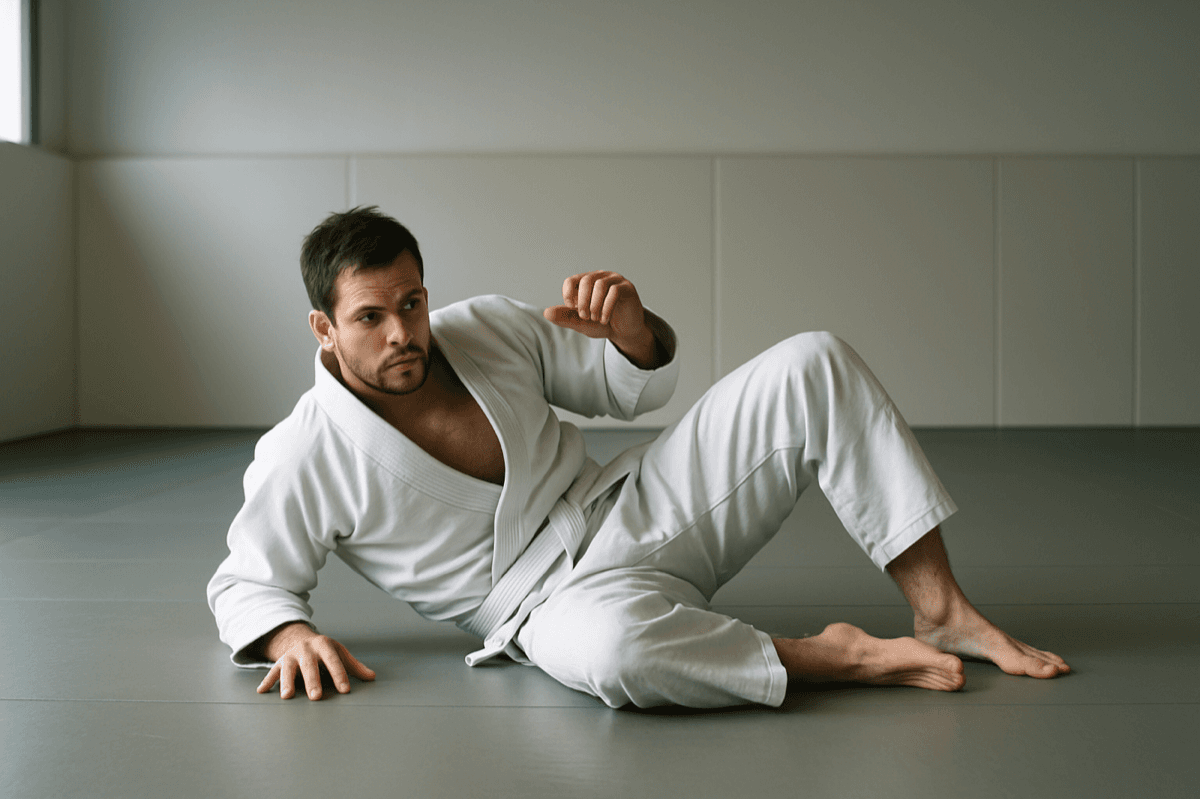
Wrestling & BJJ & Posture
Extreme hip mobility demands, cervical loading, grappling posture
Updated May 2025
What Wrestling & BJJ Does to Your Body
Wrestling and Brazilian jiu-jitsu place demands on the body that no other sport replicates. Extremes of hip external rotation in guard positions. Cervical loading from neck cranks and pressure. Explosive hip extension from takedowns and sprawls. Spinal flexion from defensive postures. These demands are unique, and the postural program that addresses them needs to be specific.
The Specific Structural Changes
Guard positions demand hip external rotation that grappling itself restricts
BJJ guard positions require significant hip external rotation. Ironically, the physical demands of grappling, constant hip loading in multiple planes, can progressively restrict this range if not actively maintained. Athletes find their guard becomes less effective as hip mobility decreases.
Cervical spine takes unique loading from grappling
Neck cranks, guillotines, head control positions, and defending shots all place the cervical spine in loaded positions that other sports rarely approach. The cumulative cervical compression from years of grappling is significant and requires specific decompression work.
Spinal flexion dominance from defensive positions
The turtle position, guard recovery, and defensive sprawl mechanics all involve thoracic and lumbar flexion under load. Over years of training, this trains the spine into a flexion bias that affects standing posture and creates chronic lower back tightness.
Common Injuries in Wrestling & BJJ
These aren't random injuries. They're the predictable result of the structural patterns wrestling & bjj creates.
- Cervical disc compression
- AC joint sprains
- Hip flexor and adductor tears
- Knee ligament injuries from takedowns
- Rib injuries from guard pressure
- Lower back pain from spinal flexion loading
Why posture matters for performance
Hip mobility is the foundation of guard effectiveness. Cervical health is fighting longevity. Thoracic mobility determines the positions you can attack from. The most durable grapplers are the ones who manage structural health as deliberately as they manage their game.
The Wrestling & BJJ Program
The Wrestling & BJJ Posture Fix specifically addresses the patterns grappling creates: hip rotation restoration, cervical decompression, thoracic extension, and the core stability that protects the spine in every position.
What Wrestling & BJJ Athletes Actually Deal With
These are the injuries and pain patterns that come up in every wrestling & bjjforum, group ride conversation, and training camp. Here's how each one connects back to structural alignment, and what you can do about it.
"Wrestler's neck" / cervical disc compression from takedowns and mat work
Cervical disc compression is the defining long-term structural consequence of wrestling and grappling. Defending shots with the head, being stacked in guillotines, and the general cervical loading of takedown defense and ground work creates an accumulative cervical compression that shows up as "wrestler's neck", the chronic stiffness, reduced rotation, and eventual cervical disc herniation that affects wrestlers across all levels and ages. Many wrestlers simply consider neck tightness "normal."
Posture connection: Wrestler's neck is cervical forward head posture taken to its extreme by the specific loading patterns of grappling. The chin-down defensive position during shot defense places the cervical spine in sustained flexion under load, the exact position that compresses the posterior cervical disc margins. Over years of training, this creates the forward head posture that characterizes experienced wrestlers even off the mat. Cervical retraction exercises specifically reverse this compression by restoring the cervical spine's neutral lordosis.
Hip labral tears from guard and butterfly guard positions
Hip labral tears are one of the most underdiagnosed injuries in BJJ specifically. The butterfly guard, de la Riva, and rubber guard positions all demand extremes of hip external rotation that stress the labrum at its anterior-superior margin, the same location as soccer players' and golfers' labral injuries, but through different mechanics. BJJ players describe a deep clicking or catching sensation in the hip during specific guard transitions that often gets worse over a season of heavy training.
Posture connection: Hip labral stress in grappling comes from the combination of hip external rotation demand and the pelvic floor's inability to stabilize the hip joint during those positions. Anterior pelvic tilt reduces the hip's available external rotation range before the labrum is stressed, which means labral contact happens earlier in the movement arc than it should. Restoring pelvic neutrality and hip external rotation mobility through corrective work creates more available range before the labrum is stressed.
Shoulder injuries from takedowns and scrambles
Shoulder separations (AC joint sprains) and rotator cuff strains in wrestling happen during scrambles, shots, and takedown defense, moments of high force in positions the shoulder isn't prepared for. The AC joint separation from falling onto the point of the shoulder, and the rotator cuff strain from an arm being caught in a compromised position during a takedown, are among the most common shoulder injuries in wrestling.
Posture connection: Wrestling shoulder injury risk is partly determined by pre-existing shoulder positioning. A shoulder in internal rotation from the wrestling crouch position starts every scramble from a position of greater anterior instability. When the shoulder girdle is properly positioned, thoracic extended, scapula retracted, shoulder in neutral rotation, the shoulder can absorb unexpected forces more safely. Thoracic extension and posterior shoulder stability work builds the shoulder's starting position for every scramble.
Lower back pain from spinal flexion dominance
The defensive posture of wrestling, rounded thoracic, flexed lumbar, hips loaded, is sustained spinal flexion under repeated load. Over years of training and competing, wrestlers develop a spinal flexion bias that persists off the mat: a habitually rounded thoracic spine and anteriorly tilted pelvis that is recognizable in experienced wrestlers at rest. The chronic lower back tightness this creates is normalized within the sport.
Posture connection: Wrestling's spinal flexion dominance creates the posterior lumbar disc compression pattern from below (hip flexor shortening and anterior pelvic tilt) and from above (thoracic kyphosis increasing lumbar compensation). Static back decompression specifically addresses this by creating lumbar traction in the neutral position while simultaneously restoring hip flexor length through the gravity-assisted hip extension of the position.
Knee injuries from takedown and sprawl mechanics
Knee ligament injuries in wrestling occur during takedowns (particularly the single-leg and double-leg) and sprawl defense. The MCL and ACL are most commonly affected, with the mechanism being a planted foot with a rotating, collapsing knee, the same pattern as soccer and basketball ACL injuries but occurring in the specific context of takedown resistance. Many wrestlers develop chronic knee instability from multiple minor ligament injuries that never fully healed.
Posture connection: Knee ligament protection in wrestling begins with hip abductor and external rotator strength that prevents the knee from collapsing inward during the split-second of a takedown. When the hip can't control the thigh's position under the force of a takedown attempt, the knee torques in the medial compartment and the ligaments bear the stress. Hip alignment work builds the rotational stability that catches the knee before it collapses.
Questions from the Wrestling & BJJ Community
Why is my neck always tight from wrestling / BJJ?
Neck tightness in grapplers is the accumulated effect of chin-down defensive posture under load, the cervical spine in sustained flexion during shot defense, guillotine defense, and head control positions compresses the posterior cervical disc margins and tightens the posterior cervical muscles. This is so universal in grappling that it's normalized, but it's a cervical structural problem that responds well to consistent cervical retraction and decompression work.
Is the clicking in my hip from guard positions something to worry about?
Hip clicking during guard positions, particularly a deep, internal clicking with a "catching" quality that gets worse over a training week, is worth taking seriously as a sign of labral irritation or tear. Unlike the more benign snap of the hip flexor tendon over the greater trochanter (which is external and painless), labral clicking has a depth and a catch quality that signals joint structure involvement. Hip external rotation stability work can reduce labral stress before it progresses.
Can wrestling damage your spine permanently?
Long-term grappling without structural maintenance does create measurable cervical and lumbar changes that can become permanent, particularly the cervical disc compression from years of chin-down defensive posture and the lumbar disc changes from spinal flexion loading. These changes are progressive and accumulate slowly, which is why they're easy to ignore until they become symptomatic. Consistent cervical decompression and lumbar neutrality work is what prevents progressive changes from becoming permanent dysfunction.
Why do I feel so stiff the morning after hard rolling?
Post-rolling stiffness comes from the structural compression of grappling, the cervical spine, hip joints, and lumbar spine spend hours in loaded, non-neutral positions during training. The body expresses this as stiffness and aching in the 12–24 hours after training, which is when the inflammatory response peaks. Grapplers who do 15 minutes of structural decompression immediately after training consistently report less next-morning stiffness because they're reversing the compression before it sets overnight.
Will fixing my posture actually improve my grappling?
Hip mobility directly improves guard effectiveness, the range you have in external rotation determines the quality of your guard positions. Thoracic extension changes what upper body positions are available during scrambles. Cervical health determines longevity in the sport. The structural improvements that reduce pain are the same improvements that open up positions that were previously structurally unavailable.
Frequently Asked Questions
I train every day. Should I do this every day too?
Yes. At daily training frequency, daily corrective work is what keeps the structural damage from compounding into injury. The program is recovery work, it doesn't add fatigue.
I have a cervical disc issue. Is this safe?
The cervical retraction and decompression work in this program is gentle and specifically designed to reduce cervical compression. Avoid any exercise that creates radiating symptoms, and consult your physio if post-surgical.

Written by Mike Boshnack
Corrective Exercise Specialist · Posture Guy Mike
Mike Boshnack grew up skateboarding and surfing, trained MMA, and rode road bikes competitively, before a shoulder injury put him on a path to postural correction. He's since helped thousands of athletes fix the specific postural patterns their sport creates, without surgery or passive treatments.
The mobile app is here.
Do your program on your phone, anywhere. Download free on iPhone or Android, or keep using it in your browser.