
Football & Posture
Cervical compression, loaded hip flexion, impact across the kinetic chain
Updated May 2025
What Football Does to Your Body
American football places more demand on the cervical spine than almost any other sport. Linemen operate in constant loaded hip flexion. Running backs absorb force through the entire kinetic chain. Quarterbacks throw under duress with complex rotational mechanics. Every position creates specific structural patterns that compound over a career.
The Specific Structural Changes
Linemen develop chronic hip flexion loading
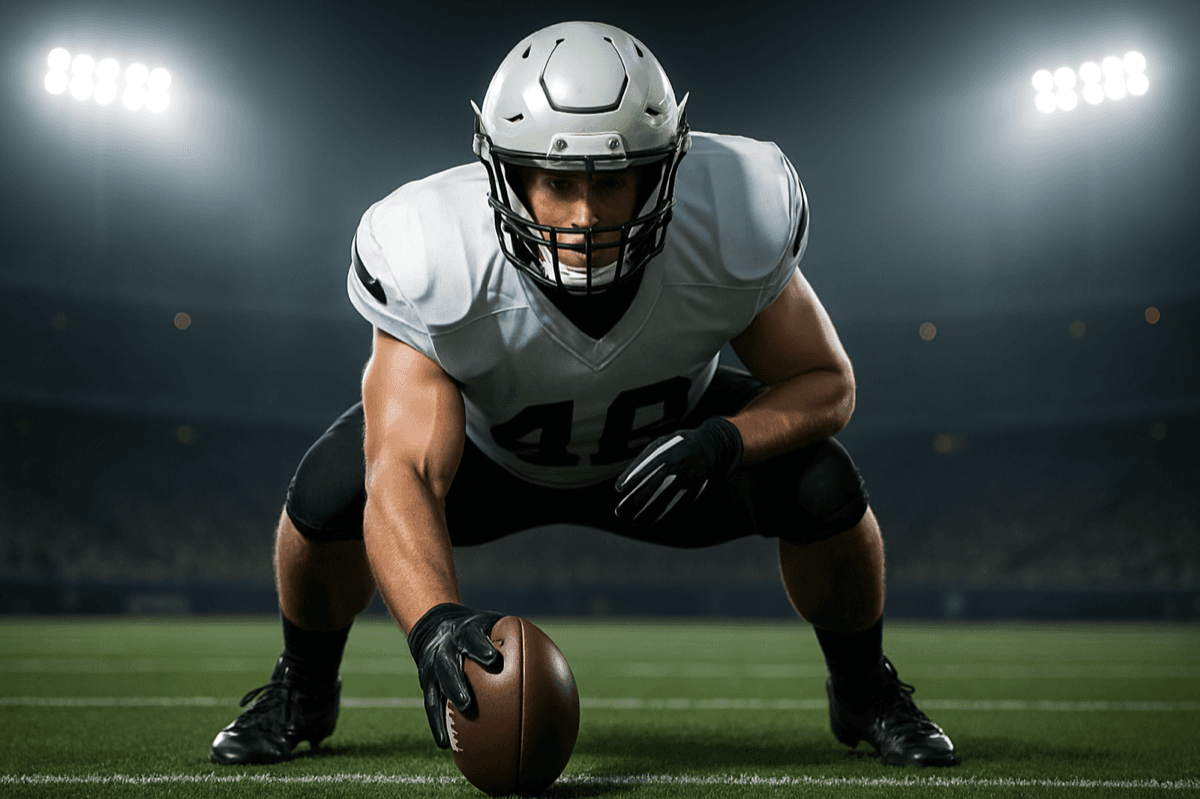
An offensive lineman's stance and blocking mechanics keep the hip flexors in constant loaded flexion throughout every play. Over a career, this shortens the hip flexors, creates anterior pelvic tilt, and loads the lumbar spine chronically, explaining the extremely high rate of lower back injury in linemen.
Impact distributes load through the kinetic chain
Every block, tackle, and collision sends force through the kinetic chain. If any link in the chain, ankle, knee, hip, or spine, is misaligned, that link takes disproportionate load. Postural alignment determines how safely the body distributes impact force.
Helmet weight loads the cervical spine
A football helmet weighs 4–6 pounds. Wearing this on a head that is already forward of the shoulders multiplies the effective cervical load with every pound of forward head position. For linemen in constant contact, the cervical compression is significant.
Common Injuries in Football
These aren't random injuries. They're the predictable result of the structural patterns football creates.
- Cervical disc injuries and stingers
- Lower back disc herniation
- Hip flexor tears
- ACL and knee ligament tears
- Shoulder separations and labral tears
Why posture matters for performance
Football longevity is structural health. The players who have long, productive careers are the ones who actively manage the structural damage the sport creates, not the ones who ignore it until surgery becomes unavoidable.
The Football Program
The Football Player's Posture Fix addresses cervical decompression, hip flexor release, thoracic mobility, and the core stability that protects the spine in contact situations.
What Football Athletes Actually Deal With
These are the injuries and pain patterns that come up in every footballforum, group ride conversation, and training camp. Here's how each one connects back to structural alignment, and what you can do about it.
"Stingers", cervical nerve root pain from tackling
A stinger is the electric, burning sensation down one arm that football players know from big hits, the cervical nerve root is momentarily compressed or stretched. Most stingers resolve in minutes, but repeated stingers over a career indicate structural cervical vulnerability. Players who get recurrent stingers often have pre-existing forward head posture that makes the cervical nerve roots more susceptible.
Posture connection: Cervical nerve root vulnerability is significantly increased by forward head posture. When the head sits forward of the spine, the cervical vertebrae are already in a loading position that reduces the space available for the nerve roots. Cervical alignment work reduces the baseline compression that makes stingers more likely and more severe.
Hip flexor tears from explosive drive blocking
Linemen drive block with explosive hip extension from a hip-flexed stance, demanding that the hip flexor go from maximally shortened to maximally loaded extension in a fraction of a second. This is exactly the mechanism that tears hip flexors. Skill players experience similar loading from cutting and acceleration.
Posture connection: Hip flexor tears are much more likely in athletes with chronic hip flexor shortening, where the tissue is already operating near its end range in the football stance before any explosive movement is attempted. Restoring hip flexor length changes the mechanical starting position and dramatically reduces tear risk.
Lumbar spine injuries from blocking and tackling posture
The blocking and tackling stance, pads low, forward lean, explosive hip drive, places the lumbar spine in extension under load repeatedly. For linemen doing this on every play of every game and practice, lumbar disc and facet injuries are cumulative rather than sudden. Most offensive linemen have some degree of lumbar disc changes by the end of a career.
Posture connection: Lumbar loading in football positions is worsened by anterior pelvic tilt, when the pelvis tilts forward, the lumbar extension required in the football stance is even more exaggerated, compressing the posterior elements further. Neutral pelvic position work changes the lumbar loading pattern in the fundamental football positions.
Questions from the Football Community
Why do I get stingers and my teammates don't even though we hit the same way?
Cervical vulnerability is structural, the geometry of your cervical spine and the alignment of your head relative to your spine determines how much space the nerve roots have in a given impact. Players with forward head posture have less space to begin with, making stingers more likely from the same impact. Cervical alignment work changes this baseline.
My hip flexor keeps "popping" when I run. Should I be worried?
A snapping hip flexor is usually the iliopsoas tendon snapping over the iliopectineal eminence, it's common in athletes with hip flexor tightness. It's often not painful but indicates the hip flexor is operating in a compressed, short position. Addressing the length and neuromuscular control of the hip flexor resolves the snapping in most cases.
Frequently Asked Questions
Is this appropriate for high school and college players?
Yes, and the earlier, the better. The structural patterns football creates compound over a career. Starting corrective work at 16 instead of 26 makes a profound difference.

Written by Mike Boshnack
Corrective Exercise Specialist · Posture Guy Mike
Mike Boshnack grew up skateboarding and surfing, trained MMA, and rode road bikes competitively, before a shoulder injury put him on a path to postural correction. He's since helped thousands of athletes fix the specific postural patterns their sport creates, without surgery or passive treatments.
The mobile app is here.
Do your program on your phone, anywhere. Download free on iPhone or Android, or keep using it in your browser.
Related Conditions