
Hockey & Posture
Skating stance, thoracic collapse, cervical loading
Updated May 2025
What Hockey Does to Your Body
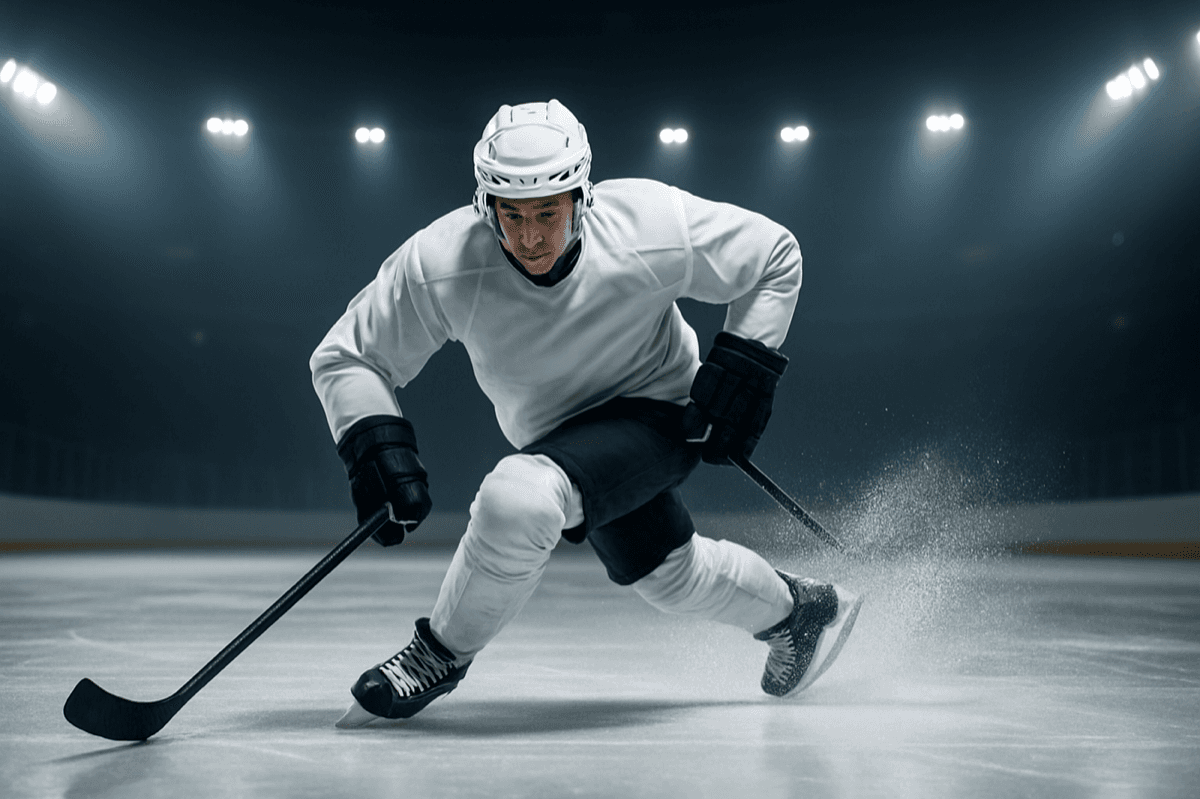
The hockey skating position is one of the most posturally damaging athletic stances in sport. Deep hip flexion, forward trunk lean, rounded thoracic spine, and helmet weight on the cervical spine, held for repeated shifts, in every game, over a career. Without corrective work, hockey players develop some of the most pronounced postural dysfunctions of any athlete.
The Specific Structural Changes
The skating stance trains the body into flexion
The hockey position, knees bent, hip flexed, trunk forward, spine rounded, is maintained for every second of ice time. This position trains the hip flexors, thoracic flexors, and cervical extensors into chronic activation. Off the ice, hockey players are often recognizable by their forward lean.
Stick handling creates thoracic rotation asymmetry
Stickhandling, shooting, and passing all favor one direction of thoracic rotation. Over a career of practice and games, this creates a rotation bias identical to what golfers and baseball players develop.
Helmet and shoulder pad weight add cervical load
Hockey equipment adds significant weight to the upper body. A helmet alone is 3–5 pounds. In a forward head position, which the skating stance creates, this effective weight multiplies. Over a career, the cervical load from skating in helmet and pads is significant.
Common Injuries in Hockey
These aren't random injuries. They're the predictable result of the structural patterns hockey creates.
- Hip flexor strains and tears
- Groin injuries
- Lower back pain
- Shoulder separations
- Knee injuries
- Cervical disc compression
Why posture matters for performance
A hockey player with mobile hips gets lower, generates more power, and changes direction more explosively. Better thoracic rotation means a more powerful and accurate shot. Cervical health determines how long the career lasts.
The Hockey Program
The Hockey Player's Posture Fix addresses the skating-stance hip flexion pattern, thoracic extension, cervical decompression from helmet load, and the rotation work that shooting mechanics demand.
What Hockey Athletes Actually Deal With
These are the injuries and pain patterns that come up in every hockeyforum, group ride conversation, and training camp. Here's how each one connects back to structural alignment, and what you can do about it.
Hockey groin, adductor strains and sports hernia
Groin injuries are hockey's most common soft tissue injury. The skating stride requires explosive hip abduction and powerful adductor return, the adductors are loaded eccentrically on every stride extension. Combined with the sharp direction changes of hockey, the adductors are under extraordinary repetitive demand. Adductor strains range from minor pulls to complete tears requiring surgery.
Posture connection: Adductor strains in hockey are significantly worsened by the anterior pelvic tilt that the skating posture promotes. When the pelvis tilts forward, the adductor attachment angle changes and the muscle is placed in a mechanically vulnerable position for the explosive abduction of the skating stride. Pelvic neutral positioning changes the adductor's structural loading pattern.
Lower back pain from the skating position
The hockey skating posture, forward trunk lean, hip flexed, sustained throughout a shift, is structurally identical to the position that causes "cyclist's back." Hours of skating in this position progressively shortens the hip flexors and compresses the lumbar discs. Defensemen who play heavy minutes often have lumbar pain as a constant companion by mid-career.
Posture connection: Lower back pain from skating is a hip flexor and lumbar decompression problem. The hip flexors shorten to the length of the skating position and maintain anterior pelvic tilt off the ice. Evening hip flexor release and lumbar decompression work prevents the day's skating compression from accumulating across a season.
Shoulder separations from board checks
Shoulder separations, acromioclavicular joint injuries, are hockey's most common shoulder injury. Direct impact into the boards, with the shoulder taking the force, stretches or tears the AC ligaments. The resulting joint instability, if not properly rehabilitated, creates ongoing shoulder asymmetry that affects stick handling and shot mechanics.
Posture connection: Post-AC separation, the shoulder sits lower on the injured side and the thoracic spine compensates with lateral flexion. If this structural asymmetry isn't addressed through rehabilitation, it becomes a permanent postural pattern that loads the cervical spine asymmetrically. Bilateral shoulder and thoracic alignment work restores symmetry after AC joint recovery.
Questions from the Hockey Community
Why do hockey players get so many groin injuries?
The skating stride makes extraordinary demands on the adductors, they must eccentrically decelerate the powerful abduction of each stride extension at high speed. The combination of explosive demand, cold muscles, and the postural changes that skating creates (anterior pelvic tilt, hip flexor shortening) places the adductors in a mechanically vulnerable position on every stride.
My lower back is fine during the season but seizes up when I stop playing. Why?
During the season, the constant low-level movement and warmth of regular skating keeps the lower back from seizing despite the structural compression accumulating. When you stop playing, the movement disappears but the structural compression remains, and without the daily warm-up of skating, the lumbar spine tightens around the accumulated disc compression. Off-season hip flexor and lumbar decompression work prevents this.
Frequently Asked Questions
I play 4–5 days a week. When should I do this?
After skates, when the hip flexors and thoracic spine are warm and most in need of decompression. The static back work is particularly effective post-skate.

Written by Mike Boshnack
Corrective Exercise Specialist · Posture Guy Mike
Mike Boshnack grew up skateboarding and surfing, trained MMA, and rode road bikes competitively, before a shoulder injury put him on a path to postural correction. He's since helped thousands of athletes fix the specific postural patterns their sport creates, without surgery or passive treatments.
The mobile app is here.
Do your program on your phone, anywhere. Download free on iPhone or Android, or keep using it in your browser.
Related Conditions