
Hiking & Backpacking & Posture
Backpack load, lumbar compression, ankle and hip demand
Updated May 2025
What Hiking & Backpacking Does to Your Body
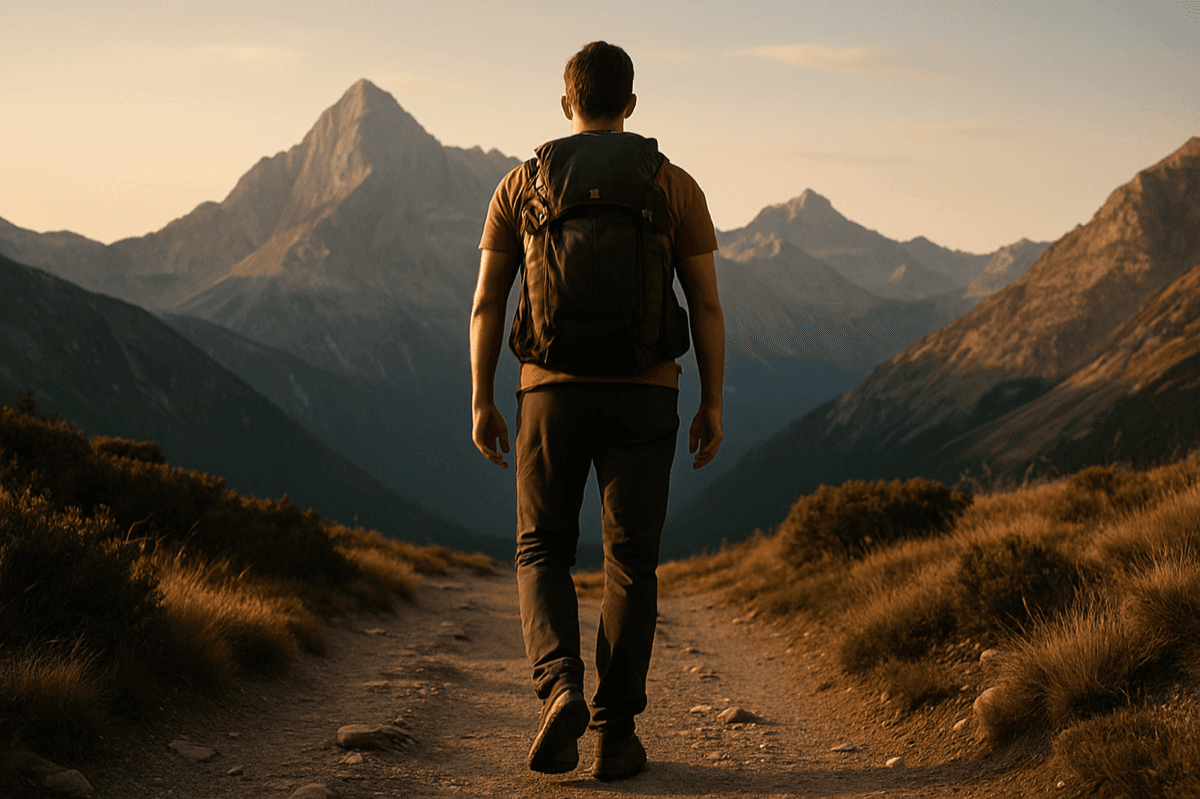
Hiking and backpacking are among the most enjoyable outdoor activities, and some of the most structurally demanding for people who don't prepare specifically. Carrying weight on the back shifts the center of gravity, forces forward lean, and compresses the lumbar spine. Long descents pound the knees. Uneven terrain tests ankle stability constantly.
The Specific Structural Changes
Backpack load forces forward lean and lumbar compression
A loaded pack changes your center of gravity backward, so the body compensates by leaning forward. This forward lean compresses the lumbar spine and activates the hip flexors in a sustained contraction for hours. After a full backpacking day, the lower back is significantly loaded.
Descents create high eccentric knee load
Going downhill requires the quadriceps to decelerate the body eccentrically on every step. At hiking pace over thousands of steps of descent, this is a massive cumulative load on the patellar tendon and knee cartilage, explaining why knee pain is the most common hiking complaint.
Uneven terrain demands ankle stability that most people lack
Trail surfaces are constantly uneven, requiring constant ankle micro-adjustments to maintain stability. Hikers with poor ankle dorsiflexion and arch control fatigue quickly on technical terrain and are at high risk for ankle sprains.
Common Injuries in Hiking & Backpacking
These aren't random injuries. They're the predictable result of the structural patterns hiking & backpacking creates.
- Lower back pain from pack load
- IT band syndrome on descents
- Ankle sprains
- Knee pain (patellofemoral)
- Hip flexor strains on steep climbs
- Plantar fasciitis from sustained heel striking
Why posture matters for performance
Hikers with strong glutes, mobile hips, and stable ankles cover more ground with less pain and recover faster between days. The structural preparation you do at home determines how much you enjoy the trail.
The Hiking & Backpacking Program
The Hiker's Posture Program builds hip mobility for climbing, ankle stability for technical terrain, spinal decompression from pack load, and the single-leg stability that trail running demands.
What Hiking & Backpacking Athletes Actually Deal With
These are the injuries and pain patterns that come up in every hiking & backpackingforum, group ride conversation, and training camp. Here's how each one connects back to structural alignment, and what you can do about it.
"Hiker's knee", IT band syndrome on descents
Every experienced hiker knows the feeling: knees fine on the way up, screaming on the way down. IT band syndrome on descents is caused by the repetitive knee flexion at 30 degrees, exactly the range where the IT band crosses the lateral femoral condyle, combined with the longer stride on downhill that increases impact force. It's the most predictable hiking injury.
Posture connection: ITBS on descents is a hip stabilization failure. Descending increases the demand on the gluteus medius to prevent hip drop, and when it fatigues, the femur adducts and internally rotates, tightening the IT band at the lateral knee. Hip strengthening specifically for the eccentric demands of descending is the structural solution.
Plantar fasciitis from pack weight and uneven terrain
Backpacking adds significant load to every foot strike, a 40-pound pack increases plantar fascia stress proportionally on every step. On uneven terrain, the foot constantly adapts to changing surfaces, placing the plantar fascia under variable angles of stress that a flat road doesn't create. Multi-day hikers with plantar fasciitis often have it before the hike and dramatically worsen it.
Posture connection: Pack weight plantar fasciitis is a foot and hip alignment problem. When the arch collapses under load and the hip drops on the stance side, the plantar fascia is loaded asymmetrically and excessively. Foot intrinsic strengthening and hip stabilization work addresses the mechanical cause of plantar fascia overload under pack weight.
Hip flexor fatigue from sustained elevation gain
Sustained uphill hiking at altitude means the hip flexors fire on every step to clear the foot on steep terrain. Multi-day climbs progressively fatigue and shorten these muscles, by day three, most hikers have noticeably shortened hip flexors that create lower back ache even when flat sections appear. This is the ache that makes the last miles to the car feel endless.
Posture connection: Hip flexor shortening from sustained elevation gain creates anterior pelvic tilt and lumbar compression that accumulates with each day of hiking. Evening corrective work, specifically hip flexor release and glute activation, prevents the structural compression from accumulating and dramatically reduces next-day lower back stiffness.
Questions from the Hiking & Backpacking Community
Why are my knees fine going up but destroyed coming down?
Descending loads the knee more than ascending, the quadriceps control a greater force eccentrically going down. IT band syndrome specifically emerges on descents because the stride length increases and the IT band crosses the lateral condyle more frequently. Hip stabilization is the structural fix that allows the glutes to absorb the descent forces the knee shouldn't be taking.
My lower back seizes up on long hikes. What causes this?
Lower back seizing on long hikes is anterior pelvic tilt from hip flexor fatigue. As the hip flexors tire from sustained elevation gain, they shorten and pull the pelvis forward, compressing the lumbar facets and erectors. The seizing is these structures reaching their threshold. Regular hip flexor release during breaks prevents the accumulation.
Does a heavier pack make injuries more likely, or is it just about conditioning?
Both, but structural alignment under load matters more than most people realize. A well-aligned hiker can carry more weight with less injury risk than a misaligned hiker carrying less. Pack fit also matters enormously: a properly fitted pack transfers weight to the hips through the hip belt, reducing spinal loading. Structural work that maintains pelvic neutral under load makes pack weight more manageable.
Frequently Asked Questions
Should I do this before a trip or after?
Both, a 2-week pre-trip build strengthens the structures that hiking demands. Post-hike recovery work reduces next-day soreness and prepares the body for the following day.

Written by Mike Boshnack
Corrective Exercise Specialist · Posture Guy Mike
Mike Boshnack grew up skateboarding and surfing, trained MMA, and rode road bikes competitively, before a shoulder injury put him on a path to postural correction. He's since helped thousands of athletes fix the specific postural patterns their sport creates, without surgery or passive treatments.
The mobile app is here.
Do your program on your phone, anywhere. Download free on iPhone or Android, or keep using it in your browser.
Related Conditions